
Introduction
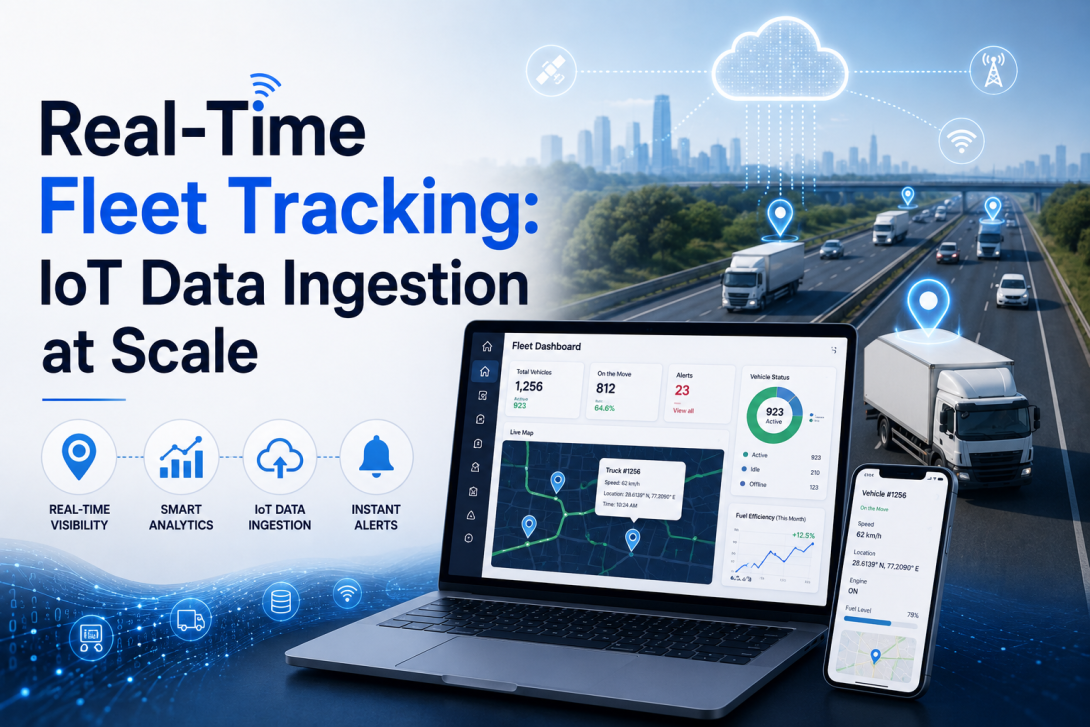
Real-time fleet tracking has become an important part of modern logistics operations. Companies need to know where their vehicles are, whether deliveries are on schedule, how drivers are performing, and whether a vehicle may need maintenance. This information can come from GPS trackers, telematics devices, vehicle sensors, mobile applications, electronic logging devices, and other connected equipment.
The difficult part is not collecting data from one vehicle. The real challenge begins when an organization needs to collect and process information from thousands of vehicles at the same time. Every vehicle can generate location updates, engine information, speed readings, fuel data, temperature measurements, and other events. A fleet platform must receive this information, process it, store it, and make it available to dispatchers and other systems without creating unnecessary delays.
The scale of connected devices also continues to increase. IoT Analytics estimated that the number of connected IoT devices would reach 21.1 billion globally by the end of 2025, up 14% from the previous year.
This growth shows why logistics companies need data architectures that can handle large volumes of connected-device information. Real-time fleet tracking is therefore not only a GPS problem. It is a combination of IoT, cloud infrastructure, data engineering, software integration, analytics, and automation.
What Is Real-Time Fleet Tracking?
Real-time fleet tracking is the process of continuously collecting and processing information about vehicles while they are operating.
A basic tracking system may only show the current location of a truck on a map. A modern platform can provide much more information, including speed, direction, route progress, driver status, fuel consumption, engine condition, delivery status, and geofence activity.
From Vehicle to Application
The basic flow of information looks like this:
Vehicle sensors → Telematics device → Network → IoT ingestion → Data processing → Storage → Fleet applications
Each stage has an important role.
The sensors collect information from the vehicle. A telematics device gathers and prepares that information. The network transfers it to the cloud. The ingestion layer receives the data and routes it for processing. Storage systems keep current and historical information, while applications turn that information into dashboards, alerts, reports, and operational workflows.
AWS's January 2026 reference architecture for real-time fleet tracking uses AWS IoT Core, Kinesis Data Streams, Data Firehose, S3 Tables, and QuickSight to collect, process, store, and visualize vehicle telemetry.
Why IoT Data Ingestion Is Difficult at Scale
Fleet telemetry is continuous. A vehicle can send location information every few seconds or minutes, while other sensors may generate data at different rates.
When thousands of vehicles are active, the number of messages can become very large.
Handling Different Data Volumes
Not every vehicle produces the same amount of information. One vehicle may only send GPS coordinates, while another may send engine diagnostics, temperature readings, fuel information, driver behavior data, and video-related events.
The ingestion system must therefore support different message sizes and frequencies.
AWS's connected mobility guidance describes a telemetry pipeline designed to handle high-volume streams from thousands of vehicles simultaneously, including real-time detection of trips, safety events, and maintenance alerts.
Handling Traffic Spikes
Data traffic can also increase suddenly.
For example, many vehicles may reconnect after passing through an area with poor network coverage. The platform may then receive a large number of stored messages at nearly the same time.
A scalable ingestion architecture needs to absorb these spikes without causing application failures or data loss.
Core Architecture of a Fleet Tracking Platform
A reliable fleet tracking system usually has several layers that work together.
Vehicle and Sensor Layer
The first layer exists inside the vehicle.
GPS devices provide location information. Telematics systems can collect information from vehicle components, while additional sensors can monitor temperature, fuel, tire pressure, battery condition, cargo status, and other measurements.
The platform should be able to identify each device and associate its data with the correct vehicle.
Connectivity Layer
Vehicle information needs to reach the central platform. Cellular connectivity is widely used, but coverage can vary based on location. Vehicles may enter tunnels, remote areas, or regions with weak signals.
The system should therefore tolerate temporary connectivity problems.
IoT Ingestion Layer
The IoT ingestion layer receives incoming messages and routes them to the appropriate services.
MQTT is commonly used for IoT communication because it is designed for lightweight messaging. AWS's fleet tracking architecture uses MQTT-based communication between vehicles and cloud services.
Security is also important at this stage. Devices should be authenticated, communication should be protected, and unauthorized devices should not be allowed to send information into the platform.
Stream Processing Layer
After ingestion, telemetry can be processed as a continuous stream.
The processing layer can validate information, normalize different data formats, detect events, calculate derived values, and route information to different applications.
For example, a location event may update the live fleet dashboard while the same information is stored for historical analysis.
Creating a Common Data Model
Different vehicles and devices may produce different formats. One telematics provider may use one field for vehicle speed, while another may use a different field name or measurement unit.
Normalizing Vehicle Data
A common data model can solve this problem. The ingestion layer can convert incoming information into a standardized format before passing it to other systems. A location event might contain a vehicle ID, timestamp, latitude, longitude, speed, heading, and device status.
Other telemetry can follow similar structures. AWS's connected mobility guidance describes a modular approach for collecting telemetry from different vehicle sources and processing it through a common architecture.
This allows applications to work with standardized information instead of requiring every application to understand every device manufacturer's data format.
Real-Time Location Processing
Location information is the foundation of most fleet tracking systems, but raw coordinates are only the starting point.
Geofencing
Geofencing creates virtual geographic boundaries around locations. For example, a logistics company can create a geofence around a warehouse. When a truck enters that area, the system can automatically generate an event.
That event could update the shipment status, notify warehouse employees, or trigger another workflow. AWS recommends combining IoT tracking devices, logistics APIs, and geofencing to create real-time visibility across transportation, warehousing, and last-mile operations.
Route Progress
Location data can also be compared with planned routes. The system can identify whether a vehicle is following the expected path, has stopped for longer than expected, or may be delayed.
This information can help dispatchers respond before a small delay becomes a larger delivery problem.
Designing Reliable Data Pipelines
Real-time fleet systems need to account for unreliable network conditions. A vehicle cannot always maintain a stable connection.
Store and Forward
A telematics device can temporarily store information when the network is unavailable. When connectivity returns, the device can send the stored information to the cloud.
This prevents short communication interruptions from creating large gaps in vehicle history. AWS IoT FleetWise documentation describes an edge-agent approach where vehicle data is collected and transferred to cloud services through MQTT.
Handling Duplicate Events
Distributed systems can sometimes receive the same message more than once. The platform should use event identifiers, timestamps, or other controls to identify duplicate records.
Without this, the same location event could be counted multiple times and affect route calculations, mileage reports, or analytics.
Real-Time Data and Historical Analytics
Fleet platforms need to support both immediate operational decisions and long-term analysis.
Real-Time Processing
Real-time processing can be used for events such as:
- Vehicle entering a restricted zone
- Unexpected route deviation
- Excessive idling
- Temperature crossing a threshold
- Vehicle stopping unexpectedly
- Delivery approaching a scheduled time
The objective is to detect these events quickly enough for the operations team to act.
Historical Analysis
Historical information can be used to study route performance, fuel consumption, vehicle utilization, driver behavior, delivery delays, and maintenance patterns. AWS's real-time fleet architecture combines streaming ingestion with analytical storage so organizations can work with both current and historical fleet information.
The Integration Challenge in Logistics
Fleet tracking rarely operates as a standalone system. It needs to communicate with transportation management systems, warehouse management systems, ERP platforms, order management applications, route optimization tools, customer portals, and driver applications.
This creates a major integration challenge in logistics because these systems may use different data structures, APIs, communication methods, and update cycles.
Connecting Fleet Data With Business Workflows
Consider a delivery order. The order management system knows what needs to be delivered. The TMS knows the planned route. The fleet system knows the vehicle's current location. The warehouse system knows whether the shipment has been loaded.
If these systems are disconnected, employees may have to compare information manually. APIs and event-driven architecture can connect these systems. For example, when a vehicle enters a delivery zone, the fleet platform can create an event that updates the shipment workflow automatically.
Avoiding Too Many Direct Connections
Connecting every application directly to every other application can make the architecture difficult to maintain. A better approach is to use APIs, integration services, event buses, and shared data services. This creates a controlled communication layer and makes it easier to add new applications later.
The Role of Fleet Management Software
Raw IoT data becomes useful when it is connected to operational workflows.
This is where fleet management software development becomes important. A modern fleet platform can bring together real-time tracking, dispatching, driver management, maintenance, fuel monitoring, route planning, alerts, reporting, and analytics.
Moving Beyond the Map
A map showing vehicle locations is useful, but it does not tell an operations team what to do. The software should provide context.
If a truck has stopped, the system should help determine whether the stop is expected, whether the vehicle is near a delivery location, whether the driver is on a required break, and whether the delay could affect the schedule.
This converts raw telemetry into operational information.
Security for Connected Fleet Systems
Every connected vehicle becomes another potential entry point into the technology environment. Security must therefore be included in the architecture.
Device Authentication
Each device should have a unique identity, and the platform should verify that incoming information comes from an authorized source.
Secure Communication
Data traveling between vehicles and cloud services should use secure communication. Access to vehicle commands should be controlled even more carefully because unauthorized actions could create operational and safety risks.
Device Monitoring
The platform should also monitor the health of connected devices. If a device suddenly stops sending data or begins sending unusual information, the system should create an alert for investigation.
Storing Fleet Telemetry
Fleet systems can generate large amounts of historical information. Storage architecture should therefore separate operational requirements from analytical requirements where appropriate.
Current Vehicle State
The current location and status of a vehicle need to be available quickly to dispatchers and other applications. This information can be stored in an operational database designed for fast access.
Historical Telemetry
Historical data can be stored in data lakes, warehouses, or other analytical systems. This allows organizations to analyze long-term patterns without placing unnecessary load on the database used by the live tracking application.
Predictive Maintenance From IoT Data
Once a fleet platform has reliable historical telemetry, it can support predictive maintenance.
Identifying Vehicle Problems
The system can analyze engine information, fault codes, mileage, temperature, battery readings, and other signals to identify patterns associated with potential problems.
Instead of waiting for a vehicle to break down, maintenance teams can investigate issues earlier. AWS has demonstrated fleet architectures where real-time telemetry is analyzed against models to identify anomalies and trigger maintenance workflows.
Reducing Unplanned Downtime
The goal is not simply to collect more data. The goal is to use that data to make maintenance decisions at the right time. This can help reduce unexpected vehicle downtime and improve fleet availability.
Driver and Safety Analytics
IoT data can also provide information about driver behavior. The platform can analyze speeding, harsh acceleration, harsh braking, excessive idling, and other driving patterns.
Supporting Driver Coaching
The purpose should be to identify patterns that require attention. Managers can use the information to provide targeted coaching and monitor whether driving behavior improves over time.
Connected fleet systems can combine GPS, fuel sensors, driver monitoring systems, and other signals to provide a broader view of vehicle and driver activity. AWS describes such an architecture in its Novus Hi-Tech fleet case study.
Moving From Automation to Agentic Logistics
Traditional automation generally follows predefined instructions. For example, a rule may say that when a truck enters a delivery geofence, the system should update the order status.
The movement from automation to agentic logistics goes further. Agentic systems can evaluate multiple data sources, determine the next appropriate action within defined boundaries, and coordinate several steps in a workflow.
AI Agents for Fleet Operations
Imagine a delivery that is likely to arrive late. An AI agent could review the vehicle's location, traffic information, delivery schedule, driver status, warehouse availability, and customer commitments.
It could identify possible solutions, recommend a route change, notify the relevant team, and update connected workflows after receiving the required approval.
The key difference is that the system is not simply responding to one predefined event. It is coordinating several related tasks.
Keeping Humans in Control
Agentic systems should not operate without controls. Actions involving safety, significant financial decisions, customer commitments, or regulatory requirements may need human approval. The agent can prepare recommendations and perform low-risk actions while escalating important decisions to employees.
How IoT Data Supports AI Agents
AI agents are only as useful as the information available to them. If location data is delayed, incomplete, duplicated, or incorrectly associated with a vehicle, an AI agent can make a poor recommendation.
This makes the IoT ingestion layer a foundation for intelligent logistics. AWS's recent fleet case study shows how IoT Core, Kinesis, databases, and workflow services can provide the data and infrastructure used by AI-supported fleet operations.
Reliable telemetry, therefore, needs to come before advanced AI.
Scaling From Hundreds to Thousands of Vehicles
Scalability should be considered before the fleet grows. A system that works well for a small fleet may struggle when the number of vehicles increases.
Horizontal Scaling
Cloud-based systems can increase processing capacity as message volumes increase. Streaming platforms can distribute incoming events across multiple processing resources rather than forcing every message through a single server.
Load Testing
Testing should simulate real operating conditions. This includes normal traffic, peak message volumes, network reconnects, delayed messages, invalid data, duplicate events, and device failures.
The objective is to understand how the system behaves under pressure before a real fleet creates that pressure.
Monitoring the Data Pipeline
The fleet platform needs to monitor itself.
Operations teams should be able to see how many devices are connected, how many messages are being received, whether processing is delayed, and whether data is being lost.
Important Performance Metrics
Useful measurements include ingestion rate, processing latency, GPS update frequency, device connection status, failed messages, duplicate events, API response time, and system resource usage.
These metrics can help technical teams identify problems before they affect fleet operations.
Building a Future-Ready Fleet Tracking Platform
Fleet requirements will continue to change. Companies may add new vehicle types, sensors, telematics providers, customer applications, AI systems, or external logistics services.
The architecture should make these additions possible without requiring the entire platform to be rebuilt.
Businesses considering a customized platform can work with providers such as Citrusbug develops logistics software, particularly when they need fleet tracking, IoT integration, logistics workflows, analytics, and automation within one connected system.
Modular Architecture
The ingestion layer should be separated from business applications. Standardized data models should prevent individual devices from becoming tightly connected to downstream applications.
APIs and event-driven services can then allow new applications to consume fleet information without changing the core tracking system.
Cost and Complexity Considerations
Building a real-time fleet tracking platform involves more than application development.
Organizations need to consider hardware, connectivity, cloud infrastructure, data storage, security, integration, analytics, maintenance, and ongoing device management. The cost also depends on fleet size and data frequency.
A system receiving one GPS update every few minutes will have very different infrastructure requirements from a platform receiving high-frequency vehicle telemetry and video-related information.
This is why architecture should be planned around actual operational requirements rather than simply choosing the most advanced technology available.
Conclusion
Real-time fleet tracking is becoming a core part of modern logistics operations.
The challenge is not just displaying vehicles on a map. A scalable platform needs to collect data from many devices, handle unreliable connectivity, normalize different formats, process events quickly, store historical telemetry, integrate with business applications, and protect connected devices.
IoT provides the data foundation, while cloud and streaming architectures provide the infrastructure needed to process that information at scale.
Once this foundation is in place, organizations can build predictive maintenance, route optimization, driver analytics, automated alerts, and AI-supported workflows on top of it.
The transition from traditional automation toward agentic logistics will make reliable data even more important. AI agents need current and structured information to make useful recommendations and coordinate workflows.
For logistics companies, the best approach is therefore to build the foundation in stages. Start with secure device connectivity and reliable ingestion, establish a common data model, connect fleet information with business systems, and then add analytics and intelligent automation.
A well-designed real-time fleet platform can ultimately turn continuous IoT signals into practical decisions across dispatch, delivery, maintenance, customer service, and fleet operations.