

Buy Now: https://www.eastwestoffroad.com/product/dana-60-kingpin-crossover-high-steer-complete-kit
A Dana 60 High Steer Arm Pair gives a Kingpin axle two raised steering attachment platforms, one on each side. That sounds straightforward, but the arm pair sits at the center of a larger system involving Kingpin support, studs, tie-rod and drag-link lengths, steering ends, pitman-arm position, and suspension geometry.
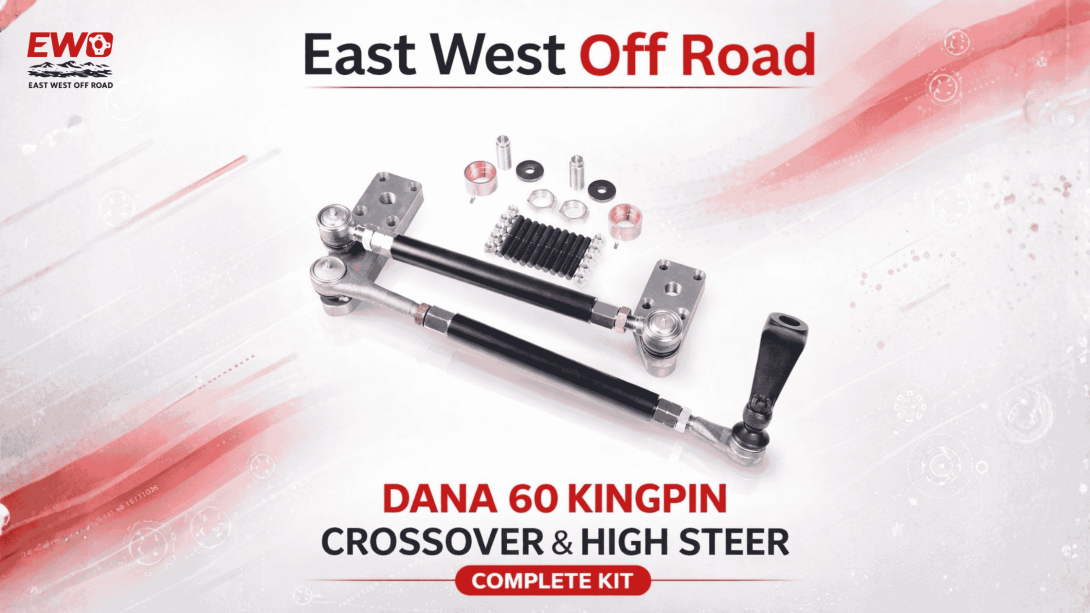
For builders starting more than an arm replacement, East West Off Road offers the pair within a complete Dana 60 Kingpin steering kit that also supplies bronze bushings, DOM tubing, ES-series ends, weld bungs, jam nuts, and mounting hardware.
Why Both Sides Matter in a High Steer Layout
A crossover drag link connects the pitman arm to the passenger-side steering arm, while the tie rod spans between the knuckles. Using raised attachment points on both sides supports an above-knuckle linkage layout and gives the fabricator a consistent plane from which to establish the tie rod.
On lifted trucks, raising the links can improve obstacle clearance and may reduce an excessive drag-link angle. However, arm height alone cannot correct a track-bar mismatch, worn Kingpin components, poor alignment, or interference from wheels and suspension parts.
Examining the Dana 60 High Steer Arm Pair
Domestic billet steel and 1.25-inch thickness
The package contains one driver-side and one passenger-side arm made from domestic billet steel. Both are 1.25 inches thick. Their substantial construction is intended for demanding off-road steering loads, including rock-crawling and oversized-tire applications, when mounted and used correctly.
Five-hole patterns for configuration flexibility
Each arm has five holes, giving the installer choices for tie-rod and drag-link placement. Not every hole is automatically appropriate. The final selection must protect joint articulation, thread engagement, wheel clearance, and link geometry through full steering and suspension travel.
What Turns the Arm Pair Into a Complete System
One set of bronze Dana 60 Kingpin bushings supports the upper assemblies under the arms. Ten 1/2-inch fine-thread studs rated at 180,000 PSI, paired with ten tapered nuts, provide the principal arm-mounting hardware.
The linkage material is one 54-inch and one 43-inch heavy-wall DOM tube, each measuring 1.50-inch OD, 1.00-inch ID, and .250-inch wall. For the drag link, the supplied ends are ES2026R and ES2027L; the tie rod instead receives ES2234L and ES2234R.
Four 7/8-18 weld bungs and four matching fabrication jam nuts are split evenly between left- and right-hand thread. Two screws, two grease fittings, two spacers, and two additional jam nuts complete the supplied parts. The pitman arm is available only as an option.
Verified Product Specifications
Component
Verified details
Intended application
Dana 60 Kingpin crossover and high steer
High steer arm pair
One driver and one passenger arm; domestic billet steel
Arm dimensions
1.25-inch thickness; five-hole pattern
Kingpin bushings
One bronze set
DOM tubing
One 54-inch and one 43-inch tube; 1.50-inch OD; 1.00-inch ID; .250-inch wall
Drag-link ends
ES2026R and ES2027L with hardware
Tie-rod ends
ES2234L and ES2234R with hardware
Studs and tapered nuts
Ten 1/2-inch fine-thread studs rated at 180,000 PSI; ten nuts
Weld hardware
Two LH and two RH 7/8-18 bungs with matching jam nuts
Additional hardware
Two screws, two grease fittings, two spacers, and two jam nuts
Pitman arm
Optional; not included as standard
Country
Made in the USA
Arm Placement, Crossover Steering, and Clearance
The passenger arm receives the crossover drag link, creating a longer steering path from the box across the axle. The raised tie rod improves ground and obstacle clearance compared with a low linkage position. The driver arm completes the connection between knuckles and helps establish the tie-rod plane.
Actual routing depends on wheel backspacing, tire sidewall, spring or link position, shock mounts, brakes, differential cover, sway bar, and full steering sweep. A five-hole arm is useful because it offers options, but the physical vehicle determines which option is viable.
Why the Complete Geometry Controls Bump Steer
As the axle moves, the drag link travels through an arc. On track-bar suspensions, the track bar controls another arc. If their lengths, angles, and mounting points cause different lateral motion, the vehicle can steer as it compresses or droops.
Raising the arm connection may help flatten the drag link, but builders must evaluate steering-box location, pitman-arm height, axle movement, link length, joint range, and alignment. The system should be cycled through compression, droop, articulation, and full lock. Correct design may reduce bump steer; it cannot guarantee elimination.
Applications for the Arm-and-Linkage Package
Intended projects include Kingpin Dana 60-equipped GM and Chevy trucks, Jeeps, custom one-ton builds, solid axle swaps, rock crawlers, overlanding vehicles, and lifted trail rigs on larger tires. The full package is most useful when the existing linkage is incomplete, mismatched, damaged, or not suited to the planned geometry.
Fitment Checks Before Choosing the Arm Holes
Verify the axle and knuckles, Kingpin condition, mounting surfaces, steering box and sector shaft, pitman arm, suspension type, track bar, springs or links, shocks, brakes, differential cover, wheels, backspacing, tires, and travel. Inspect for previous modifications that could affect arm seating or clearance.
Decide whether the project also needs an optional pitman arm, revised track-bar mounts, steering-box relocation, brake changes, or wheel-spacing corrections. When the geometry is uncertain, obtain professional guidance before ordering or positioning the links.
Fabrication, Alignment, and Service Responsibility
The DOM tubes must be measured, cut, and fitted with welded 7/8-18 bungs. A qualified fabricator or experienced steering professional should complete and inspect the work. Applicable component instructions and the vehicle service manual should guide installation; generic torque or welding figures should not be assumed.
Once assembled, verify toe, steering centering, joint articulation, thread engagement, jam-nut security, and clearance throughout full motion. During service, inspect arm fasteners, Kingpin bushings, steering ends, grease points, welds, and contact marks. Reinspect after an impact or handling change.
Arm Pair or Full Kit: Which Buyer Are You?
An experienced builder with verified tubes, ends, bushings, studs, and geometry may only need replacement arms. Someone completing a fresh conversion or correcting a mixed system benefits more from a complete package. Neither route removes the need for measurements, qualified fabrication, alignment, and inspection.
Frequently Asked Questions
Which axle is this arm pair designed for?
The complete system is intended for Dana 60 Kingpin axle applications. Buyers should verify the knuckle mounting provisions and exact axle configuration because modified or mixed-component axles can differ. Steering, suspension, brake, wheel, and tire clearance also requires careful confirmation.
Are both driver- and passenger-side arms included?
Yes. The package includes one driver-side and one passenger-side domestic billet steel arm. Both measure 1.25 inches thick and carry five-hole patterns. Final hole selection should follow measured linkage geometry and clearance checks throughout full steering and complete vehicle motion.
Does the kit contain bronze Kingpin bushings?
Yes. One set of bronze Dana 60 Kingpin bushings is supplied. They support the Kingpin assemblies and should be fitted, lubricated, and inspected correctly. Related components and arm mounting surfaces should be checked carefully during the complete steering conversion process.
What tube sizes and steering ends are supplied?
The kit includes 54-inch and 43-inch DOM tubes, both 1.50-inch OD, 1.00-inch ID, and .250-inch wall. ES2026R and ES2027L serve the drag link, while ES2234L and ES2234R serve the tie rod throughout the finished fabricated vehicle steering system's motion.
Is welding required for the complete package?
Yes. The DOM tubing must be cut to vehicle-specific lengths and fitted with separate 7/8-18 weld bungs. A qualified fabricator or experienced steering professional should perform and inspect the welding before the linkage is aligned and used on the vehicle.
Does the standard package include a pitman arm?
No. The pitman arm is optional. Its design depends on the steering box, sector shaft, drag-link end, suspension height, and desired geometry. Verify those details carefully before selecting an optional arm or retaining the existing one for continued vehicle service.
Can a Dana 60 High Steer Arm Pair eliminate bump steer?
No arm pair can guarantee that outcome. Raised connections may help improve the drag-link angle, but bump steer depends on track-bar and drag-link arcs, axle travel, pitman-arm location, fabrication accuracy, alignment, component condition, and the complete modified vehicle suspension design.
Is the system appropriate for lifted trucks and large tires?
Those are intended applications when a suitable Dana 60 Kingpin axle is present. Builders must still evaluate steering loads, wheel backspacing, tire clearance, full steering sweep, suspension travel, and any additional parts needed for the completed and verified vehicle configuration.
Final Thoughts
A Dana 60 High Steer Arm Pair establishes the raised mounting points, but the steering system extends far beyond the arms. East West Off Road's complete package adds the bushings, linkage material, ends, and hardware needed for a coordinated build. Verify fitment, plan the geometry, and rely on qualified fabrication.