
India Laboratory Equipment Market Overview Analysis By Fortune Business Insights
Market Summary
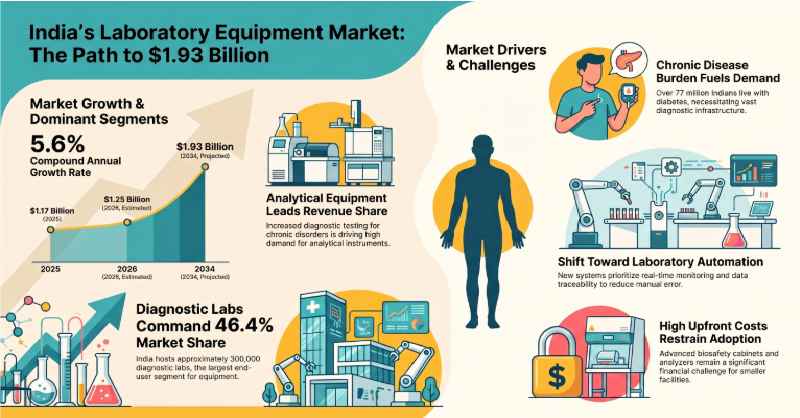
According to Fortune Business Insights: The India laboratory equipment market size was valued at USD 1.17 billion in 2025 and is projected to grow from USD 1.25 billion in 2026 to USD 1.93 billion by 2034, exhibiting a CAGR of 5.6% during the forecast period. Laboratory equipment refers to the specialized tools, apparatus, and instruments used for conducting experiments, performing measurements, and analyzing substances across research laboratories, clinical facilities, and academic institutes. Market growth is supported by the increasing prevalence of chronic and infectious diseases, a rising volume of diagnostic procedures, growing healthcare expenditure, and expanding pharmaceutical and biotechnology manufacturing activity across the country. India's vast patient population, government impetus for domestic life sciences production, and the rapid scaling of private diagnostic networks are all reinforcing long-term structural demand for laboratory instruments and systems.
Get a Sample Research PDF: https://www.fortunebusinessinsights.com/enquiry/request-sample-pdf/115375
Key Market Drivers
The rising burden of chronic and infectious diseases is the primary driver of market growth. A growing patient population requiring regular diagnostic monitoring is generating a sustained increase in the volume of clinical and pathological tests performed across India's healthcare system. According to the WHO's 2024 statistics, approximately 77 million people aged 18 and above have Type 2 diabetes in India — a patient cohort requiring extensive laboratory monitoring for disease management, complications screening, and treatment efficacy assessment. Tuberculosis continues to represent a major public health burden, with the Global TB Report estimating 2.8 million new cases in India in 2023 alone, adding further pressure on diagnostic laboratory capacity and equipment utilization across both public and private health systems.
Expanding diagnostic capacity and pharmaceutical manufacturing are reinforcing structural demand. India's private laboratory network has grown rapidly, with approximately 300,000 diagnostic labs currently operational nationwide. States including Maharashtra, Karnataka, Telangana, Tamil Nadu, and Gujarat are recording particularly high demand for laboratory instrumentation, driven by the concentration of pharmaceutical, biotech, and healthcare providers in these regions. Government support through Production-Linked Incentive (PLI) schemes for pharmaceutical and medical device manufacturing, combined with rising R&D investment, is also broadening the installed base of laboratory instruments across CRO, CDMO, and quality-control testing environments.
Market Restraints and Challenges
The high cost of technologically advanced laboratory equipment is the most significant restraint on market penetration. Analyzers, ultra-low temperature freezers, and advanced biosafety infrastructure involve substantial upfront investment, compounded by recurring maintenance, calibration, and skilled operator costs. Smaller hospitals, regional diagnostic labs, and academic institutions often find it difficult to justify the capital expenditure required for premium equipment, leading to extended use of equipment beyond optimal replacement cycles and limiting adoption of next-generation platforms. For reference, Labconco biosafety cabinets range from USD 6,000 to USD 15,000 per unit — a cost structure that becomes a meaningful barrier in budget-constrained settings.
Regulatory complexity presents an additional challenge. Laboratory equipment classified under India's Medical Devices Rules (MDR), overseen by the Central Drugs Standard Control Organisation (CDSCO) under the Ministry of Health and Family Welfare, is subject to documentation, licensing, and ongoing safety and quality compliance requirements. Navigating this framework is particularly demanding for new product launches, imported capital instruments, and smaller companies with limited regulatory expertise. Supply chain reliance on imports for high-end equipment further introduces foreign exchange and trade-related cost risks, while after-sales service gaps outside major metropolitan areas constrain expansion into Tier 2 and Tier 3 markets.
Market Opportunities
The rapid expansion of Contract Research Organizations (CROs) and Contract Development and Manufacturing Organizations (CDMOs) represents the most significant growth opportunity for the India laboratory equipment market. According to 2026 data from Cliniminds, India is home to more than 100 international and domestic CROs. The increasing demand from pharmaceutical, biotechnology, and life sciences companies for outsourced bioanalytical services, formulation development, clinical trial support, and specialized quality control testing is creating sustained incremental demand for advanced laboratory instruments — spanning molecular assays, analytical testing platforms, bioprocessing support equipment, and automated quality control systems.
Segmentation Analysis
By product type, the analytical equipment segment held the largest revenue share in 2025, driven by the rising volume of chronic disease diagnostics and the growing focus of key market players on launching innovative instruments. In July 2025, Agilent Technologies launched its InfinityLab Pro iQ Series mass detectors for next-generation liquid chromatography–mass spectrometry (LC-MS) in India, illustrating the active pace of premium product introduction in this segment. The specialty equipment segment is the fastest-growing category, projected to expand at a CAGR of 6.3% over the forecast period, reflecting demand for increasingly specialized and application-specific instruments in research and regulated testing environments. General equipment and support equipment serve as foundational categories sustaining baseline laboratory operations across all end-use settings.
By application, the clinical and diagnostic laboratories segment dominated the market in 2025 with a projected 46.4% share in 2026, anchored by the sheer number of diagnostic labs nationwide, the growing volume of routine and specialized testing, and the increasing shift of patients toward private laboratory networks. The pharmaceutical and biopharmaceutical companies segment is expected to grow at a CAGR of 5.8% during the forecast period, driven by expanding domestic drug manufacturing, export-oriented generic production, and growing biologics and biosimilars R&D activity. Academic and research institutes and the veterinary segment contribute incrementally, with both supported by rising government research funding and growing awareness of animal health diagnostics.
Connect with Our Expert for any Queries: https://www.fortunebusinessinsights.com/enquiry/speak-to-analyst/115375
Competitive Landscape
The India laboratory equipment market is moderately competitive, featuring a combination of global multinational instrument leaders and established domestic suppliers. Key players profiled by Fortune Business Insights include Thermo Fisher Scientific Inc. (U.S.), Agilent Technologies Inc. (U.S.), Sartorius AG (Germany), Bio-Rad Laboratories Inc. (U.S.), Avantor Inc. (U.S.), Toshvin (India), Accumax Lab Devices Pvt Ltd (India), ELECTROLAB INDIA PVT. LTD. (India), Sai Scientific Instruments (India), and Borosil Scientific (India). Leading multinationals are reinforcing their India positions through significant local investment — in October 2025, Thermo Fisher Scientific committed USD 20 million to expand its Bengaluru facility, supporting advanced automation platforms for immunoassays, protein analysis, and cell-based studies. In August 2025, Agilent Technologies inaugurated a Biopharma Experience Centre in India to support R&D workflows in chromatography, mass spectrometry, and cell analysis, while fostering academia–industry collaboration. Domestic manufacturers are competing on cost, local service capabilities, and growing product sophistication, with companies such as VFL Sciences and Labindia Instruments launching innovative products including photo bioreactors and ductless fume hoods at major industry exhibitions in 2025.