
Desk Mats Market Overview Analysis By Fortune Business Insights
Market Summary
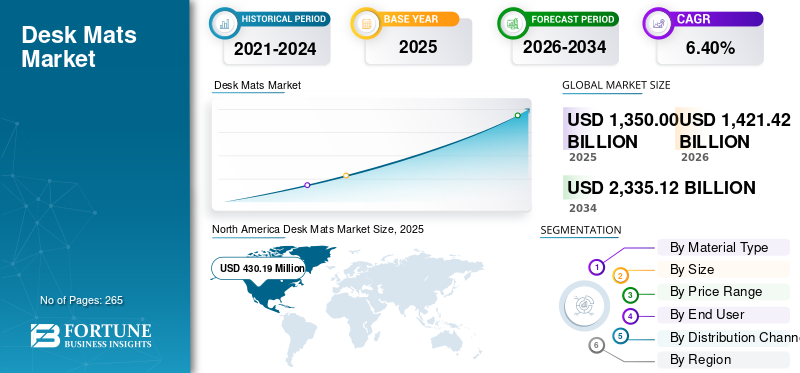
According to Fortune Business Insights: The global desk mats market size was valued at USD 1,350.00 million in 2025 and is projected to grow from USD 1,421.42 million in 2026 to USD 2,335.12 million by 2034, exhibiting a CAGR of 6.40% during the forecast period. Desk mats are surface accessories designed to protect desks, improve mouse and keyboard usability, and enhance workspace aesthetics across residential, commercial, and educational settings. The market has been growing steadily, driven by rising demand for eco-friendly, neat, ergonomic, and visually pleasing workspaces propelled by the sustained expansion of remote and hybrid working arrangements. North America dominated the market with a 31.87% share in 2025.
Get a Sample Research PDF: https://www.fortunebusinessinsights.com/enquiry/request-sample-pdf/115825
Key Market Drivers
The growing emphasis on ergonomic workspaces is the primary driver of market growth. The expansion of remote and hybrid work has kept home workstations in continuous, extended use, with improper wrist positioning and hard desk surfaces identified as key contributors to musculoskeletal discomfort and strain. Remote workers and organizations are investing heavily in ergonomic desk accessories that provide cushioned support, a well-defined workspace, and smooth mouse movement, improving overall comfort and productivity. According to the U.S. Economic Report of the President (ERP 2025), approximately 20% of the American workforce was engaged in remote work — fully or partially — by late 2024, with roughly half of that share working in hybrid arrangements, underscoring the durability of the structural shift driving demand. Corporate investment in premium desk setups and the rising consumer inclination toward customizable and designer desk accessories, supported by e-commerce growth, are further accelerating global market expansion.
Market Restraints
The widespread availability of low-cost substitutes is the most significant constraint on premium market growth. Many consumers opt for inexpensive generic surface protectors that meet basic functional needs, limiting willingness to pay for higher-quality or branded products and adding to competitive pricing pressure across the industry.
Market Opportunities
Rising demand for sustainable and eco-friendly desk accessories presents a significant growth opportunity. As consumer awareness of environmental sustainability increases, manufacturers are launching products made from cork, FSC-certified wood, recycled felt, and vegan leather. This shift toward green consumerism is stimulating product differentiation, supporting price premiums, and unlocking new revenue streams while reinforcing brand loyalty.
Market Challenges
Intense price competition from unorganized and online sellers is pressuring profit margins. Low entry barriers have enabled numerous small players to bring similar-looking products to market at heavily discounted prices, forcing established brands to either compress margins or increase promotional spending to maintain market position.
Segmentation Analysis
By material type, leather held the highest market share, driven by its durability, visually appealing aesthetics, and strong consumer demand for an executive style suited to both home workspaces and corporate environments. The availability of economical PU leather alternatives widens accessibility while preserving a premium appearance. The fabric/felt segment is expected to record the second-fastest CAGR of 7.64% over the forecast period.
By size, medium-sized desk mats (60–80 cm width) dominated the market in 2025, offering an optimal balance between surface coverage and affordability while accommodating keyboards, mice, and other accessories across the widest range of setups. The large/extended segment (above 80 cm width) is projected to grow at the fastest CAGR of 7.07%, reflecting rising demand for expansive, multifunctional workstation surfaces.
By price range, the mid-range segment (USD 10–30) is anticipated to hold the dominant market share, appealing to the broadest pool of buyers through an optimal balance of durability, price, and design. The premium segment (above USD 30) is projected to grow at a CAGR of 7.28%, reflecting rising willingness to pay for design-led and sustainable products among design-conscious consumers.
By end user, the residential/home office segment dominated market growth, driven by sustained consumer investment in personal workstation upgrades amid ongoing hybrid and remote work arrangements. Higher purchase volume and recurring replacement and upgrade demand from individuals accelerate the segment's revenue share. The educational institutions segment is expected to record the second-fastest CAGR of 6.21%.
By distribution channel, e-commerce dominated the global market, favored for the product's lightweight, non-perishable nature and ease of shipment, alongside e-retail platforms' ability to offer a wider range of materials, colors, prints, and custom designs than most offline channels. The rise in home office setups has further prompted consumers to use digital channels, where bundled accessories and promotions improve overall value for money.
Regional Outlook
North America is projected to record a growth rate of 5.90%, reaching a valuation of USD 430.19 million in 2025, driven by the continued scale of remote and hybrid work. The U.S. market reached USD 346.66 million in 2025, accounting for roughly 25.68% of global market sales. Asia Pacific secured second place at USD 401.86 million in 2025, driven by growing urbanization, rising disposable income, and an expanding middle-class population. China reached USD 130.01 million (9.63% of global sales), India reached USD 104.74 million (7.76%), and Japan reached USD 66.92 million (4.96%), with Japan's rapid e-commerce penetration cited as a key accelerant. Europe held the third-largest share in 2025 at USD 366.19 million (27.13% of the global market), led by increased ergonomic awareness; Germany reached USD 79.98 million and the U.K. reached USD 62.80 million. South America reached USD 80.93 million, with consumers increasingly treating desks as part of home décor and driving demand for designer finishes and coordinated accessories. The Middle East and Africa are growing steadily, with the UAE reaching USD 13.41 million and South Africa reaching USD 11.54 million in 2025.
Connect with Our Expert for any Queries: https://www.fortunebusinessinsights.com/enquiry/speak-to-analyst/115825
Competitive Landscape
Desk mat brands are competing through design-led differentiation, channel expansion, and sustainability initiatives. Manufacturers are investing in high-performance surface technologies including enhanced tracking precision, anti-slip bases, and micro-textured finishes for gaming and professional use, while RGB lighting integration is emerging within gaming desk pads to align with broader peripheral ecosystems. Companies are also introducing larger, multifunctional mats with organizers and cable-management features to serve demand for clutter-free, efficient workstations. Key players profiled include Grovemade (U.S.), Orbitkey (Australia), Oakywood (Poland), Steelcase Inc. (U.S.), Secretlab (Singapore), Logitech International S.A. (Switzerland), 3M Company (U.S.), YSAGi (China), Satechi (U.S.), and Kingston Technology's HyperX brand (U.S.). In August 2025, Secretlab introduced its MAGNUS Pro Dark Knight Archives Edition desk mat as part of an extended collaboration with Warner Bros. and DC. In March 2025, Steelcase integrated additional desk accessories into its broader office systems portfolio to support ergonomic hybrid workstation setups. In February 2025, Oakywood launched new cork-and-felt desk mat variants paired with complementary accessories to reinforce its lifestyle-oriented workspace ecosystem and appeal to design-conscious consumers.