
CNC Machine Market Overview Analysis By Fortune Business Insights
Market Size & Growth Outlook
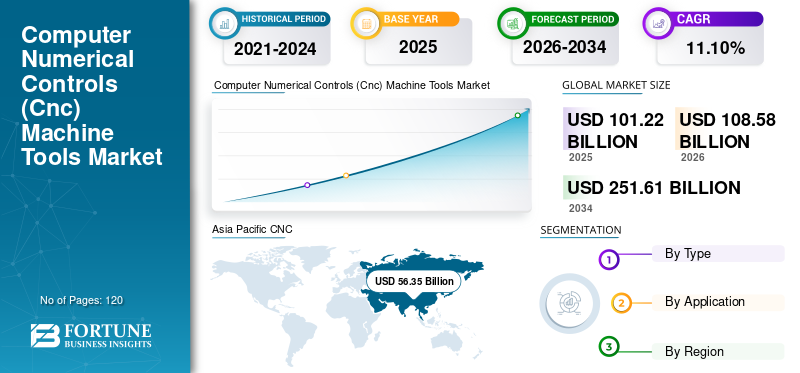
According to Fortune Business Insights: The global CNC (Computer Numerical Control) machine market was valued at USD 101.22 billion in 2025 and is projected to grow from USD 108.58 billion in 2026 to USD 251.61 billion by 2034, exhibiting a CAGR of 11.10% during the forecast period. Asia Pacific dominated the global market with a 55.70% share in 2025, valued at USD 56.35 billion — driven by rapid industrialization, extensive automation investment, and the presence of the world's largest automotive and electronics manufacturing ecosystems across China, Japan, South Korea, and India.
CNC machines are programmable, automated machining tools that use pre-programmed computer software to control factory machinery and tools — performing complex manufacturing tasks with high precision, repeatability, and efficiency. As manufacturers across industries transition toward smart factories and Industry 4.0 environments, CNC machines have become indispensable for optimizing production processes, maintaining consistent product quality, reducing labor dependency, and enabling mass customization at scale.
Get a Sample Research PDF: https://www.fortunebusinessinsights.com/enquiry/request-sample-pdf/101707
Market Trends
Integration of Advanced Technologies Embedding Intelligence into Machining Tools: The defining trend reshaping the global CNC machine market is the accelerating integration of artificial intelligence, machine learning, IoT, and cloud computing into CNC systems — enabling real-time process monitoring, predictive maintenance, adaptive control, and data-driven optimization across manufacturing operations. The demand for high-precision, energy-efficient, and environmentally friendly machines at lower operating costs is driving vendors to shift from conventional CNC architectures toward AI-augmented, connected machining platforms. JTEKT exemplifies this direction — deploying automated inspection equipment with image processing technology to replace manual inspection, and developing Programmable Logic Controllers incorporating edge computing and autonomous grinding capabilities within its machine tools division. The increasing popularity of additive-subtractive hybrid CNC machines is another prominent industry trend — enabling manufacturers to combine 3D metallic additive manufacturing with precision CNC machining in single integrated systems, reducing setup time, tooling costs, and material waste.
Market Driver
Rising Automotive Industry Demand Driving Adoption of CNC Precision Manufacturing: The primary market driver is the rapid growth and technological transformation of the global automotive processing industry — which represents the single largest application segment for CNC machines. Automotive manufacturers are leveraging numerical control technology and rapid prototyping techniques to speed up machine run times, optimize material selection, and tighten part tolerances — directly improving performance standards across fuel efficiency, aerodynamics, connectivity, and vehicle safety. The introduction of advanced technological features in modern vehicles — including electric powertrains, ADAS systems, and lightweight structural components — is compelling OEMs and Tier-1 suppliers to invest in highly precise, high-throughput CNC machining capabilities for engine components, transmission parts, complex body panels, and battery enclosures. The shift toward electric vehicles is particularly significant — requiring new types of precision machining for electric motor housings, battery management components, and power electronics that demand tighter tolerances and superior surface quality than conventional ICE components.
Market Restraint
Lack of Skilled Operators and Complex Maintenance Requirements Constraining Adoption: The primary market restraint is the shortage of technically proficient CNC operators capable of managing the complex programming, setup, and maintenance requirements of modern machining systems. CNC machines are configured with sophisticated programming environments where commands vary with each product customization — requiring operators to have precise understanding of machine processes to avoid costly errors. Maintenance complexity is a concurrent challenge: CNC machines require precise cleaning, regular lubrication, and timely component replacement at defined intervals to sustain optimal performance. Improper lubrication leads to overheating, air blockage, and material handling errors — while inadequate cleaning causes debris accumulation that accelerates component wear and reduces dimensional accuracy. These operational requirements increase total cost of ownership and create workforce training burdens — particularly for small and medium-sized manufacturers in emerging markets seeking to deploy CNC systems without access to experienced technical personnel.
Market Opportunity
Industry 4.0 and Smart Manufacturing Creating Transformational Demand: The most significant market opportunity is the emergence of intelligent manufacturing platforms — encompassing IoT connectivity, AI analytics, machine learning, big data, and digital twin technologies — that are fundamentally transforming how manufacturers manage and optimize machining operations. Smart CNC systems capable of communicating real-time process data, enabling remote diagnostics, and performing predictive maintenance are becoming central infrastructure components in modern digital manufacturing ecosystems. Manufacturers are increasingly investing in digital manufacturing platforms to expand globally, collaborate with customers and suppliers across industrial digital ecosystems, and support autonomous, lights-out manufacturing operations. In March 2021, ROMI USA unveiled the DCM 620-5X Hybrid 5-Axis vertical machining center — featuring a direct-drive spindle and a 30-tool automatic tool changer — exemplifying the industry's push toward integrated, high-performance smart machining centers.
Segmentation Analysis
By Type: Metal cutting dominates with a projected 78.96% market share in 2026, reflecting its foundational role across automotive, aerospace, electronics, and precision engineering manufacturing. CNC-based metal cutting machines — encompassing machining centers, turning centers, grinding machines, and electrical discharge machines — deliver superior precision, efficiency, and repeatability across the most demanding manufacturing applications globally. The growing trend toward automation and the expanding need for precision components across high-value industrial sectors are reinforcing the segment's dominant market position. The metal forming segment — encompassing rolling mills, bending machines, mechanical presses, and shearing machines — is expected to record the fastest growth during the forecast period, driven by increasing demand for high-speed machining in die stamping, forging, and pressing operations as manufacturers pursue higher production throughput and improved component precision.
By Application: Automotive leads with a projected 38.42% market share in 2026, driven by the industry's strong and growing demand for precision, high-volume production of critical components including engines, transmission systems, and complex structural body parts. Electrification is a powerful secular growth catalyst — with rising EV demand compelling automotive manufacturers to invest in advanced CNC capabilities for manufacturing lightweight structures and high-precision electric drivetrain components. Precision engineering is expected to grow at the highest application CAGR — driven by its focus on producing intricate, high-quality components for aerospace, medical devices, and semiconductor manufacturing, where dimensional accuracy and surface quality requirements are exceptionally demanding. General machinery and transport machinery — including railway, aerospace, and marine components — are growing steadily as manufacturers seek enhanced productivity and advanced manufacturing capabilities.
Regional Outlook
Asia Pacific leads the global market at USD 56.35 billion in 2025 (55.70% share), projected to reach USD 60.84 billion in 2026. China is the region's — and the world's — largest CNC market, projected to reach USD 35.04 billion in 2026, driven by its dominant automotive and electronics manufacturing base, government "Made in China 2025" industrial upgrade initiatives, and extensive smart manufacturing investment programs. Japan follows at USD 17.93 billion in 2026 — supported by world-class automotive and electronics production ecosystems and a deeply embedded culture of precision manufacturing innovation. In January 2023, Yamazaki Mazak Corporation announced the construction of a new manufacturing plant in Pune, India — producing 40 units per month of the VC-Ez series vertical machining center — to meet India's rapidly growing demand across automotive and aerospace sectors. India's market is projected to reach USD 2.62 billion by 2026.
Europe contributed USD 29.11 billion in 2025 (28.80% share), projected to reach USD 31.07 billion in 2026. Germany leads the region — projected to reach USD 12.44 billion by 2026 — driven by its globally recognized automotive, precision engineering, and industrial machinery manufacturing sectors and advanced Industry 4.0 adoption. The U.K. follows at a projected USD 4.73 billion in 2026. The region's strong emphasis on energy-efficient, automated, and highly precise machinery continues to sustain robust CNC machine demand across manufacturing verticals.
North America contributed USD 10.76 billion in 2025 (10.60% share), projected to reach USD 11.44 billion in 2026 — with the U.S. market alone projected to reach USD 10.87 billion in 2026 and USD 15.03 billion by 2032. Steady market expansion is supported by strong aerospace, defense, and automotive sector demand, technological advancements, and increasing industrial automation investment across U.S. manufacturing.
Latin America contributed USD 2.25 billion in 2025, projected to reach USD 2.35 billion in 2026, with Brazil and Mexico gradually shifting toward manufacturing automation.
Middle East & Africa reached USD 2.75 billion in 2025, projected to reach USD 2.88 billion in 2026, supported by expanding oil & gas, automotive, and aerospace manufacturing activities and government industrial diversification programs in the UAE and Saudi Arabia.
Connect with Our Expert for any Queries: https://www.fortunebusinessinsights.com/enquiry/speak-to-analyst/101707
Competitive Landscape
The global CNC machine market is highly consolidated, led by Yamazaki Mazak Corporation (Japan), FANUC Corporation (Japan), Doosan Machine Tools Co. Ltd. (Korea), Okuma Corporation (Japan), Makino Inc. (Japan), JTEKT Corporation (Japan), Amada Machine Tools Co. Ltd. (Japan), Trumpf (Germany), Schuler AG (Germany), MAG IAS GmbH (Germany), Mitsubishi Heavy Industries Machine Tool Co. Ltd. (Japan), Hyundai WIA (Korea), ANCA Group (Australia), XYZ Machine Tools (U.K.), Komatsu Ltd. (Japan), and General Technology Group Dalian Machine Tool Corporation (China). Players compete through R&D investment, IoT-integrated product development, strategic partnerships, and emerging market expansion.
Key recent developments include DMG Mori's May 2023 launch of the Lasertec 30 SLM US — a Laser Beam Powder Bed Fusion additive manufacturing machine developed and manufactured in the U.S. featuring adaptive beam control and a 1.2 kW laser hybrid toolpath strategy; Mitsubishi Electric India CNC and SolidCAM's April 2023 partnership integrating Digital Twin Technology with Mitsubishi CNC systems to reduce cycle times across automotive, aerospace, and medical manufacturing; Hwacheon's January 2023 launch of seven new CNC machines including 5-axis machining centers and the Gantry System GR-5 for automated unmanned operations; Yamazaki Mazak's January 2023 announcement of its new Pune manufacturing facility; and Makino's September 2022 launch of the Slim3n three-axis vertical machining center for high-volume automotive, die casting, and medical manufacturing applications.
What’s Driving Japan’s Market? Discover the Latest - CNC Machine Market Insights