
Burn Care Market Overview Analysis By Fortune Business Insights
Market Summary
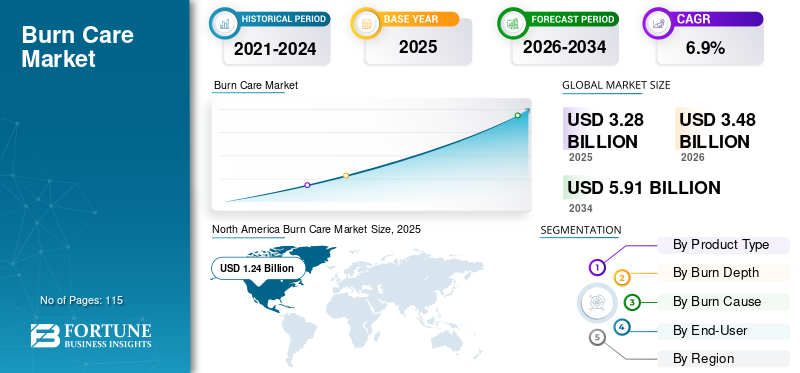
According to Fortune Business Insights: The global burn care market size was valued at USD 3.28 billion in 2025 and is projected to grow from USD 3.48 billion in 2026 to USD 5.91 billion by 2034, at a CAGR of 6.9% during the forecast period. Burn care encompasses the treatment and management of skin injuries caused by heat, chemicals, electricity, or radiation. It covers a broad range of products including advanced dressings, biologics, skin substitutes, ointments, and supportive care solutions deployed across hospitals, specialized burn centers, and outpatient clinics. Market growth is attributed to the rising global prevalence of burn injuries, the launch of advanced burn care devices and dressings, and a growing emphasis on faster healing, infection control, and reducing the duration of hospital stays. North America dominated the market with a 37.80% share in 2025, while Asia Pacific is expected to record the fastest regional growth over the forecast horizon.
Get a Sample Research PDF: https://www.fortunebusinessinsights.com/enquiry/request-sample-pdf/116386
Key Market Drivers
The widespread and rising incidence of burn injuries is the primary market driver. According to the World Health Organization, approximately 180,000 deaths are caused by burns each year globally, with the majority occurring in low- and middle-income countries. In the United States, over 500,000 people receive treatment for burn injuries annually. Domestic accidents, industrial workplace incidents, cooking-related scalds, and road traffic injuries generate consistent large-scale demand for burn care products across all severity levels — from superficial to life-threatening full-thickness wounds requiring surgical intervention and prolonged hospitalization.
Technological advancement in wound care is a parallel and increasingly significant driver. Healthcare providers are directing investment toward advanced dressings, biologics, skin substitutes, and wound therapy devices that deliver faster tissue regeneration, superior infection control, and better cosmetic outcomes. In February 2025, Convatec Group launched its next-generation AQUACEL Ag+ burn dressing featuring enhanced ionic silver technology, designed to improve antimicrobial performance and reduce biofilm formation in partial and full-thickness burn wounds. Innovation in enzymatic debridement — such as Vericel Corporation's NexoBrid — is also expanding treatment options for severe burns, enabling less invasive removal of non-viable tissue prior to grafting.
Market Restraints and Challenges
The high cost of advanced burn care treatments is the most significant barrier to market expansion. Biologics, bioengineered skin substitutes, and premium foam dressings carry substantially higher price points than conventional treatments, limiting adoption in healthcare systems with constrained budgets — particularly across low- and middle-income countries where burn injury rates are disproportionately high. Inadequate healthcare infrastructure in underserved regions further restricts access to specialized burn centers and trained burn care professionals, compressing the geographic reach of premium product categories. A global shortage of skilled burn care specialists adds another layer of constraint, extending treatment timelines and increasing complications in resource-limited settings.
Market Opportunities
The biologics and skin substitutes segment represents the most compelling near-term growth opportunity, with a projected CAGR of 7.5% over the forecast period. Bioengineered skin scaffolds, allografts, xenografts, and advanced tissue-engineered products are gaining rapid clinical traction as evidence of their superior outcomes in wound closure, infection prevention, and scar reduction accumulates. Expansion of homecare burn management — driven by telemedicine platforms, remote wound monitoring tools, and patient-friendly dressing formats — is also emerging as a structural opportunity, particularly in markets where outpatient care pathways are being strengthened to reduce hospitalization costs.
Segmentation Analysis
By product, the advanced dressings segment held substantial market share in 2025, anchored by its ability to maintain a moist wound environment, reduce infection risk, and promote faster tissue regeneration. Clinicians increasingly prefer dressings that minimize the frequency of changes, reduce patient pain during removal, and support better cosmetic recovery — all attributes well delivered by hydrocolloid, foam, and silver-impregnated formats. The biologics and skin substitutes segment is the fastest-growing product category at a projected CAGR of 7.5%, driven by rising adoption of bioengineered tissue products and skin grafting solutions in severe burn management.
By burn depth, the partial-thickness burns segment dominates the market, reflecting the higher overall incidence of second-degree injuries relative to full-thickness wounds. The full-thickness burns segment is expected to grow at a CAGR of 7.1%, driven by the disproportionately high resource intensity of treating third-degree injuries — including extensive use of skin grafts, biologics, advanced dressings, and prolonged wound therapy devices.
By burn cause, thermal burns dominate the global market. Heat and flame-related injuries represent the most prevalent cause of burn wounds worldwide, accounting for the majority of burn center admissions across all age groups. Thermal burns result from contact with flames, scalding liquids, hot surfaces, and steam, spanning a broad severity spectrum from minor superficial burns to life-threatening full-thickness wounds. Chemical, electrical, and radiation burn sub-segments serve more specialized clinical and occupational health applications.
By end user, hospitals and burn centers held the highest market share in 2025, projected at 68.4% in 2026. They serve as the primary treatment facilities for moderate to severe burn injuries, offering comprehensive multidisciplinary care spanning emergency management, surgical intervention, wound care, infection control, and long-term rehabilitation. Dedicated burn centers are equipped with specialized infrastructure including negative pressure wound therapy systems, sterile dressing rooms, skin grafting suites, and intensive care units. The homecare settings segment is projected to grow at a CAGR of 7.1%, driven by discharge-accelerating protocols, remote monitoring tools, and the growing availability of patient-friendly dressing formats.
Regional Outlook
North America leads the global market, supported by a high burn injury incidence, advanced healthcare infrastructure, a strong network of specialized burn centers, and favorable reimbursement policies for advanced therapies. The U.S. healthcare system's capacity for surgical intervention, skin grafting, and long-term rehabilitation drives sustained premium product demand across all categories. Europe maintains a substantial and stable market share, underpinned by NHS-led innovations in trauma and emergency care, a world-leading research base in regenerative medicine and stem cell therapy, and growing clinical adoption of bioengineered skin scaffolds and advanced dressings across the U.K., Germany, and France. Asia Pacific is the fastest-growing regional market, propelled by a large and rapidly expanding population, high burn injury rates from industrial and domestic accidents, increasing healthcare expenditure, and improving access to advanced burn care in China, India, and Japan. Latin America and the Middle East and Africa are expanding steadily, supported by improving healthcare infrastructure, government burn prevention initiatives, and growing demand for affordable wound care solutions.
Connect with Our Expert for any Queries: https://www.fortunebusinessinsights.com/enquiry/speak-to-analyst/116386
Competitive Landscape
The global burn care market features a mix of large multinational medical device and wound care companies alongside specialized providers. Key players profiled by Fortune Business Insights include Smith+Nephew (U.K.), Mölnlycke Health Care AB (Sweden), ConvaTec Group (U.K.), 3M Company (U.S.), Cardinal Health (U.S.), Integra LifeSciences Corporation (U.S.), AVITA Medical (U.S.), Kerecis (Iceland), DeRoyal Industries (U.S.), and B. Braun Melsungen AG (Germany). Companies are competing through R&D investment in advanced dressings and biologics, strategic acquisitions to broaden product portfolios, and partnerships with specialized burn centers to support clinician training and protocol adoption. In 2025, the FDA granted QIDP designation to Destiny Pharma's XF-73 Dermal Gel for burn wounds, while Kerecis' launch of its fish skin-derived products for burn healing illustrated the ongoing expansion of biologically derived treatment platforms reshaping this market.