
Automotive Data Monetization Platforms Market Overview Analysis By Fortune Business Insights
Market Summary
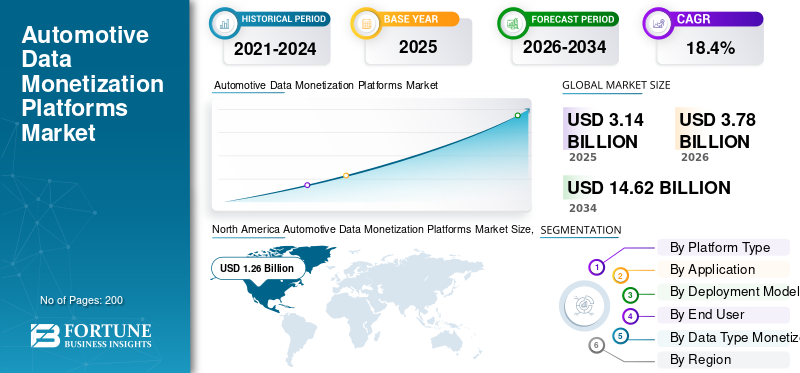
According to Fortune Business Insights: The global automotive data monetization platforms market size was valued at USD 3.14 billion in 2025 and is projected to grow from USD 3.78 billion in 2026 to USD 14.62 billion by 2034, exhibiting a CAGR of 18.4% during the forecast period. Automotive data monetization platforms are digital systems that collect, process, and analyze vehicle-generated data to create revenue streams through services such as usage-based insurance, fleet management, predictive maintenance, and in-vehicle applications. Modern connected vehicles generate terabytes of data daily through embedded sensors, telematics units, onboard communication systems, ADAS, and infotainment platforms — data that OEMs, insurers, fleet operators, and third-party providers are increasingly converting into scalable revenue streams. North America dominated the market with a 40.12% share in 2025, while Asia Pacific is expected to record the fastest regional growth with a CAGR of 20.4% over the forecast period.
Get a Sample Research PDF: https://www.fortunebusinessinsights.com/enquiry/request-sample-pdf/116129
Key Market Drivers
The rapid proliferation of connected vehicles is the primary driver of market growth. As modern vehicles become progressively embedded with sensors, 5G connectivity, and V2X (Vehicle-to-Everything) communication capabilities, the volume, variety, and commercial value of vehicle-generated data expands exponentially. This connectivity transformation has fundamentally shifted the automotive industry's revenue model from hardware-centric to software- and data-driven, enabling OEMs to unlock recurring revenue streams through subscriptions, digital services, and third-party data partnerships. As margins on vehicle hardware sales narrow and competition intensifies, data monetization is becoming a critical strategic growth lever for global automakers. In November 2025, HERE Technologies introduced an industry-first Software-Defined Vehicle maturity framework enabling automakers to benchmark their progress and transition toward software-driven mobility ecosystems with new recurring revenue streams. In October 2025, Volkswagen partnered with Nuvei to launch a connected vehicle payment solution in Brazil, enabling subscription-based services and seamless in-car payments that advance OEM data monetization through integrated digital service ecosystems.
Advancements in AI, cloud computing, and growing OEM focus on new digital revenue streams are parallel drivers. AI and machine learning are enabling platforms to extract increasingly granular and commercially actionable insights from raw vehicle data — spanning driver behavior scoring, predictive component failure detection, real-time location intelligence, and personalized in-vehicle recommendations. Cloud-native infrastructure provides the scalability necessary to process fleet-scale data volumes at low latency, making enterprise-grade analytics accessible to a broader range of OEMs, insurers, and mobility service providers.
Market Restraints and Challenges
Stringent data privacy regulations represent the most significant structural constraint on market growth. Strict data protection frameworks — including the EU's GDPR, the U.S. CCPA, and the UN R155 cybersecurity regulation for connected vehicles — impose rigorous consent management, data minimization, and cross-border transfer requirements that limit the scope and commercial utility of vehicle data that can be collected, processed, and shared. Compliance with overlapping and evolving regulatory regimes adds cost and complexity, particularly for platforms operating across multiple geographies. Lack of standardization across OEM data formats and telematics architectures further constrains platform scalability, as aggregators must invest heavily in normalization and integration infrastructure before analytics value can be generated.
Market Opportunities
The growing adoption of usage-based insurance (UBI) is the most significant near-term commercial opportunity. Insurers are leveraging real-time driving behavior data — including speed, braking patterns, cornering, and time-of-day — to deliver personalized, risk-accurate premium pricing that improves both customer retention and claims performance. The expansion of mobility-as-a-service (MaaS) platforms and ride-hailing and car-sharing ecosystems is driving parallel demand for real-time operational data insights, while the rise of electric vehicles is creating new monetization opportunities from battery health, charging behavior, and energy consumption datasets.
Segmentation Analysis
By platform type, the vehicle data monetization platforms segment dominates the market due to its direct integration with connected vehicle and OEM ecosystems, enabling continuous collection and analysis of real-time vehicle data supporting multiple simultaneous revenue streams including insurance, diagnostics, and in-vehicle content services. The fleet data monetization platforms segment serves commercial operators, providing routing, driver scoring, and fuel-efficiency analytics. The MaaS data platforms segment is the fastest-growing, with a CAGR of 21.7% over the forecast period, driven by the rapid expansion of ride-hailing, car-sharing, and smart mobility services globally.
By application, usage-based insurance holds the largest market share, driven by widespread insurer demand for personalized, cost-efficient underwriting models that leverage real-time driving data for accurate risk segmentation. Predictive maintenance ranks as the second-largest application, enabling vehicle health monitoring, proactive service scheduling, and downtime minimization for both consumer and fleet vehicles. Traffic and navigation services are expanding rapidly as location and mobility data power smart city planning, congestion management, and MaaS route optimization. The in-vehicle advertising segment is expected to grow at a CAGR of 20.2% — the fastest among all applications — as software-defined vehicles enable personalized, location-aware advertising and commerce experiences within the cabin. The location and mobility data segment is projected to grow at a CAGR of 20.3%, driven by increasing adoption of navigation services, smart mobility solutions, and real-time urban traffic optimization.
By end user, OEMs hold the dominant market share, acting as primary data generators and gatekeepers with first-party access to vehicle metrics, driver preferences, and usage patterns. Insurance companies are the second-largest end user, deploying telematics data platforms for UBI and fleet risk management. The mobility service providers segment is the fastest-growing end-user category, expanding at a CAGR of 21.7% as MaaS operators increasingly rely on vehicle data for operational optimization.
Regional Outlook
North America leads the global market, supported by a high connected vehicle adoption rate, mature telematics infrastructure, favorable regulatory frameworks for UBI, advanced ADAS integration, and the concentration of major platform and technology providers. The U.S. automotive ecosystem's early and broad adoption of telematics-based insurance programs, OTA software services, and fleet analytics has created a well-established commercial foundation for data monetization platform revenue. Europe holds the second-largest market share, characterized by stringent GDPR compliance requirements that are simultaneously creating barriers and driving investment in privacy-by-design platform architectures, alongside significant automotive OEM activity in Germany, France, and the Nordic markets. Asia Pacific is the fastest-growing region at a CAGR of 20.4%, propelled by the rapid expansion of connected vehicles, smart mobility platforms, and EV adoption in China, Japan, South Korea, and India, together with supportive government smart city and digital transport infrastructure programs. South America and the Middle East and Africa are expanding steadily as connected vehicle penetration increases and OEMs extend digital service ecosystems into emerging market geographies.
Connect with Our Expert for any Queries: https://www.fortunebusinessinsights.com/enquiry/speak-to-analyst/116129
Competitive Landscape
The global automotive data monetization platforms market is moderately consolidated, with technology giants, automotive suppliers, and specialized mobility data platforms competing across the value chain. Key players profiled by Fortune Business Insights include Microsoft Corporation (U.S.), Amazon Web Services (U.S.), IBM Corporation (U.S.), Bosch Mobility Solutions (Germany), Verizon Communications (U.S.), HERE Technologies (Netherlands), Continental AG (Germany), Harman International (U.S.), Geotab (Canada), and Wejo Limited (U.K.). Companies are competing through AI and analytics capability development, strategic partnerships with OEMs and insurers, and API platform expansion enabling third-party developer ecosystems. In May 2025, Tredence partnered with Snowflake to launch advanced AI-enabled automotive data solutions integrating operational and IT data silos for OEMs, suppliers, and fleet operators. The competitive intensity of the market is increasing as both traditional automotive suppliers and cloud hyperscalers invest in connected vehicle data infrastructure, accelerating platform consolidation and the race to build cross-OEM data aggregation capabilities.