

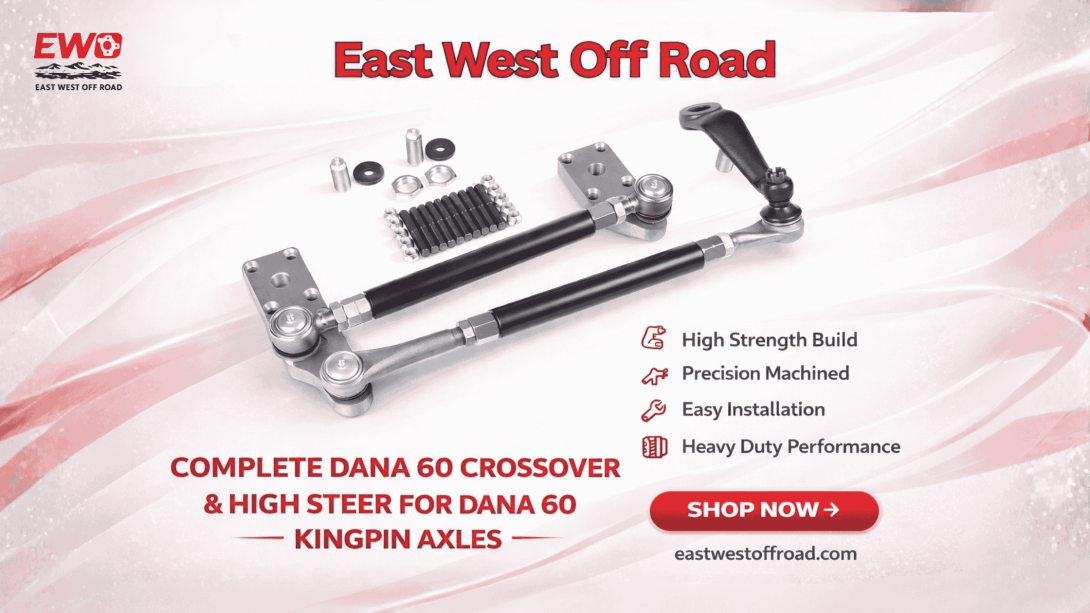
A 1 Ton Steering Upgrade Kit is often considered after a truck, Jeep, or custom 4x4 receives a Dana 60 Kingpin axle, added suspension height, larger tires, or a solid axle swap. Those changes can alter the drag link and tie rod paths, create new clearance demands, and make the original steering layout less practical. The East West Off Road package brings together high steer arms, DOM tubing, steering ends, weld bungs, studs, and related hardware for a custom crossover and high steer installation on compatible Kingpin applications.
Understanding Dana 60 Kingpin High Steer and Crossover Steering
Crossover steering changes how movement travels from the steering box to the axle. Instead of relying only on a traditional push-pull arrangement, the drag link runs from the pitman arm toward the opposite steering knuckle or high steer arm. A separate tie rod keeps both knuckles working together.
High steer places the drag link and, depending on the chosen layout, the tie rod higher on the axle. This can create a more favorable steering path and move linkage away from trail obstacles. The result depends on arm position, steering box location, pitman arm, axle placement, suspension design, and fabrication.
This kit is intended for compatible Dana 60 Kingpin axles. Kingpin and ball-joint Dana 60 assemblies use different knuckles and steering arrangements, so ball-joint compatibility must not be assumed.
Why Factory Steering Can Become Limiting
A suspension lift increases the distance between the chassis-mounted steering box and the axle. The drag link may operate at a steeper angle, while the tie rod can move closer to leaf springs, shocks, the differential cover, suspension links, wheels, or tires.
A steep drag link can transmit more axle movement into the steering wheel. On vehicles with a track bar, a drag link and track bar traveling through different arcs may contribute to bump steer. Incorrect caster, loose joints, worn steering-box parts, tire pressure, wheel offset, or poor alignment can also create wander.
Factory push-pull steering can remain suitable for near-stock vehicles. It may become harder to package when lift height, axle position, and suspension travel no longer resemble the original design. Crossover steering offers another linkage path, but it must be planned as part of the complete steering and suspension system.
Where a 1 Ton Steering Upgrade Kit Fits Into the Build
A coordinated kit gives a builder compatible-style components without sourcing every arm, steering end, bung, and fastener separately. It does not remove the need for measurement or fabrication.
The objective is suitable linkage angles, usable adjustment, and safe clearance through the vehicle’s full range. Correctly planned geometry can help reduce bump steer or wander, but no kit can compensate for worn, loose, or incorrectly installed parts.
Why 1.25-Inch Billet High Steer Arms Matter
The package includes driver-side and passenger-side high steer arms, each measuring 1.25 inches thick. They create the elevated attachment points used by the drag link and tie rod.
The arms are made from domestic billet steel and precision-machined in the USA. Billet material provides a solid base for machining the mounting surfaces, holes, and steering locations. Accurate machining helps the arms sit correctly on compatible knuckles and allows the hardware to seat as intended.
The knuckle surface must still be suitable, the studs and tapered nuts must fit correctly, and the selected holes must provide safe linkage placement without contact or binding.
Five-Hole Steering Arm and Knuckle Compatibility
The arms use a five-hole pattern, but that pattern must match the intended knuckle and installation method.
Not every Kingpin knuckle is drilled or configured identically. Before ordering, identify the knuckle manufacturer, bolt pattern, mounting surface, and any required drilling or machining. Confirm the taper size and direction for the ES-series steering components.
A mismatched arm, taper, or fastener can prevent correct seating. An experienced axle or steering professional should determine whether the knuckles are suitable.
DOM Tubing Included for Custom Steering Fabrication
DOM tubing is included with this version of the kit. The package provides one 54-inch section and one 43-inch section. Both measure 1.50 inches outside diameter, 1.00 inch inside diameter, and .250 inch wall thickness.
These sections are intended to become the drag link and tie rod after vehicle-specific fabrication. They do not arrive as completed or pre-welded steering assemblies.
The installer must establish final lengths after positioning the arms, axle, steering box, and pitman arm. Preparation may include measuring, cutting, deburring, cleaning, beveling, and welding the supplied bungs. The finished links must retain safe adjustment range and thread engagement.
Professional welding is strongly recommended because steering loads pass through the tubes, bungs, welds, ends, and arm hardware.
Steering Ends, Weld Bungs, and Mounting Hardware
The supplied drag link components are the ES2026R and ES2027L steering ends with their hardware. The ES2234L and ES2234R components are supplied for the tie rod. Their orientation and seating must be confirmed during mock-up.
Four 7/8-18 weld bungs are included: two left-hand thread and two right-hand thread, with matching jam nuts. Opposing thread directions allow linkage length to be adjusted by rotating the tube. The jam nuts secure the setting.
The mounting package includes ten 1/2-inch fine-thread studs listed at 180,000 PSI according to the supplied specifications. Ten tapered nuts, two screws, two grease fittings, two spacers, and supporting jam nuts are also included. Correct seating, thread engagement, torque, lubrication, and inspection remain essential.
Key Features and Benefits
- Component package for compatible Dana 60 Kingpin crossover and high steer conversions
- Two 1.25-inch domestic billet steel arms machined in the USA
- Five-hole arm layout for compatible knuckles
- Included 54-inch and 43-inch DOM tube sections
- 1.50-inch OD, 1.00-inch ID, and .250-inch wall tubing
- ES-series drag link and tie rod components
- Left- and right-hand 7/8-18 weld bungs and jam nuts
- Ten fine-thread studs with a supplied 180,000 PSI rating
The main benefit is having the major fabrication components in one package while retaining the flexibility required by a custom vehicle.
What’s Included
The kit contains two billet high steer arms, two DOM tube sections, four ES-series steering ends/components, four weld bungs, corresponding jam nuts, high-strength studs, tapered nuts, spacers, screws, grease fittings, and related mounting hardware.
The pitman arm is optional and is not automatically included. It may need to be selected or sourced separately based on steering-box spline, taper, required drop, indexing, and drag link position.
Important Notes Before Ordering
Confirm that the axle is a Dana 60 Kingpin model and not a ball-joint Dana 60 unless compatibility has been separately verified. Record the axle source, year, knuckle manufacturer, and current steering configuration where possible.
Measure the required drag link and tie rod lengths instead of assuming the supplied tubing will be used at full length. Verify wheel backspacing, tire clearance, spring location, shock position, differential-cover clearance, and space around suspension links.
For an optional pitman arm, confirm sector-shaft spline count, taper, drop, indexing, and orientation. Its inclusion depends on the selected product configuration.
Ideal For
This package can support custom Dana 60 Kingpin builds such as:
- Lifted GM and Chevy trucks
- Jeep Dana 60 conversions
- Rock crawlers and trail vehicles
- Overlanding rigs
- Solid axle swaps
- Trucks using oversized tires
- Custom off-road and race applications
Vehicle type or lift height alone does not confirm fitment.
Fitment and Installation Notes
Steering is a safety-critical system, and this is not a universal direct bolt-on package. Experienced steering, suspension, machining, and fabrication professionals should handle work beyond the installer’s equipment or knowledge.
Mock up the steering at ride height before final welding. Compare drag link and track bar angles where applicable. Check the linkage against springs, the differential cover, shocks, chassis, wheels, tires, and suspension links.
Cycle the axle from full compression to full droop and turn the steering from lock to lock at several suspension positions. Watch for joint bind, tube contact, tire interference, inadequate thread engagement, or an end reaching its articulation limit.
After welding and assembly, verify hardware torque and tapered-nut seating. Center the steering box, set toe, inspect welds, grease serviceable components, and complete a professional alignment. Reinspect the system after initial road and trail use.
Why Builders Choose East West Off Road
East West Off Road combines USA-machined billet arms with DOM tubing, steering ends, weld bungs, studs, and smaller hardware needed to begin a custom Dana 60 Kingpin crossover conversion. Builders receive a coordinated package without the misleading assumption that every axle or vehicle uses the same finished dimensions.
For builders researching a 1 Ton Steering Upgrade Kit, the next step is comparing these specifications with the exact axle, knuckles, steering box, suspension, and fabrication plan. Review the complete kit and available options at https://www.eastwestoffroad.com/product/complete-dana-60-crossover-and-high-steer-for-dana-60-kingpin-axles.
7. FAQs
1. Does this 1 Ton Steering Upgrade Kit fit every Dana 60 Kingpin axle?
No. It is intended for compatible Dana 60 Kingpin axle applications, but Kingpin knuckles can differ by manufacturer, machining, mounting pattern, taper, and previous modifications. Buyers should confirm the exact five-hole arm compatibility, knuckle condition, steering-end orientation, and vehicle layout before ordering.
2. Can this crossover high steer kit be installed on a ball-joint Dana 60?
Ball-joint Dana 60 compatibility should not be assumed. Ball-joint axles normally use different knuckles and steering-arm arrangements than Kingpin Dana 60 axles. Separate confirmation is necessary before using any of these components on a ball-joint application.
3. What steering components and hardware come with the kit?
The package includes driver-side and passenger-side 1.25-inch billet arms, ES2026R and ES2027L drag link components, ES2234L and ES2234R tie rod components, DOM tubing, weld bungs, jam nuts, tapered nuts, spacers, screws, grease fittings, and ten 1/2-inch fine-thread mounting studs.
4. Is DOM tubing included, and what sizes are supplied?
Yes. One 54-inch tube and one 43-inch tube are included. Each section measures 1.50 inches in outside diameter, 1.00 inch in inside diameter, and has a .250-inch wall thickness.
5. Are the DOM tubes supplied as pre-welded drag link and tie rod assemblies?
No. The tubing is supplied as raw material for custom steering fabrication. The installer must determine the final lengths and may need to measure, cut, deburr, clean, prepare, and weld the 7/8-18 bungs into the tubes. Professional fabrication and welding are recommended.
6. Is a pitman arm included with this Dana 60 high steer kit?
The pitman arm is optional and must not be assumed to be included. It may need to be selected or sourced separately because steering boxes can differ in sector-shaft spline count, indexing, taper, and required pitman-arm drop.
7. Why does the kit use 1.25-inch billet arms and high-strength mounting studs?
The billet arms provide elevated connection locations for the drag link and tie rod on compatible knuckles. They are 1.25 inches thick, made from domestic billet steel, and precision-machined in the USA. The ten 1/2-inch fine-thread studs carry a supplied rating of 180,000 PSI, but correct seating, torque, thread engagement, and inspection are still required.
8. Will crossover high steer completely eliminate bump steer or steering wander?
No. Correctly planned crossover steering can improve linkage angles and may help reduce bump steer or wander, but results also depend on track bar geometry, caster, toe, steering-box condition, joint wear, tire setup, axle position, fabrication quality, and alignment. The suspension should be cycled fully, the steering checked lock to lock, and the completed system professionally inspected and aligned.