

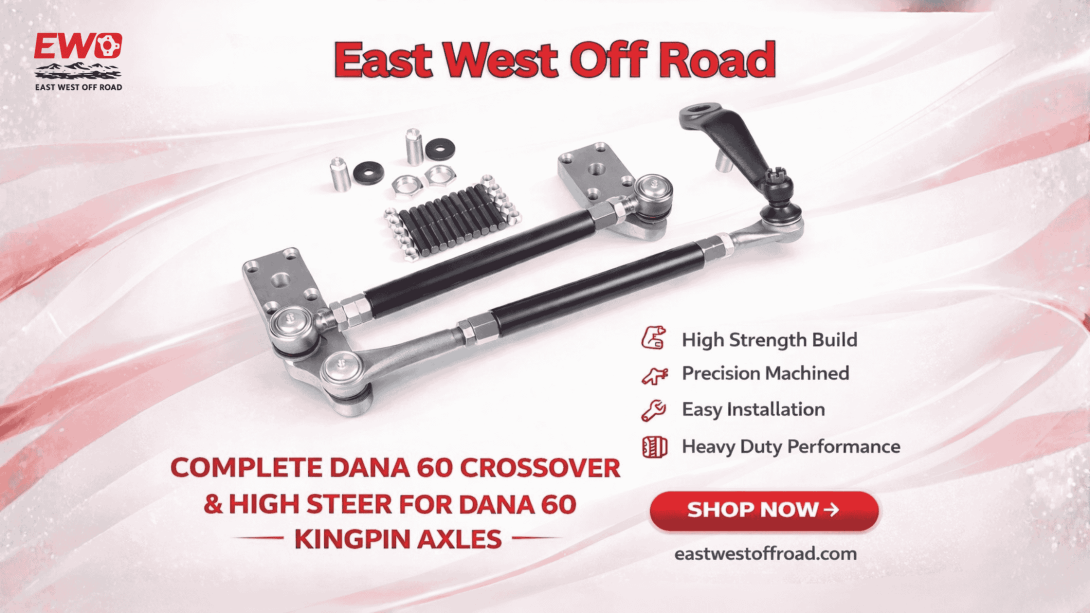
Planning Off Road Crossover Steering for a lifted truck or custom 4x4 involves more than replacing factory linkage parts. Axle type, steering-box position, knuckle pattern, suspension geometry, wheel clearance, and final linkage dimensions all influence how the system must be built. East West Off Road’s component package supplies the major parts needed to fabricate crossover and high steer linkage for compatible Dana 60 Kingpin axles.
Understanding Dana 60 Kingpin High Steer and Crossover Steering
Factory steering was designed around original ride height, stock axle placement, and factory tire size. In a crossover layout, the drag link generally runs from the steering box or pitman arm to the passenger-side steering arm, while the tie rod connects the two knuckles.
High steer arms move steering connection points higher on the axle. This can create more workable drag link and tie rod positions on certain lifted or custom builds.
A complete Dana 60 Kingpin crossover and high steer kit provides compatible arms, steering ends, raw linkage material, and hardware for a vehicle-specific system. The final result still depends on accurate measurement, fabrication, and installation.
Why Factory Steering Can Become Limiting
Raising a vehicle increases the vertical distance between the frame-mounted steering box and axle. This can steepen the drag link angle and change how steering input interacts with suspension movement.
Factory push-pull steering may become less suitable when the axle has been relocated, the suspension has substantial lift, or a solid axle swap changes the original layout. A low tie rod may also face reduced clearance around rocks, springs, shocks, differential covers, or suspension links.
Poor geometry can contribute to steering feedback, bump steer, wander, inconsistent response, or limited travel. Caster, toe, worn joints, tire pressure, wheel offset, track-bar position, loose hardware, and chassis movement can produce similar symptoms.
Correctly planned geometry can improve steering angles and may help reduce unwanted behavior. No kit can guarantee that every steering concern will disappear.
Why 1.25-Inch Billet High Steer Arms Matter
The kit includes driver-side and passenger-side high steer arms, each 1.25 inches thick. Both are manufactured from domestic billet steel and precision-machined in the USA.
Billet material provides a solid workpiece for machining mounting holes, tapers, and accurately positioned connections. Precision machining matters where the arms must seat correctly on the knuckles and establish the intended drag link and tie rod locations.
Material and thickness do not replace proper installation. Knuckle condition, stud seating, tapered-nut contact, thread engagement, torque, and inspection remain essential.
Five-Hole Steering Arm and Knuckle Compatibility
These arms use a five-hole pattern, but every Dana 60 Kingpin knuckle should not be assumed identical.
Verify the axle, model year when known, knuckle manufacturer, hole spacing, taper direction, and existing machining. Some knuckles may need drilling or machining by a qualified shop. Previously modified or aftermarket knuckles require careful inspection.
This product is intended for compatible Kingpin axles. It should not automatically be treated as suitable for a ball-joint Dana 60 because those axles may use different knuckles, mounting arrangements, and steering geometry.
DOM Tubing Included for Custom Steering Fabrication
DOM tubing is included. The package provides one 54-inch section and one 43-inch section. Each has a 1.50-inch outside diameter, 1.00-inch inside diameter, and .250-inch wall thickness.
These tubes are raw material for custom Dana 60 tie rod and drag link fabrication. They are not finished, pre-welded, or vehicle-specific steering assemblies.
The installer must determine final lengths after considering axle width, arm location, pitman-arm position, weld-bung depth, steering-end engagement, and adjustment range. The tubing may require measuring, cutting, deburring, cleaning, weld preparation, and repeated test fitting.
Professional welding is important because linkage failure can lead to loss of vehicle control. Completed tubes should be inspected before road or trail use.
Steering Ends, Weld Bungs, and Mounting Hardware
The ES2026R and ES2027L steering ends/components are supplied for the fabricated drag link. The ES2234L and ES2234R steering ends/components are supplied for the tie rod, along with their listed hardware.
Two left-hand and two right-hand 7/8-18 weld bungs are included with matching jam nuts. Opposing thread directions allow linkage length to be adjusted by rotating a correctly fabricated tube.
Ten 1/2-inch fine-thread mounting studs are included and listed at 180,000 PSI according to the supplied specifications. Ten tapered nuts support arm retention and seating.
Two screws, two grease fittings, two spacers, and two additional jam nuts complete the hardware package. Each component must be correctly positioned, seated, lubricated where specified, and torqued.
Key Features and Benefits
- Component package for compatible Dana 60 Kingpin conversions
- Two 1.25-inch domestic billet steel high steer arms
- Five-hole arm design for verified compatible knuckles
- Precision-machined in the USA
- Included 54-inch and 43-inch DOM tubes
- ES-series drag link and tie rod components
- Left- and right-hand 7/8-18 weld bungs
- High-strength 1/2-inch fine-thread arm studs
- Suitable for planned lifted-truck, Jeep, trail-rig, and solid-axle-swap steering systems
The package allows linkage to be built around the actual vehicle instead of relying on a universal finished length.
What’s Included
The package contains:
- One driver-side and one passenger-side 1.25-inch billet arm
- One 54-inch and one 43-inch DOM tube
- ES2026R and ES2027L drag link ends/components
- ES2234L and ES2234R tie rod ends/components
- Two left-hand and two right-hand 7/8-18 weld bungs
- Matching left- and right-hand 7/8-18 jam nuts
- Ten 1/2-inch fine-thread studs listed at 180,000 PSI
- Ten tapered nuts
- Two screws, grease fittings, spacers, and additional jam nuts
The pitman arm is optional. It is not automatically included and must be selected or sourced separately when required.
Important Notes Before Ordering
Confirm the axle is a Dana 60 Kingpin and that the five-hole arms match the actual knuckles. Check steering-end tapers, linkage orientation, required tube lengths, and possible knuckle machining.
Pitman arm selection depends on steering-box sector-shaft size, spline count, indexing, drop, and steering-end taper. Choosing by vehicle name alone can result in poor fitment or geometry.
Where a track bar is used, compare its length and operating angle with the drag link. Their relationship can affect steering response as the suspension moves.
Ideal For
This kit can support compatible lifted GM and Chevy trucks, custom Jeeps, rock crawlers, overlanding vehicles, trail rigs, race builds, and Dana 60 solid axle swaps.
It is also relevant to oversized-tire or custom-suspension builds where final tie rod and drag link dimensions must be established on the vehicle.
Fitment and Installation Notes
Steering is safety-critical. Installation should be performed or supervised by an experienced steering, suspension, or fabrication professional.
Before final welding and torque, verify:
- Steering movement from lock to lock
- Full suspension compression, droop, and articulation
- Tire, wheel, spring, shock, differential-cover, chassis, and link clearance
- Correct steering-end taper and orientation
- Adequate weld-bung and steering-end thread engagement
- Proper stud seating and tapered-nut contact
- Grease-fitting access and sufficient adjustment range
Cycle the suspension with the steering turned both ways. Clearance at ride height does not prove that components will clear during compression or articulation.
Complete a professional alignment and steering inspection after fabrication. Recheck torque, weld condition, joint movement, and clearance after initial use.
Planning Off Road Crossover Steering as a Complete System
Evaluate the steering box, optional pitman arm, drag link, tie rod, knuckles, track bar, axle, suspension, wheels, and tires together. A change to one component can affect angles or clearance elsewhere.
Final dimensions should come from the assembled vehicle and be confirmed through complete steering and suspension travel before welding.
Why Builders Choose East West Off Road
East West Off Road supplies axle and steering components for modified trucks and purpose-built 4x4s. This package combines USA-machined billet arms, included DOM tubing, steering ends, weld bungs, adjustment parts, and mounting hardware.
Builders retain control over tube length, pitman-arm selection, linkage position, and vehicle-specific geometry. That flexibility is useful because lifted trucks and solid axle swaps rarely share an identical configuration.
For a professionally planned Off Road Crossover Steering conversion on a compatible Dana 60 Kingpin axle, verify every fitment and fabrication requirement before purchasing. View the complete kit at https://www.eastwestoffroad.com/product/complete-dana-60-crossover-and-high-steer-for-dana-60-kingpin-axles
FAQs
1. Does this kit fit every Dana 60 Kingpin axle?
No. It is designed for compatible Dana 60 Kingpin axle applications, but knuckle patterns, steering-end tapers, machining, and existing modifications can vary. Buyers should verify the axle, knuckle manufacturer, five-hole pattern, taper orientation, and any drilling or machining requirements before ordering.
2. Can the kit be used on a ball-joint Dana 60?
Ball-joint Dana 60 compatibility should not be assumed. The product is intended for compatible Kingpin axle applications. Ball-joint axles can use different knuckles, arm-mounting arrangements, and steering geometry, so the exact axle and components must be evaluated separately.
3. What components come with the Dana 60 crossover and high steer kit?
The package includes driver-side and passenger-side 1.25-inch billet arms, two DOM tube sections, ES2026R and ES2027L drag link ends/components, ES2234L and ES2234R tie rod ends/components, weld bungs, jam nuts, studs, tapered nuts, screws, grease fittings, spacers, and related hardware.
4. Is DOM tubing included, and what sizes are supplied?
Yes. The kit includes one 54-inch DOM tube and one 43-inch DOM tube. Both tubes have a 1.50-inch outside diameter, a 1.00-inch inside diameter, and a .250-inch wall thickness.
The supplied lengths should be compared with the vehicle’s required finished tie rod and drag link dimensions before fabrication begins.
5. Are the included DOM tubes already welded and ready to install?
No. The tubes are supplied as raw fabrication material rather than completed steering assemblies. They may require accurate measurement, cutting, deburring, cleaning, weld preparation, weld-bung installation, welding, adjustment, clearance testing, and professional inspection.
6. Is a pitman arm included with the package?
The pitman arm is optional and is not automatically included. Steering boxes can use different spline counts, sector-shaft sizes, indexing, drops, and steering-end tapers. This allows the builder to select or source the pitman arm required for the specific steering box and vehicle layout.
7. What are the ES-series steering ends and 7/8-18 weld bungs used for?
The ES2026R and ES2027L components are supplied for drag link fabrication. The ES2234L and ES2234R components are supplied for tie rod fabrication.
The left- and right-hand 7/8-18 weld bungs and matching jam nuts connect the steering ends to the DOM tubes. Opposing thread directions allow the fabricated linkage length to be adjusted by rotating the tube.
8. Will this kit correct bump steer and steering wander on a lifted truck?
Properly designed crossover steering can improve steering angles and may help reduce bump steer or wander, but it cannot guarantee that these conditions will be eliminated.
Caster, toe, track-bar geometry, tire pressure, wheel offset, worn joints, hardware condition, and suspension movement must also be evaluated. Professional welding, installation, full-travel clearance checks, final alignment, and steering inspection are strongly recommended.
The kit also includes ten 1/2-inch fine-thread mounting studs listed at 180,000 PSI. Correct thread engagement, tapered-nut seating, and torque remain essential regardless of the supplied stud rating.