

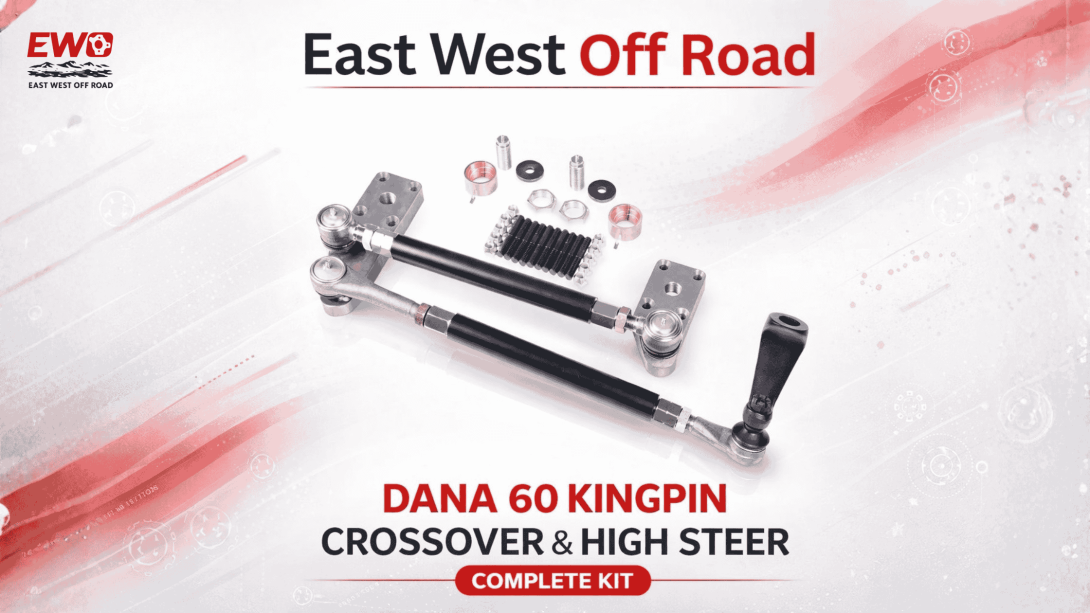
Buy Now: https://www.eastwestoffroad.com/product/dana-60-kingpin-crossover-high-steer-complete-kit
Searching for Dana 60 High Steer Arms Billet components usually means a builder is ready to move vulnerable steering linkage higher on a Kingpin axle. A substantial arm can provide the mounting foundation for a raised tie rod and crossover drag link, but thickness and material are not the only considerations. Hole placement, knuckle condition, steering-end angles, wheel clearance, and suspension movement determine whether the finished layout works as intended.
East West Off Road uses a driver- and passenger-side pair of 1.25-inch domestic billet steel arms in its complete Dana 60 Kingpin steering system. The five-hole pattern gives an experienced installer choices when positioning the links, while the rest of the package supplies the bushings, studs, ends, tube stock, and fabrication hardware needed to complete the steering path.
Why High Steer Arms Carry So Much Responsibility
High steer arms relocate attachment points from a lower factory-style position to the top of compatible Kingpin knuckles. The change can move linkage away from rocks and help the installer establish better drag-link and tie-rod placement on a lifted vehicle. Every steering input and trail impact transmitted through those connections also loads the arms, their mounting studs, the knuckles, and the Kingpin assemblies.
Dana 60 High Steer Arms Billet Construction and Thickness
“Billet” describes a component machined from solid stock rather than a thin formed piece. In this kit, both arms are made from domestic billet steel and measure 1.25 inches thick. That construction creates a substantial platform for the steering connections used in demanding off-road applications.
What a Five-Hole Pattern Allows
A five-hole arm offers flexibility for placing a tie-rod connection, crossover drag-link connection, and related hardware. This can help a fabricator package the steering around different wheel backspacing, differential covers, suspension links, leaf springs, or chassis dimensions.
Arms as Part of a Complete Steering System
The billet Dana 60 high steer arms are supplied within a broader East West Off Road package rather than as the only pieces of the steering conversion. The kit includes bronze kingpin bushings, DOM tubing, ES-series drag-link and tie-rod ends, mounting studs, tapered nuts, weld bungs, jam nuts, and related hardware.
This matters because the arms merely establish connection points. The tie rod synchronizes the knuckles, the drag link carries input from the steering box, the bushings support the upper Kingpin area, and the DOM links transmit the forces among those pieces.
Verified Components and Dimensions
Component group
Specification
High steer arms
One driver and one passenger arm, domestic billet steel
Arm thickness and layout
1.25-inch thick with five-hole pattern
Kingpin bushings
One bronze bushing set
DOM tube lengths
One 54-inch and one 43-inch tube
DOM tube size
1.50-inch OD, 1.00-inch ID, .250-inch wall
Drag-link ends
ES2026R and ES2027L with hardware
Tie-rod ends
ES2234L and ES2234R with hardware
Studs and nuts
Ten 1/2-inch fine-thread studs rated at 180,000 PSI; ten tapered nuts
Additional mounting items
Two threaded screws, two grease fittings, two spacers, two jam nuts
Weld hardware
Two left and two right 7/8-18 bungs with matching jam nuts
Pitman arm
Optional, based on build requirements
Origin
Made in the USA
Kingpin Support Beneath the Arms
The package includes bronze kingpin bushings because steering-arm performance is connected to the condition of the Kingpin assembly below it. Bushings support the upper Kingpin area and can promote consistent movement when they are fitted and lubricated correctly. Before assembly, inspect the kingpins, springs, caps, knuckles, and mating surfaces for wear or damage.
Fasteners and Tapered Connections
Ten 1/2-inch fine-thread studs rated at 180,000 PSI and ten tapered nuts are included for arm mounting. Fine threads can provide controlled clamping when assembled through the correct procedure, but a strength rating is not permission to improvise tightening values. Use the instructions applicable to the components and vehicle, and confirm clean threads, full engagement, and proper seating.
Building the Links Around the Arm Position
Once the arms and steering ends are mocked up, the fabricator can establish the tie-rod and drag-link lengths. The included DOM material consists of a 54-inch tube and a 43-inch tube, both with 1.50-inch OD, 1.00-inch ID, and .250-inch wall. Left- and right-hand 7/8-18 weld bungs support adjustment after fabrication.
Tube cutting and welding should occur only after steering-box centering, axle positioning, toe planning, and clearance checks. A qualified fabricator should prepare and weld the bungs. The finished links must then be cycled through full steering and suspension movement to confirm that the ends do not bind and the tubes do not contact nearby components.
Choosing Arm Positions for Real-World Use
A rock crawler may prioritize obstacle clearance and articulation, while an overland truck may place greater emphasis on predictable road behavior and serviceability. A leaf-spring truck, linked suspension, and track-bar-equipped swap can each require a different arrangement even when they share a Dana 60 Kingpin axle.
Ongoing Inspection of High Steer Arms
Inspect the arms, studs, tapered joints, jam nuts, bushings, grease points, DOM links, and welds after hard use or a change in steering feel. Follow verified service information rather than a universal interval.
Frequently Asked Questions
What are the high steer arms made from?
The driver- and passenger-side arms are made from domestic billet steel. Each arm is 1.25 inches thick and uses a five-hole layout. Those specifications provide a substantial mounting platform, but correct knuckle fit, fastener installation, linkage geometry, and clearance remain essential to the completed system.
Why does the kit include both driver- and passenger-side arms?
An arm pair provides elevated connection options on both sides of the axle. This supports a raised tie rod between the knuckles and a crossover drag link to the passenger side. The exact holes used depend on the intended steering layout and must be verified during mock-up.
Does a five-hole pattern fit every steering arrangement?
No. The pattern offers configuration flexibility, but each build has different steering ends, wheels, suspension components, and clearance limits. An installer must choose positions that allow full steering travel, suitable link angles, secure hardware access, and sufficient separation between the tie rod and drag link.
Are mounting studs supplied with the arms?
Yes. The package includes ten high-strength 1/2-inch fine-thread studs rated at 180,000 PSI and ten tapered nuts. Proper thread engagement, seating, and tightening procedures are still required. Installers should follow verified component guidance rather than inventing a torque specification from the strength rating.
Are Kingpin bushings part of the package?
Yes. One set of Dana 60 bronze kingpin bushings is included. They support the upper Kingpin area, but existing kingpins and knuckles should be inspected before installation. Bushings cannot compensate for damaged or severely worn mating components elsewhere in the assembly.
Can the arms be installed without fabricating steering links?
The complete system includes unfinished DOM tube lengths and weld bungs, so building the supplied tie rod and drag link requires measuring, cutting, and welding. A vehicle that already has compatible linkage would still need a professional fitment review rather than an assumption that the existing parts will align.
Does raising the tie rod guarantee more usable clearance?
Raising the tie rod generally moves it away from low trail obstacles, but usable clearance depends on the entire vehicle. The elevated link must not contact wheels, tires, springs, shocks, the differential cover, or chassis during steering and articulation. Full-cycle testing is necessary before driving.
Is the pitman arm included?
The pitman arm is optional. Its suitability depends on the steering box, sector shaft, taper, and desired drag-link position. Builders should determine those requirements from the actual vehicle geometry before adding an arm, because a generic drop measurement does not define a complete steering solution.
Final Thoughts
Dana 60 High Steer Arms Billet construction provides a sturdy foundation, but successful high steer involves far more than bolting thick arms to the knuckles. The East West Off Road package connects those arms to bronze Kingpin support, matched steering ends, heavy-wall DOM material, and high-strength hardware. Careful mock-up, qualified fabrication, verified assembly, and full-range clearance checks turn those individual parts into a functional steering system.