

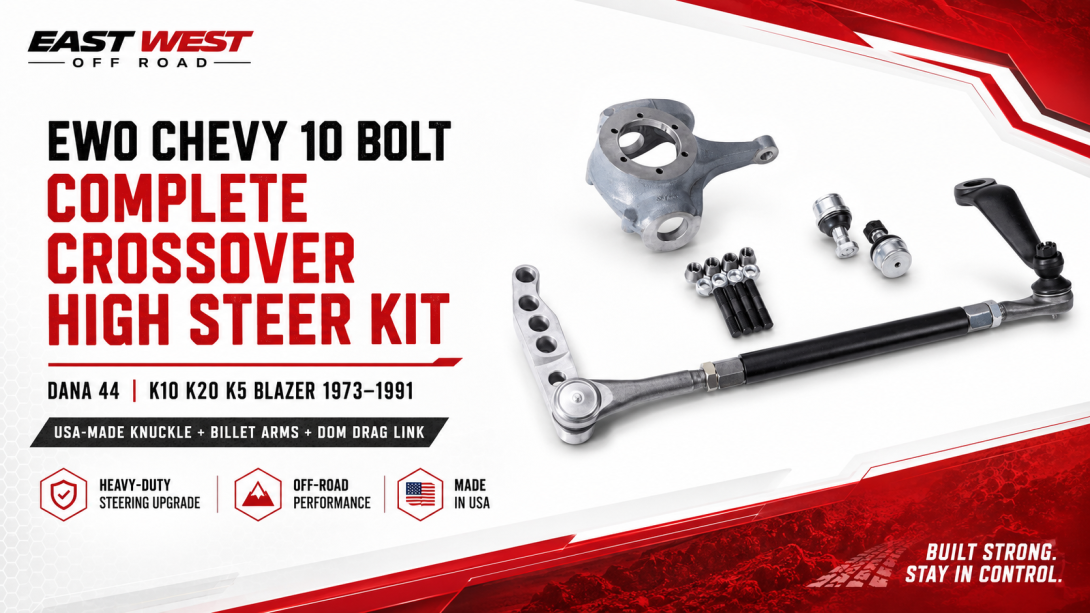
Buy Now : https://www.eastwestoffroad.com/product/ewo-chevy-10-bolt-complete-crossover-high-steer-kit
Most steering conversations focus on drag links and pitman arms, but the component that anchors everything is the knuckle. The Dana 44 steering knuckle carries the ball joints, locates the steering arm, and provides the tapered connections your linkage bolts into. Understanding it clarifies why high-steer setups are designed the way they are. This guide breaks down the knuckle's role, how a flat-top design changes things, and how tapered connections work.
What the Steering Knuckle Does
The steering knuckle is the pivoting component at the end of the axle that the wheel hub mounts to. It pivots on the ball joints and is what actually turns when you steer.
Its core jobs:
- Carry the upper and lower ball joints.
- Provide the mounting point for the steering arm.
- Transfer steering forces from the linkage into the wheel.
- Locate the hub and braking components.
Because so much converges here, the knuckle's design dictates what kind of steering setup is possible.
Ball Joints and the Knuckle
The knuckle rides on the ball joints, which allow it to pivot. The EWO kit includes metal-on-metal upper and lower ball joints as part of the complete system.
Ball-joint condition is critical to steering feel — worn joints introduce slop that degrades handling and can amplify bump steer. When evaluating any steering issue, the ball joints at the knuckle are one of the first things to check.
Conventional vs Flat-Top Design
A conventional Dana 44 knuckle isn't set up to mount a steering arm on top. A flat-top knuckle adds a machined flat surface up top designed to accept a high-steer arm.
That flat surface is what makes over-the-knuckle steering possible:
- The steering arm bolts to the top of the knuckle.
- The drag-link connection relocates above the knuckle.
- The linkage rises for clearance and can run flatter.
The USA-made steering knuckle in this kit is designed for that high-steer arrangement, giving you a proper foundation for a crossover setup.
Steering-Arm Location
Where the steering arm sits on the knuckle determines your drag-link connection point — and therefore the height and angle at which the drag link runs. That's why the knuckle and arm are designed together.
This kit's 1.25-inch billet high-steer arm mounts to the knuckle with four Dana 9/16-inch studs, four conical washers, and four lock nuts. The lifetime warranty applies to the steering arm. The arm's location on the knuckle is a geometry decision, not just a mounting task.
Tapered Connections Explained
Steering connections use tapered studs seated into tapered bores — a design that self-centers and locks under load when properly torqued.
On this knuckle:
- It ships with a bottom-up taper.
- A slit tapered insert permits an alternative bottom-down orientation when the build suits it.
Taper orientation matters because it affects how your ends seat and how the drag link routes. The conical washers in the kit work with the studs to properly seat the arm. Correctly seated tapers are essential to reliable steering.
Why Knuckle Design Drives the Whole System
Knuckle Feature
Effect on the Steering System
Ball-joint mounts
Enable pivoting; condition affects feel
Flat-top surface
Enables high-steer arm mounting
Steering-arm location
Sets drag-link height and angle
Taper orientation
Affects end seating and link routing
Load transfer
Feeds steering forces into the wheel
The Knuckle Doesn't Work Alone
Even with the right knuckle, the system needs the correct steering box. A conventional crossover conversion requires a compatible 2WD Saginaw-style steering box; the factory 4WD box is not suitable, because the pitman arm has to sweep the drag link in the correct plane. The included indexable 3-inch drop-forged 32-spline pitman arm and the D.O.M. drag link with ES2026R and ES2027L ends complete the connection from box to knuckle.
Conclusion
The Dana 44 steering knuckle is the anchor of your front steering — it carries the ball joints, locates the steering arm, and provides the tapered connections your linkage relies on. A flat-top design is what makes high steer possible, arm location drives your drag-link geometry, and correctly seated tapers keep it all reliable. Understand the knuckle and the rest of a crossover system makes sense as a set of decisions built on that foundation.
CTA: When you're evaluating a high-steer setup, start at the knuckle — confirm it's built for high steer, decide your taper orientation, and understand how the arm location sets your drag-link geometry. Then confirm a compatible 2WD Saginaw-style box and review how the knuckle, arm, and linkage are matched on the EWO product page.
FAQs
What does the steering knuckle actually do?
It's the pivoting component at the end of the axle that the wheel hub mounts to. It rides on the upper and lower ball joints, provides the mounting point for the steering arm, and transfers steering forces from the linkage into the wheel. Because the ball joints, steering arm, and hub all converge on the knuckle, its design determines what kind of steering setup is possible.
Why is a flat-top knuckle needed for high steer?
Because a conventional knuckle isn't set up to mount a steering arm on top. A flat-top knuckle adds a machined flat surface up top designed to accept a high-steer arm, which relocates the drag-link connection above the knuckle. That relocation is the whole basis of over-the-knuckle steering — raising the linkage for clearance and allowing a flatter drag link.
How do tapered connections work?
Steering uses tapered studs seated into tapered bores. The taper self-centers and locks under load when properly torqued, with conical washers helping seat the connection. This knuckle ships with a bottom-up taper, and a slit tapered insert allows a bottom-down orientation when the build suits it. Correctly seated tapers are essential to reliable, safe steering.
Does the knuckle affect bump steer?
Indirectly, yes. The knuckle locates the steering arm, which sets your drag-link connection point and therefore the drag-link angle — and drag-link angle is central to geometry-related bump steer. Worn ball joints on the knuckle also introduce slop that can amplify bump steer. So while the knuckle isn't the whole story, its design and condition matter to steering behavior.
Does the kit include the ball joints for the knuckle?
Yes. The kit includes metal-on-metal upper and lower ball joints along with the USA-made knuckle, the billet high-steer arm, mounting studs, conical washers, lock nuts, the D.O.M. drag link with ES2026R and ES2027L ends, weld bungs, jam nuts, and an indexable 3-inch drop-forged 32-spline pitman arm.