

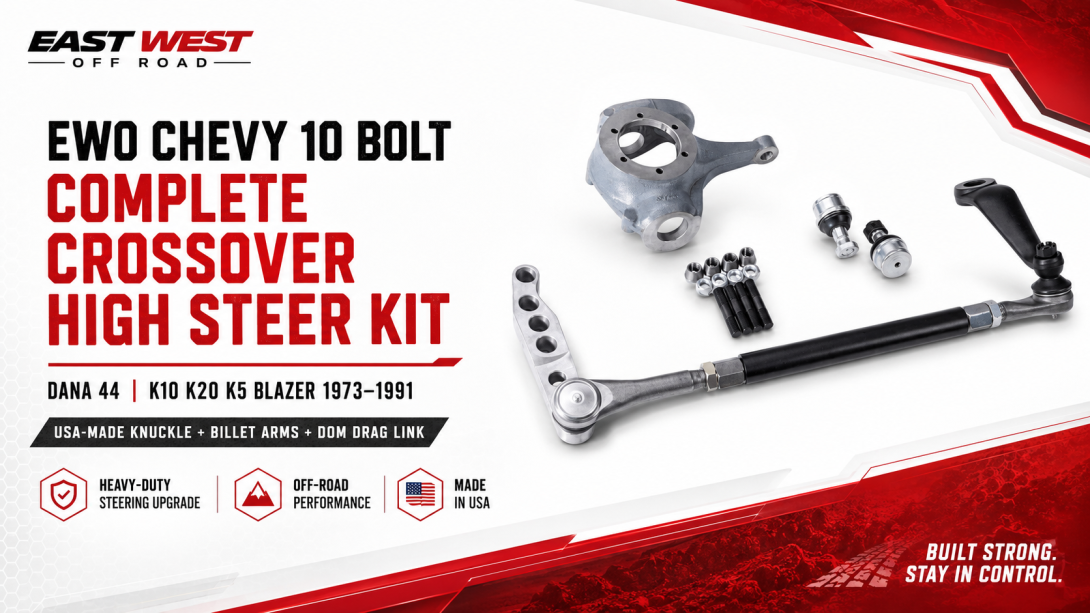
Buy Now : https://www.eastwestoffroad.com/product/ewo-chevy-10-bolt-complete-crossover-high-steer-kit
The high-steer arm looks like a simple chunk of metal bolted to the top of the knuckle, but it's one of the most important parts in a crossover steering system. Dana 44 high steer arms set your drag-link connection point, carry serious steering loads, and depend on correct installation to stay reliable. Skimp on the arm or its installation and you undermine the whole conversion. Here's what to understand about the arm's design, hardware, and setup.
What the High-Steer Arm Does
The high-steer arm mounts to the flat top of the knuckle and provides the connection point for the drag link in a crossover setup. That role means it:
- Locates the drag-link connection above the knuckle.
- Sets the height and angle of the drag link.
- Transfers steering loads between the linkage and the knuckle.
Because it defines your drag-link geometry, the arm is a geometry component as much as a structural one.
Billet Construction
Material and manufacturing matter for a part that carries steering loads. This kit's high-steer arm is:
- 1.25 inches thick.
- Precision-machined in-house from domestic billet material.
Billet construction, machined from solid stock, is a common choice for high-steer arms because of its consistency and strength characteristics under load. The arm also carries a lifetime warranty — and importantly, that lifetime warranty applies to the steering arm specifically, not the entire kit.
The Mounting Hardware
An arm is only as good as its attachment to the knuckle. This kit mounts the arm with:
- Four high-strength Dana 9/16-inch studs.
- Four conical washers.
- Four lock nuts.
Each piece has a job. The studs provide the fastening, the conical washers help properly seat the arm against the knuckle's tapered features, and the lock nuts secure everything. Using the supplied hardware as intended is part of a reliable installation.
Why Conical Washers Matter
Conical washers aren't generic hardware — they're shaped to seat correctly with the tapered stud connections, helping the arm mate properly to the knuckle. Proper seating is what keeps the connection tight and reliable under steering loads, so the washers are a functional part of the joint, not just spacers.
Taper Orientation and the Arm
The arm mounts to a knuckle that ships with a bottom-up taper, with a slit tapered insert allowing a bottom-down orientation when the build calls for it. That taper orientation affects how the arm and ends seat and how the drag link routes.
Deciding taper direction is part of setting up the arm and the drag-link geometry together — it's not an afterthought once the arm is bolted on.
Why Proper Installation Is Non-Negotiable
The arm carries steering loads, so installation quality directly affects safety and reliability. Proper installation means:
- Using the supplied studs, conical washers, and lock nuts as intended.
- Seating the tapers correctly.
- Following correct torque practices for your setup.
- Verifying the arm is properly mated to the knuckle.
A poorly installed arm can compromise steering. This is not a part to rush or improvise on. When in doubt, professional installation is worth considering.
Arm Design and Installation Factors
Factor
Why It Matters
Billet construction
Strength and consistency under load
Thickness (1.25 in)
Structural substance for steering loads
Studs (9/16 in)
High-strength fastening to the knuckle
Conical washers
Proper seating with tapered connections
Lock nuts
Secure retention
Taper orientation
Affects seating and drag-link routing
Installation quality
Directly affects safety and reliability
The Arm Connects to the Whole System
The arm is one piece of a system. The drag link (43-inch D.O.M., 1.50-inch OD, 0.250-inch wall) connects to it via ES2026R and ES2027L ends, and the drag link runs to a dropped pitman arm on a compatible 2WD Saginaw-style steering box. Remember that the factory 4WD box is not suitable for a conventional crossover install, because the pitman arm has to sweep the drag link in the correct plane. The arm's position and the box together define your steering geometry.
Conclusion
Dana 44 high steer arms do far more than bolt to a knuckle — they set your drag-link geometry and carry real steering loads. Billet construction gives the arm its strength, the studs, conical washers, and lock nuts create a reliable connection, and taper orientation ties it into the rest of the geometry. Above all, proper installation is non-negotiable. Get the arm right, mounted correctly with its intended hardware, and it becomes a dependable foundation for your crossover steering.
CTA: Treat high-steer arm installation as a precision job, not a quick bolt-on: use the supplied studs, conical washers, and lock nuts as intended, seat the tapers correctly, and decide your taper orientation deliberately. If you're not equipped to do it precisely, consider professional installation. Review the arm and hardware details on the EWO product page before you begin.
FAQs
What makes the high-steer arm important?
It provides the drag-link connection point in a crossover setup, which sets the height and angle of your drag link and transfers steering loads between the linkage and the knuckle. Because it defines your drag-link geometry and carries real loads, the arm is both a geometry component and a structural one — not just a bracket bolted to the knuckle.
Why does the kit use conical washers?
Conical washers are shaped to seat correctly with the tapered stud connections, helping the arm mate properly to the knuckle. That proper seating keeps the connection tight and reliable under steering loads. They're a functional part of the joint rather than generic spacers, which is why the kit specifies them alongside the studs and lock nuts.
Is the lifetime warranty on the whole arm assembly or the kit?
According to the supplied product information, the lifetime warranty applies to the steering arm specifically, not the entire kit. The other components are part of the complete system but aren't covered by that same lifetime warranty. Always verify current warranty terms on the product listing before purchase so you know exactly what's covered.
How important is installation on a high-steer arm?
Critical. The arm carries steering loads, so installation quality directly affects safety and reliability. Use the supplied studs, conical washers, and lock nuts as intended, seat the tapers correctly, follow proper torque practices, and verify the arm is properly mated to the knuckle. A poorly installed arm can compromise steering — this is not a part to rush or improvise on.
Does taper orientation affect the arm installation?
Yes. The knuckle ships with a bottom-up taper, and a slit tapered insert allows a bottom-down orientation when the build suits it. That orientation affects how the arm and ends seat and how the drag link routes. Deciding taper direction is part of setting up the arm and the drag-link geometry together, so plan it before finalizing the installation.