

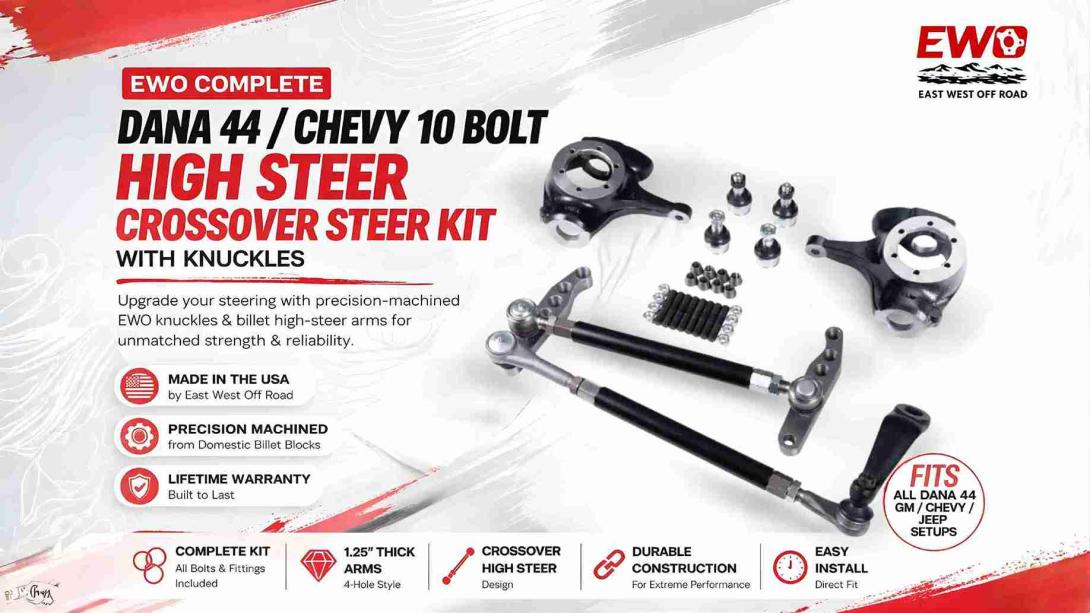
A high steer setup uses two flat top knuckles, one on each side of the axle, and they don't do exactly the same job. Understanding what the driver and passenger knuckles each contribute helps you see why a matched pair matters and how they support a crossover steering configuration. This article breaks down the distinct roles of each knuckle, explains how they work together to carry the linkage, and covers the fitment considerations that come with a two-knuckle high steer conversion on a Dana 44 front axle.
Why Two Knuckles, Not One
Steering a solid axle requires connecting the steering box to the wheels and tying both wheels together. That takes mounting points on both sides of the axle, which is why a high steer conversion uses two flat top knuckles.
Each knuckle provides the flat, machined surface that its high steer arm bolts to. Together, they establish the raised mounting points that define the crossover layout. For the conversion background, see the flat top knuckle conversion.
The Driver-Side Knuckle's Role
The driver-side knuckle is where the steering input arrives. Its high steer arm connects to the drag link, which runs from the pitman arm.
That makes the driver side the point where the steering box's motion enters the axle. When you turn the wheel, the drag link pushes or pulls on the driver-side arm, and the knuckle turns the wheel. This side handles the primary steering input.
The Passenger-Side Knuckle's Role
The passenger-side knuckle ties into the tie rod, which connects across to the driver side. Its job is to keep the passenger wheel moving in concert with the driver wheel.
When the driver side turns, the tie rod transmits that motion to the passenger side so both wheels steer together. The passenger knuckle's arm carries the tie rod end that completes this connection across the axle.
How the Pair Supports Crossover Steering
Together, the two knuckles establish the geometry that crossover steering depends on. One carries the drag link, the other anchors the far end of the tie rod, and both raise the linkage to the high-mount position.
Knuckle
Primary connection
Function
Driver-side
Drag link (ES2026R / ES2027L ends)
Receives steering input from the pitman arm
Passenger-side
Tie rod (ES2234L / ES2234R ends)
Keeps both wheels turning together
High steer placement on both knuckles is designed to improve steering-component clearance by raising the linkage. The matched EWO driver and passenger knuckles keep this geometry consistent across the axle.
Why a Matched Pair Matters
Because the knuckles establish the mounting points for the whole system, using a matched pair keeps the geometry consistent. Both knuckles come from the same coordinated design in this kit, so the arm fitment and linkage angles line up.
Sourcing knuckles separately risks mismatched dimensions between the two sides, which can compromise fitment and geometry. A matched pair removes that risk. The broader benefit of a matched kit is covered in a matched high steer kit with knuckles.
Fitment and Installation Considerations
Both knuckles rely on the upper and lower Dana 44 ball joints included in the kit, which must be pressed and set correctly. The arms then bolt to the knuckles and carry the linkage ends.
Because ball joint fitment and steering assembly affect safety, professional installation and a final alignment are recommended. You can see how the knuckles integrate on the Dana 44 flat top knuckle steering kit page.
Frequently Asked Questions
Do the driver and passenger knuckles do the same thing?
No. The driver-side knuckle receives steering input through the drag link, which runs from the pitman arm, making it the point where the steering box's motion enters the axle. The passenger-side knuckle ties into the tie rod that connects across the axle, keeping both wheels turning together. They play complementary roles rather than identical ones, which is part of why a matched pair matters for consistent geometry across the axle.
Can I use just one flat top knuckle?
A functional high steer crossover setup uses both knuckles, since you need mounting points on both sides of the axle, one for the drag link and one for the tie rod. Using only one knuckle wouldn't provide the raised mounting point needed on the other side. This kit supplies both driver and passenger flat top knuckles for that reason, establishing the complete raised geometry the crossover layout depends on across the full width of the axle.
Why do both knuckles need to match?
Because the knuckles establish the mounting points for the entire steering system, matched knuckles keep the arm fitment and linkage geometry consistent across the axle. Sourcing them separately risks dimensional mismatches between the two sides that can compromise fitment and geometry. This kit provides both knuckles from the same coordinated design, so the driver and passenger sides work together as intended, removing the uncertainty of pairing knuckles from different sources.
What connects to the driver-side knuckle?
The driver-side knuckle's high steer arm connects to the drag link, which uses the ES2026R and ES2027L ends and runs from the pitman arm. This is the path that carries steering input from the box into the axle. When you turn the wheel, the drag link acts on the driver-side arm to turn the wheel. The driver side handles the primary steering input, while the tie rod links the motion across to the passenger side.
Do both knuckles use the same ball joints?
Both knuckles rely on the upper and lower Dana 44 ball joints included in the kit to pivot on the axle. The ball joints must be pressed and set correctly on each knuckle for proper steering feel and safety. Because pressing and setting ball joints requires the right tools and technique, it's a good task for a shop if you lack the equipment. Correct ball joint fitment on both knuckles is important for safe, precise steering.
Two Knuckles, One System
The driver and passenger flat top knuckles play complementary roles, one receiving steering input through the drag link, the other tying the wheels together through the tie rod, and together they establish the raised geometry crossover steering depends on. A matched pair keeps that geometry consistent across the axle. When you're ready to build with coordinated knuckles and arms, take a closer look at the EWO Dana 44 crossover high steer kit and confirm fitment for your axle.