

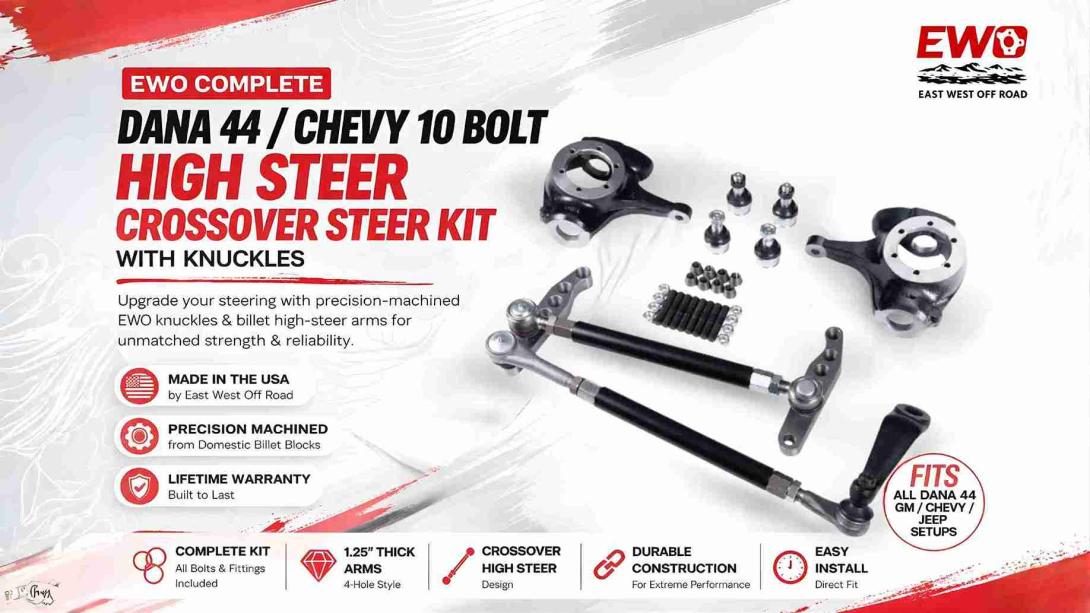
In a crossover conversion, the two knuckles aren't a matching left-and-right of the same part doing the same job. The Dana 44 driver and passenger flat top knuckles play distinct roles, and understanding that distinction clarifies why a conversion supplies both as a matched pair. One side anchors the steering input from the drag link; both tie together through the tie rod up high. This article breaks down what each knuckle does, why they must work as a set, and how the pair supports a proper high steer configuration.
Why Do You Need Both Flat Top Knuckles?
You need both flat top knuckles because a crossover steering system connects to both front wheels, and each knuckle provides the raised mounting surface a high steer arm requires. The driver side typically carries the steering-side arm the drag link connects to, while both knuckles are linked together up high by the tie rod—so the geometry only works when both are converted to flat tops.
Converting only one side would leave the other without a proper high mounting point, breaking the geometry the conversion is meant to establish.
The Driver-Side Knuckle's Role
The driver-side knuckle usually carries the steering-side high steer arm—the arm the drag link connects to as it crosses from the dropped pitman arm. That makes the driver side the point where steering input from the box enters the front axle. Its arm placement and the flat top surface that sets it are central to how the drag link angle works out.
Because this side receives the steering input, its geometry has to be right for the drag link to work at intended angles through travel. That's part of the flat top knuckle conversion explained in more detail elsewhere.
The Passenger-Side Knuckle's Role
The passenger-side knuckle carries the other end of the tie rod, which ties the two wheels together so they turn in coordination. While the driver side receives the input, the passenger side is what completes the connection between both wheels via the high-mounted tie rod.
Both knuckles carry flat top arms, and both arms mount the tie rod up high—the driver-side arm also handles the drag link. The result is a coordinated system where steering input reaches both wheels through matched geometry.
How the Pair Supports High Steer
Together, the two knuckles establish the raised geometry that defines high steer:
- Both provide flat top surfaces for the high steer arms
- Both raise the linkage above the axle for improved clearance
- The driver side connects the drag link from the pitman arm
- Both sides connect the tie rod up high, coordinating the wheels
That matched arrangement is why the system supplies driver- and passenger-side flat top knuckles together. Buying them as a set ensures the arm height and geometry agree on both sides—covered further in matched knuckle-and-arm systems.
Why a Matched Pair Matters
Sourcing knuckles individually or reusing mismatched pieces risks the two sides establishing different geometry. If one knuckle sets the arm at a slightly different height or angle than the other, the tie rod and drag link no longer work symmetrically, which can compromise steering behavior.
A matched pair removes that risk. When both knuckles are designed to work with the same arms and linkage, the geometry stays symmetrical and coherent. That's a core reason the Dana 44 flat top knuckle high steer kit supplies both sides together.
Fitment and Installation Considerations
Installing the knuckles is real mechanical work. Upper and lower Dana 44 ball joints must be pressed and installed so the knuckles pivot, and the high steer arms torqued onto the studs. From there, the linkage is fabricated—DOM tubing cut, 7/8-18 bungs welded, and the geometry set for your ride height. Crossover steering also requires a 2WD steering box. Verify your axle against the referenced Dana 44, K10, K20, and K5 Blazer applications from 1973–1991, then confirm your vehicle. Pressing ball joints, welding, alignment, and inspection are best handled by a capable shop.
Frequently Asked Questions
Why can't I convert just one knuckle to a flat top?
Because crossover steering connects to both front wheels, and each wheel's knuckle needs a raised mounting surface for its high steer arm. The driver side carries the steering-side arm the drag link connects to, while both knuckles link together up high through the tie rod. Converting only one side leaves the other without a proper high mounting point, which breaks the coordinated geometry the conversion is designed to create.
Are the driver and passenger knuckles the same part?
No. They're side-specific and play different roles. The driver-side knuckle typically carries the steering-side arm that receives the drag link, making it the steering input point, while the passenger side completes the tie rod connection between the wheels. Both carry flat top arms and mount the tie rod up high, but their roles differ, which is why a conversion supplies a matched driver-and-passenger pair rather than two identical parts.
What happens if the two knuckles set different arm heights?
If the knuckles establish different arm heights or angles, the tie rod and drag link no longer work symmetrically, which can compromise steering behavior and reintroduce geometry problems. That's the risk of mixing mismatched knuckles. A matched pair designed to work with the same arms and linkage keeps the geometry symmetrical on both sides, which is essential for the steering to behave predictably through suspension travel.
Do both knuckles need ball joints?
Yes. Both knuckles pivot on upper and lower ball joints, so a complete conversion includes Dana 44 ball joints for both sides. Pressing and seating ball joints is precise work that affects how the knuckles pivot and hold alignment. If you're not equipped to press ball joints properly, have a shop handle that part of the installation for both knuckles as part of the overall conversion.
How do the knuckles affect steering clearance?
Both flat top knuckles raise the steering arm mounting point above the axle, which lifts the drag link and tie rod up and away from terrain. That relocation is what improves clearance compared with factory-height linkage. Because both sides are raised, the entire linkage sits higher, keeping it tucked away from rocks and obstacles—one of the primary benefits of a crossover high steer conversion on a lifted truck.
A Coordinated Pair
The Dana 44 driver and passenger flat top knuckles aren't interchangeable—the driver side receives the steering input, both sides coordinate the wheels through the high-mounted tie rod, and together they establish the raised geometry that defines high steer. Supplying them as a matched pair keeps that geometry symmetrical and coherent. When you want both knuckles designed to work together from the start, the Dana 44 flat top knuckle kit supplies the matched pair as part of a complete system.