

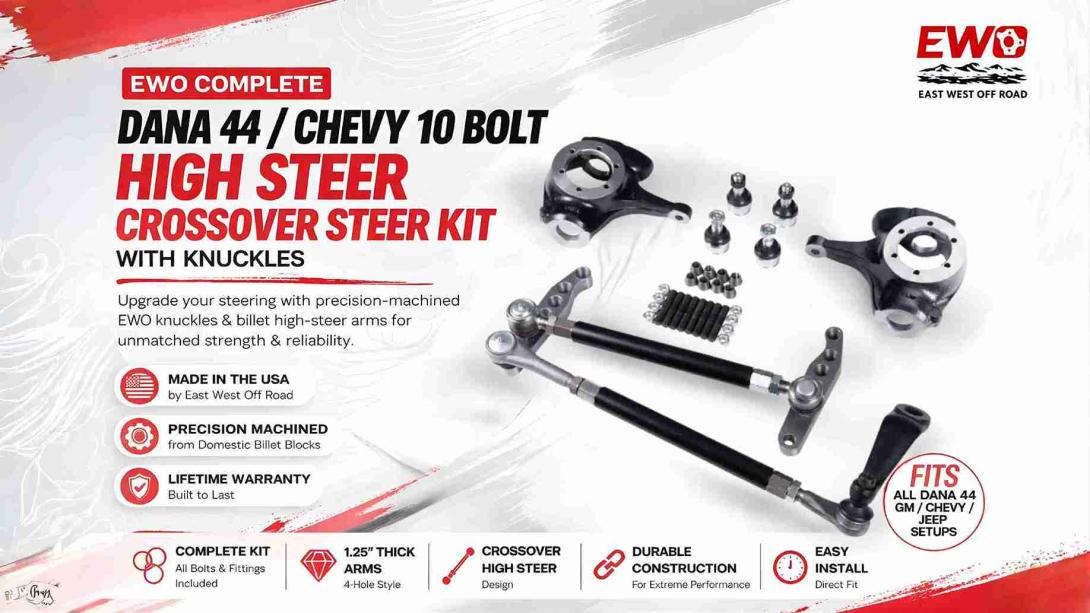
Building a vehicle capable of surviving extreme off-road abuse requires a fundamental shift in how you evaluate automotive parts. When you transition from dirt roads to vertical rock ledges or wide-open custom buggy terrain, standard factory components quickly become dangerous liabilities. One of the most heavily stressed pivot points on any solid-axle 4x4 is the steering arm. It is the direct link between the hydraulic force of your steering box and the knuckles holding your massive tires. To survive the leverage of bound-up, oversized tires, off-road fabricators consider 1.25-inch billet high steer arms to be the absolute gold standard. This article explores the engineering, material science, and practical applications that make these massive arms essential for heavy-duty off-road steering systems.
The Leverage Problem in High Steer Setups
Understanding high steer versus crossover steering is important when discussing arm thickness. A high steer setup physically relocates both the drag link and the tie rod to the top of the steering knuckles. This high steer placement is expressly designed to improve steering-component clearance, keeping your vital linkage safe from trail obstacles.
However, moving the steering linkage upward creates a new mechanical challenge: increased leverage. The factory steering arms sit low, close to the ball joints. High steer arms are mounted to the top of the knuckles. When you push and pull against an arm mounted at the very top of the knuckle, you apply significantly more twisting force to the mounting studs and the arm itself. If you are wedged in a rut and forcefully turn the wheel, a weak steering arm will shear off its mounting studs or snap in half.
Why Cast Arms Fail on the Trail
Many budget steering kits utilize cast iron or cast steel steering arms. Casting involves pouring molten metal into a mold. While this process is cheap and effective for daily drivers, it is highly problematic for rock crawlers and high-horsepower rock bouncers.
As molten metal cools in a mold, it can develop microscopic air pockets, impurities, or inconsistencies in its grain structure. Under normal driving conditions, these flaws go unnoticed. However, under the sudden, violent shock loads of off-road driving—such as the front tires slamming down after a jump or binding against a rock face—these microscopic flaws become fracture points. Cast arms do not bend; they shatter, instantly severing your steering control.
The Billet Block Advantage
To eliminate the risk of shattering, premium steering components rely on billet construction. USA-made Dana 44 steering components are typically CNC-machined out of solid blocks of extruded or forged steel or aluminum.
Because the billet block is never melted and poured into a shape, its grain structure remains highly dense, uniform, and continuous. When subjected to extreme lateral forces, a billet arm possesses incredible tensile strength. If pushed beyond its physical limits, a billet arm is far more likely to deform or bend slightly rather than catastrophically snapping, which is a crucial safety factor deep in the backcountry.
The Significance of 1.25-Inch Thickness
Material quality must be matched with adequate material volume. The thickness of the steering arm dictates its resistance to flexing and twisting.
A thickness of 1.25 inches is widely regarded as the sweet spot for heavy-duty off-road steering setups. This massive cross-section of solid metal provides unparalleled rigidity. Furthermore, this thickness is functionally necessary to accommodate heavy-duty 1-ton steering ends. The arms must be deep enough to allow a precision-machined taper for the 7/8-inch Chevy 3/4-ton-style tie rod and drag link ends to seat fully and securely. A thinner arm would lack the depth required for a proper, safe taper engagement.
Integration with Flat Top Knuckles
A 1.25-inch billet high steer arm is only as strong as its foundation. These arms are designed to bolt directly onto EWO driver-side and passenger-side flat top knuckles.
These precision-machined knuckles feature a perfectly flat upper surface that mates flawlessly with the bottom of the billet arms. The arms are secured utilizing a specific 4-hole pattern. Heavy-duty Dana 44 studs, paired with conical washers and lock nuts, are used to clamp the arms to the knuckles. The conical washers are specifically designed to wedge themselves into the arm, preventing the studs from loosening under the intense vibration and torque of off-road driving.
Fitment and Installation Considerations
Upgrading to massive billet arms is a comprehensive endeavor. The arms are part of a correctly configured crossover steering system designed to improve steering geometry and reduce bump steer.
Installing these arms requires tearing down your outer axle assemblies to install the necessary flat top knuckles and fresh upper and lower Dana 44 ball joints. You must also source a 2WD steering box, as the factory 4WD box cannot operate the crossover drag link. The heavy-duty 54-inch and 43-inch DOM tubing provided in the kit will require custom measuring, cutting, and professional welding of the 7/8-18 weld bungs.
Conclusion
When building a rig designed to conquer the harshest environments on earth, compromising on steering components is a gamble you cannot afford to take. The steering arms are the critical link in your front-end geometry, bearing the full brunt of your vehicle's turning force. By upgrading to 1.25-inch billet high steer arms, you eliminate the threat of cast-metal fractures and secure the immense tensile strength required for oversized tires and aggressive trails. Bulletproof your off-road build with the USA-made EWO complete high steer crossover steering system and take command of your steering today.
Frequently Asked Questions
What does "billet" mean when referring to a steering arm?
Billet refers to the manufacturing process where the steering arm is precision CNC-machined from a single, solid block of metal. This method retains a dense, continuous grain structure, resulting in a part that is significantly stronger and more fracture-resistant than cast metal.
Why is an arm thickness of 1.25 inches important?
A 1.25-inch thickness provides the massive structural rigidity required to resist twisting or bending under extreme off-road forces. It also provides enough depth to safely machine the large tapers required to seat heavy-duty 1-ton steering rod ends securely.
Will these billet arms fit my factory steering knuckles?
No. Factory steering knuckles have rounded tops and cannot accept high steer arms. These billet arms must be mounted to specially machined driver-side and passenger-side flat top knuckles, which are included in the complete EWO high steer kit.
Do I need special hardware to mount 1.25-inch billet arms?
Yes. Billet high steer arms should be secured to the flat top knuckles using high-strength Dana 44 studs, specialized conical washers, and lock nuts. This hardware ensures the arms remain tightly clamped despite severe vibration and torque.
Are these steering arms covered by a warranty?
Yes. Because they are manufactured from domestic billet blocks to the highest standards, the steering arms included in the East West Off Road complete Dana 44 high steer crossover steering kit carry a lifetime warranty.