

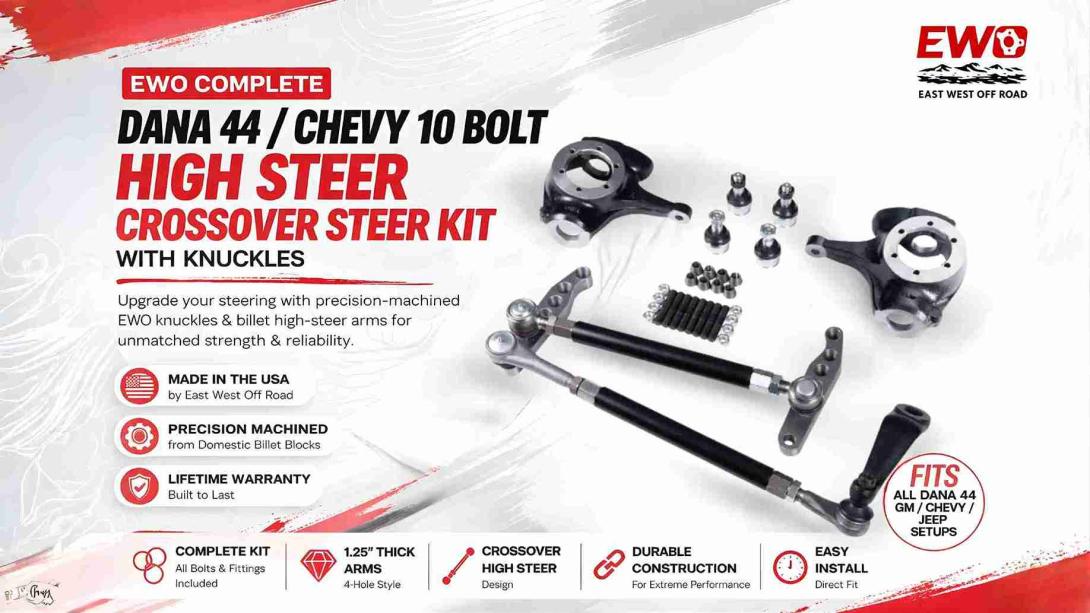
The high steer arm might look like a simple bracket, but it sits at a demanding spot in your steering system. It bolts to the knuckle, carries the linkage ends, and transmits every steering load while absorbing trail impacts. That role explains why arm construction and thickness deserve real attention. This article focuses on 1.25-inch billet high steer arms, covering how they're made, why arm thickness matters, the mounting function they perform, and how they hold up in off-road use. The aim is a clear understanding of a component that's easy to underestimate.
The Arm's Job in the Steering System
The high steer arm is the link between the knuckle and the steering linkage. It mounts on the flat top knuckle and holds the drag link or tie rod end at the raised position.
Every steering input passes through the arm, and on the trail it absorbs shock and side loads. Because it's a load-bearing part at a stress point, how well it's built directly affects steering precision and durability.
How the Arms Are Constructed
These arms are manufactured from domestic billet blocks and precision-machined in-house. Billet construction means each arm is machined from a solid block rather than cast or formed, giving tight control over the finished geometry.
In-house machining keeps the tolerances and mounting surfaces under direct control, which supports consistent fitment across the driver and passenger arms. The US manufacturing behind them is covered in US-made steering arm manufacturing.
Why Thickness Matters
The arms are 1.25 inches thick, and that dimension is functional, not cosmetic. Thickness contributes to rigidity and the arm's ability to resist deflection under load.
Construction factor
Contribution
1.25-inch thickness
Resists bending and deflection under load
Domestic billet
Consistent material for machining
In-house machining
Controlled tolerances and fitment
Lifetime warranty
Applies to the steering arms
An arm that flexes under load compromises steering precision, so substantial thickness at this stress point supports predictable steering during hard use.
The Mounting Role
The arms bolt to the flat top knuckles using the kit's Dana 44 studs, conical washers, and lock nuts. That mounting connection has to be secure, since the arm anchors the linkage.
On the other end, the arm carries the steering ends, the ES2026R and ES2027L drag link ends on the driver side and the ES2234L and ES2234R tie rod ends across the axle. The arm is effectively the bridge between the knuckle and the linkage.
Off-Road Use and Durability
In demanding conditions, the arms take repeated shock and side loads. The combination of billet construction, in-house machining, and 1.25-inch thickness targets the flex and deflection that hard use produces.
The arms carry a lifetime warranty, reflecting the confidence behind their construction. They suit rock crawling, trail rigs, overlanding builds, mud rigs, and custom off-road projects. You can see the arms as part of the complete high steer arm kit, and how they work with the linkage is covered in how the linkage components work together.
Fitment and Installation Considerations
Strong arms still require correct mounting. They bolt to the knuckles with the supplied hardware and must be torqued to your installer's specifications.
Because the arms anchor the linkage, proper mounting, alignment, and a final steering inspection matter. Confirm your axle is a Dana 44 or Chevy 10 Bolt front application before ordering, and plan the install with a qualified fabricator.
Frequently Asked Questions
Why 1.25 inches specifically?
The 1.25-inch thickness provides substantial material at a steering stress point, contributing to rigidity and the arm's ability to resist deflection under load. An arm that flexes compromises steering precision, so thickness matters for predictable steering during hard off-road use. Thickness is one factor alongside material and machining quality, but it's a meaningful one for a load-bearing part. The combination of 1.25-inch thickness and domestic billet construction targets the flex that trail loads produce.
What does machining the arms in-house achieve?
In-house machining keeps the tolerances, mounting holes, and surfaces under direct control rather than outsourced. That control supports consistent fitment across the driver and passenger arms, so each mates cleanly with its flat top knuckle and carries the steering ends correctly. For a safety-relevant steering part, controlled machining matters. Combined with domestic billet material, in-house machining produces arms whose dimensions are cut to spec rather than inherited from a mold or a third-party process.
How do the arms attach to the knuckles?
The arms bolt to the flat top knuckles using the kit's Dana 44 studs, conical washers, and lock nuts. That connection must be secure and torqued to your installer's specifications, since the arm anchors the linkage. The arm bridges the knuckle and the steering linkage, so a solid mounting connection is essential for steering precision and safety. Proper installation of this connection, followed by alignment and inspection, is part of a correct high steer build.
Do thicker arms make steering feel heavier?
Arm thickness primarily affects rigidity and load resistance rather than steering effort. Well-built arms support consistent steering feel by resisting flex, not by making steering harsh. Steering effort is influenced more by factors like the steering box, tire choice, and alignment. The 1.25-inch arms are aimed at holding geometry under load, which supports predictable response. Correct installation and alignment matter as much as construction for how the finished system feels.
Are billet arms worth it over cast alternatives?
Billet construction machines each arm from a solid block, giving tight control over geometry and consistent material, which matters for a load-bearing steering part. Whether it's worth it depends on your priorities and how hard you use your truck, but many builders value the precision and durability billet offers at a steering stress point. These billet arms also carry a lifetime warranty, reflecting the confidence behind their construction, which factors into the value for demanding off-road builds.
A Component Worth Understanding
The 1.25-inch billet high steer arm anchors your linkage at a demanding stress point, so its domestic billet construction, in-house machining, and functional thickness genuinely matter. Understanding what goes into the arm makes it easier to appreciate why construction quality affects steering precision and durability. When you're ready to build with arms designed for hard use, take a closer look at the EWO high steer crossover kit and confirm fitment for your axle.