

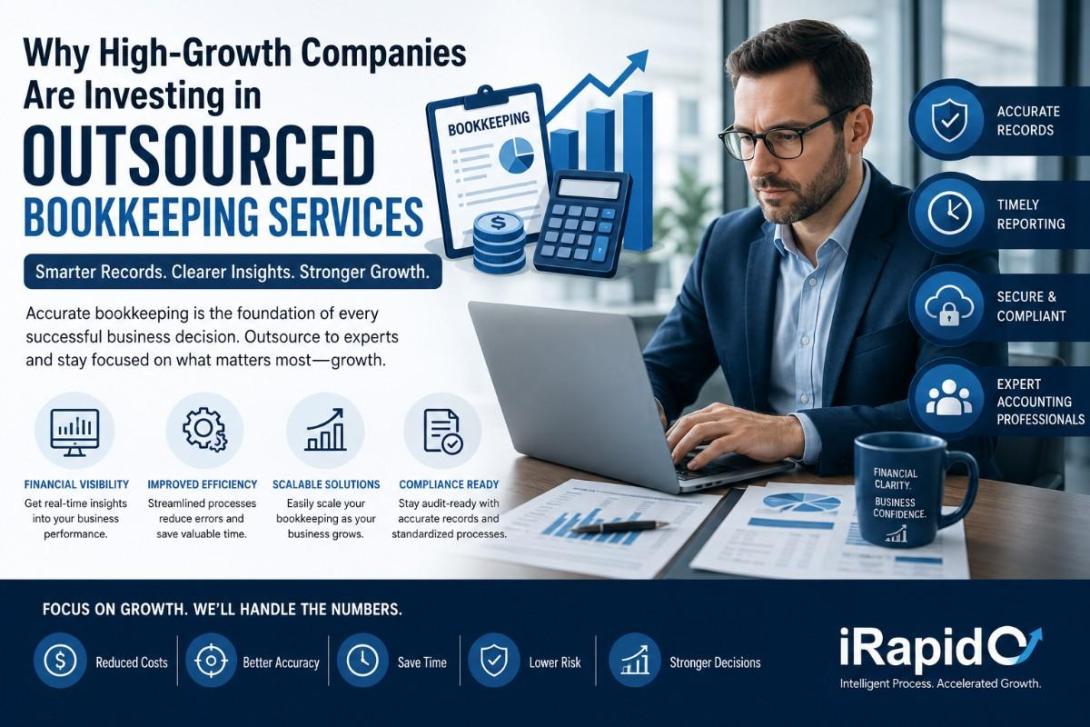
Business growth creates opportunities, but it also introduces financial complexity. As organizations expand into new markets, increase transaction volumes, onboard additional employees, or manage multiple business entities, maintaining accurate financial records becomes significantly more demanding. Finance leaders require timely information, reliable reporting, and standardized financial processes to support strategic decision-making.
Many growing organizations discover that traditional bookkeeping methods are no longer sufficient to meet evolving business requirements. Manual data entry, disconnected systems, delayed reconciliations, and increasing compliance responsibilities can reduce operational efficiency and limit financial visibility.
To address these challenges, businesses are increasingly adopting outsourced bookkeeping services as part of a modern finance strategy. Rather than treating bookkeeping as an administrative function, organizations are recognizing it as a critical business process that supports forecasting, compliance, cash flow management, and executive reporting.
Companies partnering with iRapidO gain access to experienced finance professionals, standardized processes, and technology-enabled bookkeeping solutions that help build a stronger financial foundation for long-term growth.
Why Bookkeeping Has Become a Strategic Business Function
Bookkeeping serves as the foundation for every financial decision an organization makes. Every invoice, payment, expense, payroll entry, and bank transaction contributes to the overall financial health of the business.
When bookkeeping processes lack consistency, the effects extend throughout the organization. Management reports become less reliable, audits require additional effort, forecasting loses accuracy, and financial planning becomes increasingly difficult.
Modern organizations depend on accurate bookkeeping to support:
- Financial reporting
- Budget management
- Tax preparation
- Cash flow monitoring
- Business forecasting
- Investor reporting
- Regulatory compliance
- Executive decision-making
Accurate bookkeeping enables finance teams to spend less time correcting errors and more time delivering valuable business insights.
The Challenges of Managing Bookkeeping Internally
Many organizations initially manage bookkeeping with internal resources. While this approach may work during the early stages of business growth, increasing operational complexity often exposes limitations.
Common challenges include:
- Rising transaction volumes
- Manual reconciliation processes
- Employee turnover
- Inconsistent financial documentation
- Delayed month-end closing
- Limited process standardization
- Increasing compliance obligations
- Difficulty scaling finance operations
These issues consume valuable management time while increasing operational risk.
Rather than continuously expanding internal accounting teams, many organizations are adopting scalable operating models that improve efficiency without compromising financial control.
How Outsourced Bookkeeping Services Improve Financial Operations
Professional outsourced bookkeeping services provide organizations with experienced accounting professionals who manage day-to-day financial recording using standardized processes and modern financial technologies.
These services commonly include:
- Accounts payable recording
- Accounts receivable management
- Bank reconciliation
- General ledger maintenance
- Expense tracking
- Journal entries
- Financial data organization
- Month-end bookkeeping support
By outsourcing routine bookkeeping responsibilities, finance leaders can devote greater attention to business planning, profitability analysis, and strategic initiatives.
Better Financial Visibility Supports Better Leadership Decisions
Executive teams require financial information that is both accurate and timely.
When bookkeeping records remain current, organizations gain immediate visibility into operational performance.
Leadership teams can evaluate:
- Revenue trends
- Operating expenses
- Cash position
- Outstanding receivables
- Vendor obligations
- Departmental spending
- Profit margins
- Working capital
Access to reliable financial information enables faster responses to market opportunities while reducing uncertainty during strategic planning.
Standardized Processes Improve Financial Accuracy
Consistency is essential in financial operations.
Professional bookkeeping providers establish structured workflows that reduce manual errors while improving documentation quality.
Standardized bookkeeping procedures typically include:
- Transaction verification
- Documentation controls
- Scheduled reconciliations
- Review checkpoints
- Quality assurance processes
- Approval workflows
- Financial record maintenance
These practices help organizations produce dependable financial records that support audits, compliance reviews, and executive reporting.
Technology Is Transforming Modern Bookkeeping
Bookkeeping has evolved considerably through digital transformation.
Cloud-based accounting platforms, intelligent automation, and AI-assisted workflows allow organizations to process financial information more efficiently than traditional manual methods.
Technology now supports:
- Automated transaction matching
- Digital invoice processing
- Intelligent expense categorization
- Cloud document management
- Real-time reporting
- Workflow automation
- Secure financial collaboration
- Continuous financial monitoring
Technology enhances productivity while allowing finance professionals to focus on activities requiring professional judgment and financial expertise.
Scalability Without Increasing Administrative Burden
Growing organizations often experience significant fluctuations in transaction volume.
Seasonal demand, acquisitions, international expansion, and business diversification all create additional bookkeeping requirements.
An outsourced bookkeeping model provides flexible operational capacity without requiring businesses to recruit, train, and manage additional accounting personnel.
This scalability enables organizations to adapt quickly as financial workloads increase.
Supporting Compliance and Audit Readiness
Financial compliance depends on accurate recordkeeping.
Organizations that maintain complete and organized financial records experience fewer challenges during audits, tax filings, regulatory reviews, and internal governance assessments.
Professional bookkeeping services help support compliance by maintaining:
- Organized transaction histories
- Supporting documentation
- Accurate reconciliations
- Financial consistency
- Record retention standards
- Internal control documentation
These practices improve organizational confidence while reducing compliance risks.
Characteristics of an Effective Bookkeeping Partner
Selecting the right bookkeeping provider requires evaluating more than pricing.
Enterprise organizations should consider several important capabilities, including:
- Industry expertise
- Qualified accounting professionals
- Data security standards
- Technology integration
- Process maturity
- Reporting capabilities
- Service scalability
- Communication transparency
- Compliance knowledge
- Continuous process improvement
A reliable bookkeeping partner should function as an extension of the organization's finance team while supporting long-term operational objectives.
The Future of Bookkeeping Is Intelligent, Digital, and Scalable
Bookkeeping continues to evolve alongside advances in automation, artificial intelligence, and cloud finance platforms.
Organizations are shifting away from reactive financial administration toward proactive financial management supported by real-time information and standardized digital processes.
Businesses that modernize bookkeeping operations gain stronger financial control, improved reporting accuracy, greater operational efficiency, and enhanced decision-making capabilities.
As financial complexity continues to increase, outsourced bookkeeping will remain an important component of enterprise finance transformation.
Conclusion
Bookkeeping is no longer simply a recordkeeping function. It has become a strategic business capability that supports operational efficiency, financial transparency, regulatory compliance, and sustainable growth.
Organizations investing in outsourced bookkeeping services are creating finance operations that are more scalable, technology-enabled, and prepared for future business demands. By leveraging experienced professionals, standardized workflows, and intelligent financial processes, businesses can strengthen financial management while allowing leadership teams to focus on strategic priorities.
Businesses looking to modernize their finance operations can partner with iRapidO to build efficient bookkeeping processes that support long-term business performance, operational excellence, and sustainable enterprise growth.