
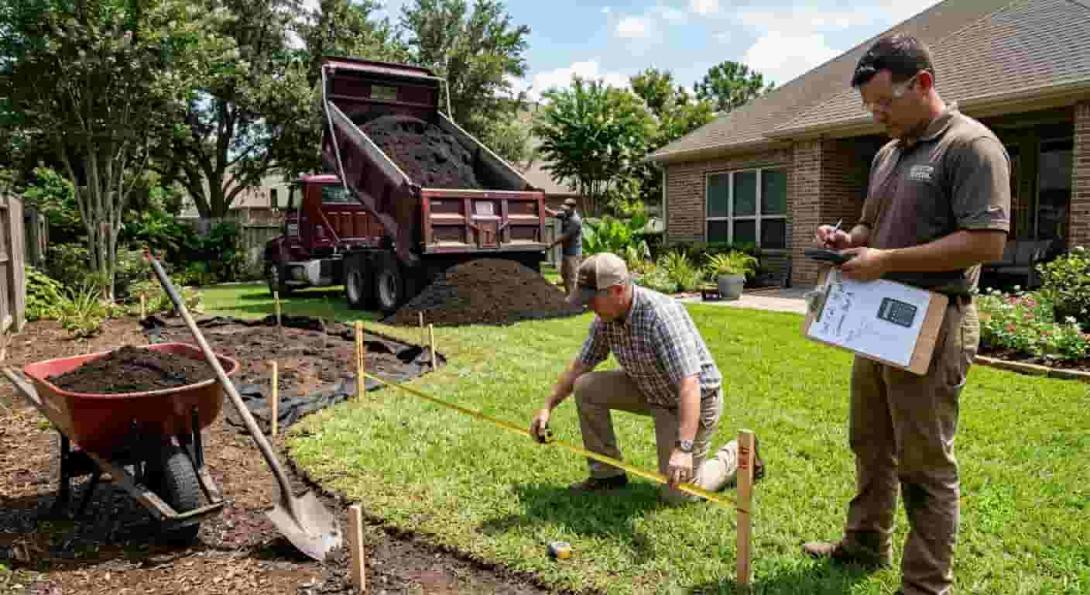
The first thing you need to know before ordering any bulk material is how to calculate cubic yards for soil delivery. Get it wrong and you either pay for soil you don’t need, or your project stalls while waiting for a second truck.
Houston homeowners deal with native, clay-heavy soils that drain poorly and compact quickly. Most landscaping and garden projects here require the import of good topsoil for any real success. However, one of the most common and costly mistakes homeowners make is ordering bulk soil without accurate measurements.
This guide gives you the exact way to calculate, real world examples from projects, and practical tips to order the right amount every time.
Why Accurate Soil Measurements Matter
Soil is sold and delivered by the cubic yard. The price per yard is fixed, but how many yards you order is entirely up to you. That means the accuracy of your measurement directly controls your project cost.
Prevent Overordering
Ordering too much soil leaves you with a pile in your driveway that you either have to move, store, or pay to have hauled away. Extra soil is not free. Every extra yard you order costs money you did not need to spend. Precise measurements keep your budget tight and your yard clean.
Avoid Multiple Deliveries
Underordering is just as costly. A second delivery means a second delivery fee on top of the material cost. It also interrupts your project timeline and can leave work half-finished for days while you wait. One accurate order gets the job done in one trip.
Save Money on Landscaping Projects
Soil volume calculations take about five minutes with a tape measure and basic math. That five minutes can save you hundreds of dollars on a mid-size project. Knowing how to calculate cubic yards for soil delivery puts you in control of the cost from the start.
What Is a Cubic Yard of Soil?
Understanding Cubic Yards
A cubic yard is a volume measurement. It equals a cube that is three feet long, three feet wide, and three feet tall. In practical terms, one cubic yard of soil fills a space of 27 cubic feet. That is the standard unit bulk suppliers use when pricing and delivering landscape materials.
Picture a large wheelbarrow. It holds roughly two to three cubic feet of soil. That means one cubic yard fills approximately nine to thirteen wheelbarrow loads. For anything beyond a very small patch, bulk delivery makes far more sense than hauling bags yourself.
Typical Coverage for Different Soil Depths
How much area one cubic yard covers depends entirely on how deep you spread it. Here are common coverage estimates:
- At one inch deep: one cubic yard covers approximately 324 square feet
- At two inches deep: one cubic yard covers approximately 162 square feet
- At three inches deep: one cubic yard covers approximately 108 square feet
- At four inches deep: one cubic yard covers approximately 81 square feet
- At six inches deep: one cubic yard covers approximately 54 square feet
Most lawn and garden projects in Houston call for two to four inches of fresh topsoil. Keep these numbers in mind as a quick reference when you start measuring your space.
Step-by-Step Guide to Calculating Cubic Yards
The formula is straightforward. You need three measurements and four simple math steps. Here is exactly how to do it.
Step 1: Measure the Length
Use a tape measure to get the length of your project area in feet. For irregular spaces, break the area into smaller rectangles and measure each section separately. You will add them together at the end.
Step 2: Measure the Width
Measure the width of the same area in feet. Write both numbers down. Length times width gives you your square footage. That is your base number for the rest of the calculation.
Step 3: Determine the Desired Depth
Decide how deep you need the soil. This depends on your project type. A lawn topdressing needs one to two inches. A new garden bed needs four to six inches. A raised bed or new construction grade fill may need eight inches or more.
Step 4: Convert Inches to Feet
Depth in the formula must be in feet, not inches. Divide your depth in inches by 12 to convert it. Three inches becomes 0.25 feet. Six inches becomes 0.5 feet. This step is the one most people skip, and it throws off the entire calculation.
Step 5: Calculate Total Cubic Feet
Multiply length (feet) by width (feet) by depth (feet). The result is your total cubic footage. Example: 20 feet by 15 feet by 0.25 feet equals 75 cubic feet.
Step 6: Convert Cubic Feet to Cubic Yards
Divide your cubic feet total by 27. There are 27 cubic feet in one cubic yard. Using the example above: 75 divided by 27 equals approximately 2.8 cubic yards. Round up to the nearest half yard to give yourself a small working buffer.
That is the complete process for how to calculate cubic yards for soil delivery. Write the formula down: (Length x Width x Depth in feet) divided by 27.
Soil Calculation Examples
Seeing the formula applied to real project types makes it much easier to use. Here are five common Houston landscaping scenarios with the math worked out.
Garden Beds
A garden bed that is 12 feet long by 6 feet wide needs four inches (0.33 feet) of topsoil. Calculation: 12 x 6 x 0.33 equals 23.8 cubic feet, divided by 27 equals 0.88 cubic yards. Order one cubic yard to cover the full bed with a little extra.
Lawn Renovation
A lawn area measuring 50 feet by 40 feet needs a two-inch (0.17 feet) topdressing to improve the surface. Calculation: 50 x 40 x 0.17 equals 340 cubic feet, divided by 27 equals 12.6 cubic yards. Order 13 cubic yards for a clean, complete coverage.
Raised Garden Beds
A raised bed frame that is 4 feet by 8 feet needs to be filled eight inches (0.67 feet) deep. Calculation: 4 x 8 x 0.67 equals 21.4 cubic feet, divided by 27 equals 0.79 cubic yards. One cubic yard fills this raised bed and gives you a small amount of extra soil.
Tree Planting Areas
A tree ring with a four-foot diameter mulch and soil zone needs three inches (0.25 feet) of fresh topsoil. The area of a circle uses pi times radius squared. Four-foot diameter means a two-foot radius: 3.14 x 2 x 2 x 0.25 equals 3.14 cubic feet. One-eighth of a cubic yard covers this comfortably. Group multiple tree rings together and order once.
New Construction Landscaping
A new build lot with a backyard area of 60 feet by 40 feet needs four inches (0.33 feet) of topsoil to establish a lawn. Calculation: 60 x 40 x 0.33 equals 792 cubic feet, divided by 27 equals 29.3 cubic yards. Order 30 cubic yards. This is exactly the kind of large project where knowing how to calculate cubic yards for soil delivery saves a significant amount of money versus guessing.
Common Mistakes When Ordering Soil
Most overordering and underordering problems come from a small set of repeat mistakes. Avoid these and your order will be accurate.
Forgetting to Convert Inches to Feet
This is the most common error. If you leave depth as inches and multiply by length and width in feet, your result will be 12 times too large. Always divide your inch depth by 12 before running the calculation. Write it as a decimal: 3 inches equals 0.25, 4 inches equals 0.33, 6 inches equals 0.5.
Ignoring Soil Compaction
Loose soil compacts after delivery and after rain. A two-inch layer of loose soil may settle down to one and a half inches once it is spread and watered. For projects where final depth matters, such as lawn grading or raised bed fills, add 10 to 15 percent to your calculated total to account for compaction loss.
Ordering Without Measuring Accurately
Eyeballing an area and guessing at square footage is a reliable way to get the wrong amount. A 30 percent error in your measurement translates directly to a 30 percent error in your order. Take five minutes to measure properly. The tape measure does all the hard work.
Should You Order Extra Soil?
When Adding a Safety Margin Makes Sense
Add 10 to 15 percent to your calculated order when the project involves compactable fill, when the area has an irregular shape that is hard to measure precisely, or when you are doing final grading work where running short mid-project would be a serious problem. It is also worth ordering a buffer on very large projects where a second delivery charge would cost more than the extra soil.
Situations Where Exact Quantities Are Sufficient
For simple, well-defined areas like rectangular raised beds or clearly bounded garden spaces, your measurement will be accurate enough without a buffer. When you are topdressing an existing lawn, a precise order keeps costs tight and avoids a leftover pile. If you are working with a reliable supplier who can do a quick same-day or next-day top-up delivery, you can order exact and top up if needed.
Benefits of Professional Soil Delivery
Once you know how to calculate cubic yards for soil delivery, you are ready to order. Professional bulk delivery takes everything from that point and makes it easy.
Convenient Bulk Delivery
A single bulk delivery drops your entire soil order at your property in one load. There are no trips to the store, no heavy bags to carry, and no renting a trailer. The material arrives ready to spread. For large Houston yards and construction sites, this is the only practical approach.
Consistent Soil Quality
Reputable suppliers like Cowboy Topsoil process and screen their topsoil to remove debris, clumps, and excessive clay content. You get a clean, workable product that spreads evenly and supports healthy plant growth. Bagged soil from retail stores varies batch to batch. Bulk supply from a consistent local source delivers the same quality every time.
Saves Labor and Transportation Costs
Hauling 10 cubic yards of bagged soil in a personal vehicle requires dozens of trips. Each bag weighs 40 pounds. The labor alone would take a full day. Bulk delivery eliminates all of that. You pay one delivery fee and spend your time spreading, not hauling.
Conclusion
Calculating cubic yards is not complicated once you know the steps. Measure length, measure width, set your depth, convert to feet, multiply, and divide by 27. That formula applies to every project, every time.
Getting your measurement right before you order protects your budget, keeps your project on schedule, and makes the delivery process as smooth as possible. Houston homeowners who take five minutes to calculate properly never end up with too much soil sitting in their driveway or too little to finish the job.
For a project of any size, working with a local supplier who knows the area makes everything easier. You get the right product, delivered on time, at a price that makes sense.
Contact Cowboy Topsoil today for fast, reliable soil delivery in Houston and get your project started with the right material from the first load.