

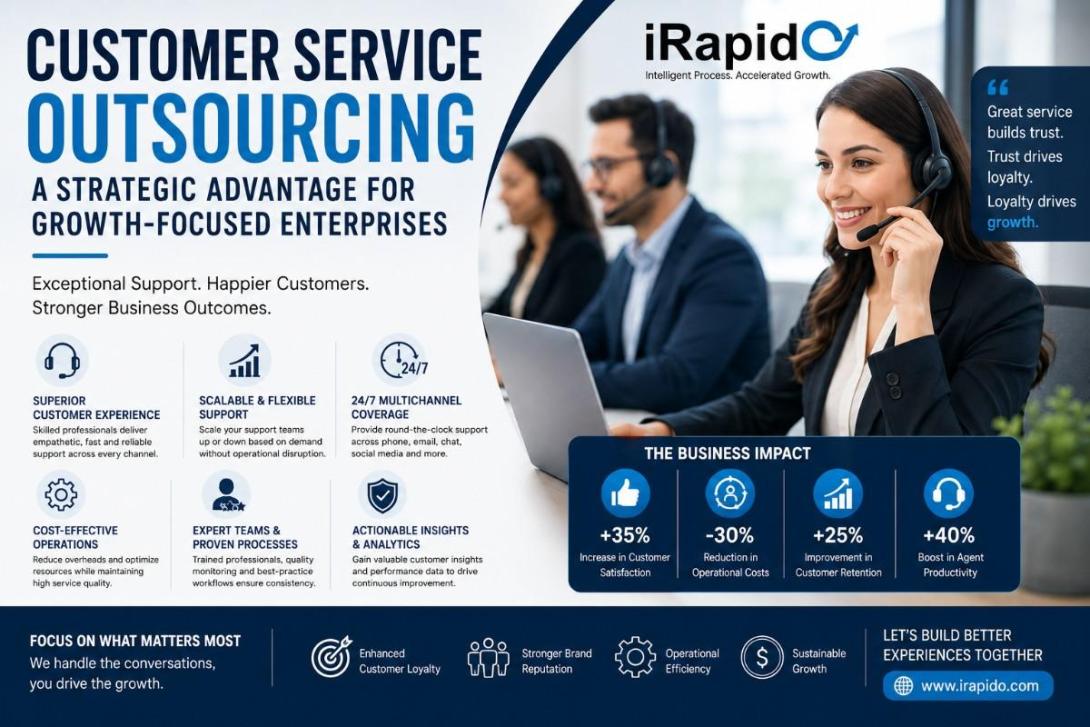
Customer experience has become one of the strongest drivers of long-term business performance. While product quality and pricing remain important, organizations increasingly compete on how effectively they engage, support, and retain customers throughout the entire customer lifecycle.
Modern customers expect immediate responses, personalized interactions, consistent communication, and seamless support across multiple channels. Meeting these expectations requires organizations to maintain highly skilled support teams, advanced technology platforms, and operational flexibility around the clock.
For many enterprises, building and scaling these capabilities internally can be expensive and resource-intensive. As a result, business leaders are increasingly adopting customer service outsourcing as a strategic operating model rather than simply a cost-saving initiative.
Organizations partnering with iRapidO are transforming customer engagement by combining experienced support professionals, intelligent workflows, and scalable delivery models that improve both operational efficiency and customer satisfaction.
Why Customer Service Has Become a Board-Level Priority
Customer service is no longer viewed as a back-office function. It directly influences revenue growth, customer retention, brand reputation, and long-term business value.
Executive leadership now measures customer service using business outcomes such as:
- Customer satisfaction
- Customer retention
- Net Promoter Score (NPS)
- First-contact resolution
- Customer lifetime value
- Revenue expansion
- Brand loyalty
- Operational efficiency
Organizations that consistently deliver positive customer experiences often strengthen their competitive position while reducing customer acquisition costs.
The Growing Complexity of Customer Support Operations
As businesses expand, customer interactions become increasingly complex.
Organizations must manage support across:
- Phone
- Live chat
- Social media
- Self-service portals
- Mobile applications
- Global customer bases
- Multiple languages
At the same time, customers expect consistent service regardless of the communication channel they choose.
Managing these expectations internally often requires significant investments in recruitment, workforce management, technology infrastructure, quality assurance, and continuous employee training.
This growing complexity has accelerated demand for professional customer support outsourcing solutions.
How Customer Service Outsourcing Supports Business Growth
Professional customer service outsourcing enables organizations to provide high-quality customer experiences without continuously expanding internal support operations.
Experienced outsourcing partners deliver structured customer support processes supported by trained professionals, performance monitoring, and technology-enabled service delivery.
Common support functions include:
- Customer inquiries
- Order assistance
- Product information
- Complaint resolution
- Technical support coordination
- Account assistance
- Billing inquiries
- Service request management
This operational model allows organizations to maintain service quality while improving business scalability.
Improving Customer Experience Through Skilled Support Teams
Customers evaluate businesses based on every interaction they experience.
Professional support representatives understand how to manage conversations with empathy, consistency, and professionalism while following established service standards.
Well-trained support teams help organizations:
- Resolve issues quickly
- Improve communication quality
- Reduce response times
- Increase customer confidence
- Strengthen brand perception
- Build long-term customer relationships
Positive customer experiences often lead to higher retention rates and stronger customer advocacy.
Scalability Without Operational Disruption
Customer demand rarely remains constant.
Seasonal business cycles, product launches, promotional campaigns, acquisitions, and market expansion frequently increase customer interaction volumes.
Organizations relying exclusively on internal teams may struggle to maintain consistent service levels during periods of rapid growth.
Outsourcing customer service provides flexible operational capacity that allows businesses to scale support resources as customer demand changes.
This flexibility helps organizations maintain service quality without unnecessary staffing challenges.
Technology Is Transforming Modern Customer Support
Today's customer support operations rely on more than human expertise.
Modern service environments integrate advanced technologies such as:
- Artificial intelligence
- Intelligent ticket routing
- CRM platforms
- Omnichannel communication
- Knowledge management systems
- Workflow automation
- Customer analytics
- Performance dashboards
These technologies improve operational efficiency while enabling support teams to deliver faster and more personalized customer experiences.
Technology enhances human service rather than replacing it.
Better Customer Insights Drive Better Business Decisions
Every customer interaction generates valuable business intelligence.
Professional outsourcing partners capture customer feedback, recurring issues, service trends, and operational insights that help leadership teams improve products, services, and business processes.
Organizations gain visibility into:
- Frequently reported issues
- Customer expectations
- Service performance
- Product improvement opportunities
- Customer behavior patterns
- Emerging business risks
These insights support continuous business improvement across multiple departments.
Maintaining Service Quality Across Every Interaction
Consistency remains one of the greatest challenges in customer service.
Professional outsourcing providers establish structured quality management programs that monitor every stage of customer engagement.
Quality assurance typically includes:
- Performance monitoring
- Call evaluations
- Customer satisfaction reviews
- Coaching programs
- Service compliance monitoring
- Process documentation
- Continuous improvement initiatives
These practices help organizations deliver consistent customer experiences across every communication channel.
Supporting Global Business Expansion
Many organizations now serve customers across multiple regions and time zones.
Global business growth requires customer support operations capable of handling increasing complexity while maintaining consistent service quality.
Professional outsourcing partners help organizations support:
- Extended business hours
- International customers
- Multiple communication channels
- Business continuity
- Workforce flexibility
- Rapid operational scaling
This operational resilience allows businesses to expand confidently without compromising customer experience.
Selecting the Right Customer Support Partner
Choosing an outsourcing provider should involve evaluating long-term business capabilities rather than focusing solely on operational costs.
Decision-makers should consider:
- Industry expertise
- Workforce quality
- Customer experience capabilities
- Technology infrastructure
- Security standards
- Quality management processes
- Performance reporting
- Business continuity planning
- Scalability
- Continuous improvement culture
A successful outsourcing partnership should strengthen customer relationships while supporting broader organizational objectives.
The Future of Customer Service Is Intelligent and Human-Centered
Customer expectations will continue to evolve alongside digital transformation.
Artificial intelligence, automation, predictive analytics, and self-service technologies will increasingly support customer interactions. However, complex situations will continue to require experienced professionals capable of building trust, solving problems, and delivering personalized assistance.
Organizations that successfully combine technology with skilled customer service professionals will be better positioned to improve customer loyalty while maintaining operational efficiency.
Conclusion
Exceptional customer service has become a strategic differentiator for organizations operating in competitive markets. Businesses that invest in responsive, scalable, and customer-focused support operations are better equipped to strengthen customer relationships, improve retention, and accelerate sustainable growth.
By leveraging customer service outsourcing, customer support outsourcing, and modern outsourcing customer service strategies, organizations can build flexible support operations that align with changing customer expectations and long-term business goals.
Businesses seeking to modernize customer engagement can partner with iRapidO to develop scalable customer support solutions that combine experienced professionals, advanced technologies, and operational excellence to deliver exceptional customer experiences while supporting enterprise growth.