

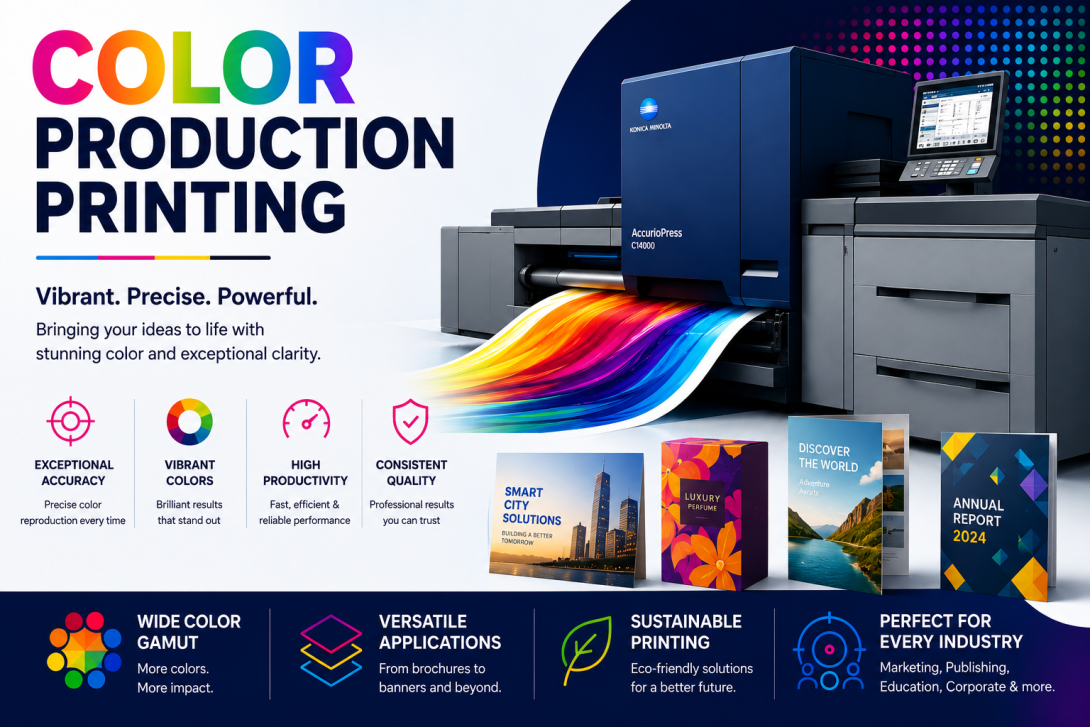
Walk into any print shop running high-volume jobs and you'll notice something: the machines never really stop. That's the reality of color production printing — a category of printing built for speed, consistency, and volume, not for the occasional birthday card or one-off flyer.
If you've ever wondered how a marketing agency turns out 50,000 identical brochures without a single page looking off, or how a publisher keeps every copy of a magazine run matching in tone and saturation, this is the process behind it.
What Color Production Printing Actually Means
At its core, color production printing refers to digital or offset printing systems designed to handle large print runs while maintaining tight color accuracy from the first sheet to the last. Unlike a desktop inkjet printer, which might drift slightly in color after a few hundred pages, production-grade equipment is built with color calibration systems, densitometers, and spectrophotometers that check output constantly during a run.
This matters more than people assume. A retailer printing catalogs needs the red on page 3 to match the red on page 300. A pharmaceutical company printing packaging inserts needs colors that meet regulatory tolerances, not just ones that look "close enough." Production printing exists to solve that problem at scale.
Digital vs. Offset: Two Paths, Same Goal
Most shops offer both digital and offset color production printing, and the choice usually comes down to run length and turnaround.
Digital production presses shine for shorter runs, variable data jobs (think personalized direct mail with each piece slightly different), and quick turnarounds. There's no plate-making step, so a 500-piece job can go from file to finished product in hours.
Offset presses still win when volume climbs into the thousands. The setup takes longer, but the per-unit cost drops sharply, and offset remains the standard for jobs where exact Pantone matching is non-negotiable — packaging, branded stationery, and premium marketing collateral.
Neither approach is universally "better." A shop that understands a client's volume, deadline, and color tolerance will usually recommend the right one rather than defaulting to whichever machine happens to be free.
Where Color Accuracy Comes From
Getting consistent output isn't just about buying an expensive press. It comes down to a handful of practices:
• Color profiling. ICC profiles calibrated to the specific paper stock and press being used, not generic defaults.
• Proofing. A physical or contract proof checked against a color standard before the full run starts.
• In-line spectrophotometry. Sensors built into modern presses that scan printed sheets in real time and adjust ink flow automatically.
• Substrate testing. Coated stock, uncoated stock, and specialty papers all absorb ink differently, so color settings shift depending on what's being printed on.
A shop skipping any of these steps might still produce decent-looking output, but "decent" and "consistent across 10,000 sheets" are different standards.
Common Applications
Color production printing shows up in more places than most people realize:
• Retail catalogs and seasonal lookbooks
• Direct mail campaigns with variable personalization
• Product packaging and point-of-sale displays
• Corporate reports and investor materials
• Educational textbooks and training manuals
• Event signage and large-format collateral
Each of these has its own tolerance for color drift. A training manual can survive minor variation; a brand's packaging usually can't.
Choosing a Print Partner
If you're evaluating vendors for a large color job, a few questions tend to separate the shops that know what they're doing from the ones that just have big machines:
1. Do they calibrate presses per job, or run everything on a default profile?
2. Can they show a recent proof-to-final-run comparison?
3. What's their process for handling a color mismatch mid-run?
4. Do they support the specific stock and finish you need?
A shop that answers these clearly, with specifics rather than general reassurance, is usually one worth working with.
The Bottom Line
Color production printing isn't glamorous, but it's the quiet infrastructure behind a huge share of the printed material people interact with daily — from the catalog in the mailbox to the packaging on a store shelf. Getting it right takes calibrated equipment, disciplined proofing, and a shop that treats color consistency as a technical requirement rather than a nice-to-have.
FAQ
What's the difference between production printing and regular commercial printing? Production printing is built for volume and consistency, using equipment with in-line color monitoring. Commercial printing can range from small digital jobs to large offset runs but doesn't always include the automated color-checking built into dedicated production presses.
Is digital color production printing as accurate as offset? Modern digital presses have closed the gap significantly and can match offset for most jobs. Offset still tends to edge ahead for exact Pantone spot-color matching at very high volumes.
How long does a large color print run typically take? It depends on the press type and job complexity, but digital runs can turn around in hours, while offset jobs involving plate-making and extended proofing typically take a few days.