

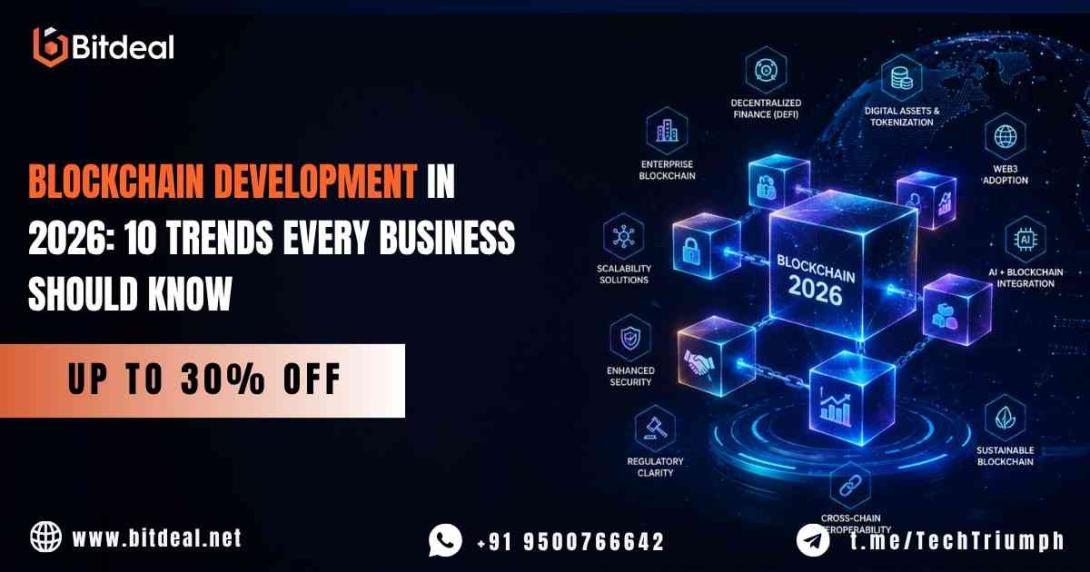
Blockchain has moved well past its cryptocurrency origins. In 2026, businesses across finance, healthcare, logistics, and real estate are using it to cut settlement times, tighten security, and open new ways to raise capital. Here are 10 trends backed by real 2026 numbers.
AI-Powered Blockchain Applications - Businesses are using AI in blockchain to handle fraud detection, risk-scoring, and smart contract auditing, while blockchain gives those AI decisions a tamper-proof record. Together they enable applications that are autonomous yet fully auditable, a combination regulators increasingly expect across finance and healthcare deployments in 2026.
RWA Tokenization Is Scaling Fast - Adoption of real-world asset tokenization (excluding stablecoins) sits between $25–60 billion on-chain as of mid-2026, up from roughly $5–8 billion in early 2025. Tokenized Treasuries lead, driven by BlackRock's BUIDL and Franklin Templeton's BENJI, alongside fast-growing private credit and tokenized equities like Binance's bStocks.
Enterprise Blockchain Adoption Is Accelerating - Banks, insurers, and logistics firms are past the pilot stage. Blockchain now sits inside supply chain traceability, records security, and financial reconciliation, increasingly owned by operations and compliance teams rather than innovation labs chasing headlines and short-lived experiments.
Stablecoins Are Reshaping Business Payments - Stablecoins crossed roughly $313 billion in market cap by mid-2026. B2B stablecoin payments grew over 700% year-over-year, settling at 0.1–0.5% cost versus 2–7% for wires, in minutes instead of days, with Visa's run rate topping $4.5 billion.
Layer 2 Scaling Solutions Are Improving Performance - Layer 2 networks keep fees low and throughput high, letting businesses run payments, gaming, and tokenized transfers without congesting or overpaying on the base chain. This matters more as tokenization and stablecoin activity both scale in parallel.
Cross-Chain Interoperability Is Connecting Networks - Tokenized RWAs alone are fragmented across Ethereum (~65% of value), BNB Chain, Solana, and Polygon, creating pricing gaps and cross-chain friction. Interoperability standards are becoming core infrastructure, not a nice-to-have, for any multi-chain business strategy.
Smart Contract Development Is Becoming More Advanced - Contracts now automate payments, insurance claims, and identity checks, often layered with AI logic. With private credit platforms alone originating over $10 billion in on-chain loans, rigorous smart contract development security audits have become non-negotiable for serious deployments.
Token Fundraising Models Continue to Evolve - Businesses are now moving beyond ICO development, turning to IDOs, IEOs, and Security Token Offerings that incorporate securities-law compliance from day one. STOs in particular are gaining ground as regulatory clarity improves, boosting investor confidence and adoption.
Blockchain Security and Compliance Are Top Priorities - Even established stablecoins aren't immune: the ResolvUSD exploit in March 2026 wiped out nearly 56% of its market cap almost overnight. Smart contract audits and compliance tooling are now table stakes, not optional extras, for any serious project.
Web3 Development Is Creating New Business Opportunities - DeFi, blockchain gaming, tokenized loyalty programs, and decentralized identity are maturing fast. The businesses winning here treat web3 development as an ownership and distribution model, not just a technology stack bolted onto existing products.
Conclusion
Blockchain development in 2026 is about business outcomes, not cryptocurrency speculation. The real question for most companies is no longer "does this work" but "where does it fit our operations" - whether that's stablecoin payment rails, RWA tokenization, or smart contract automation.
This is exactly where Bitdeal comes in. As a blockchain development company, Bitdeal helps startups and enterprises turn these trends into working products - from enterprise blockchain solutions and smart contract development to RWA tokenization and Web3 applications - so businesses can move from watching the trend to actually building on it.