

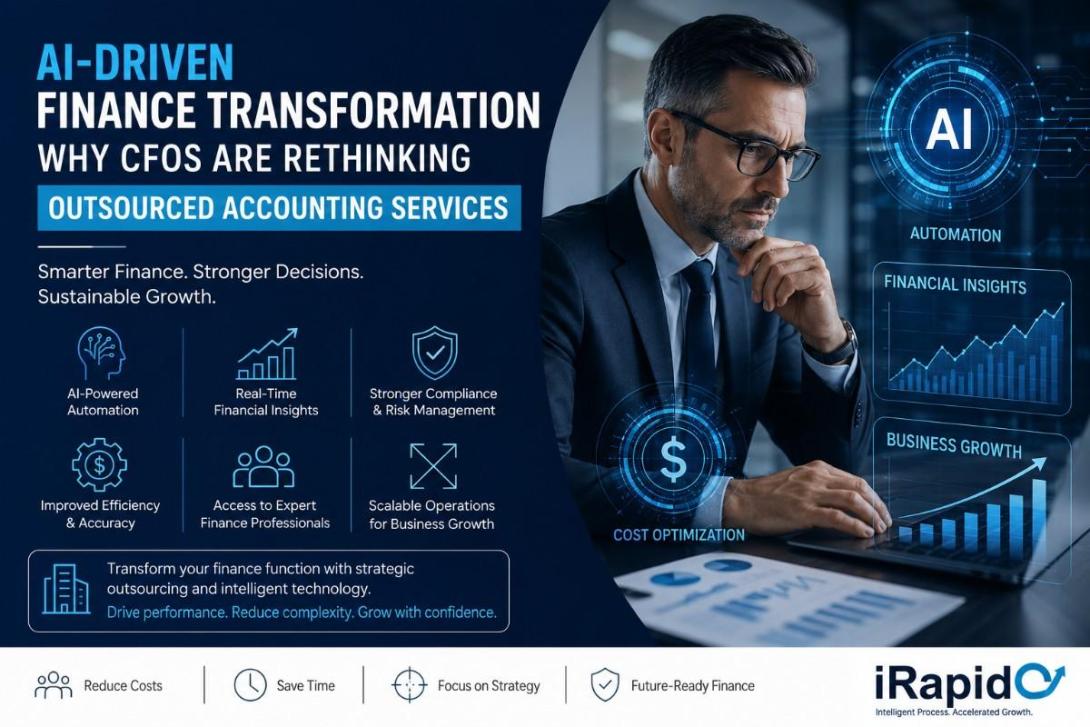
Finance has become one of the most influential business functions in modern organizations. Executive teams now expect finance departments to do far more than prepare financial statements or manage compliance. They expect finance leaders to provide reliable business intelligence, identify operational risks, improve profitability, support strategic investments, and deliver insights that shape long-term growth.
At the same time, organizations face increasing pressure from changing regulations, economic uncertainty, workforce shortages, cybersecurity risks, and the rapid adoption of artificial intelligence. These challenges have exposed the limitations of traditional finance operating models that rely heavily on manual processes and fragmented systems.
As a result, many enterprise organizations are adopting outsourced accounting services as part of a broader finance transformation strategy. Rather than viewing outsourcing solely as a method for reducing operating costs, today's finance leaders recognize it as a way to gain specialized expertise, improve operational resilience, accelerate digital transformation, and create a finance function capable of supporting future business expansion.
Organizations working with experienced partners such as iRapidO are increasingly building finance operations that combine skilled professionals, intelligent automation, standardized processes, and scalable service delivery to strengthen business performance.
Why Traditional Finance Models No Longer Support Enterprise Growth
The responsibilities of finance teams have expanded significantly over the past decade. Monthly reporting cycles that once satisfied management expectations are no longer sufficient for organizations operating across multiple markets.
Today's executives require:
- Near real-time financial visibility
- Faster month-end close cycles
- Stronger internal controls
- Accurate forecasting
- Better cash flow management
- Regulatory compliance across jurisdictions
- Data-driven strategic planning
Unfortunately, many finance departments continue to depend on disconnected systems, spreadsheet-based workflows, and labor-intensive reconciliation processes. These limitations often create reporting delays, increase operational risks, and reduce the ability of leadership teams to make timely business decisions.
Instead of expanding internal finance departments indefinitely, organizations are redesigning their operating models to improve efficiency without sacrificing governance.
The Modern CFO Has Become a Strategic Business Leader
The responsibilities of Chief Financial Officers have changed dramatically.
Today's CFO is expected to balance financial stewardship with business innovation.
Beyond managing budgets, CFOs now contribute directly to:
- Enterprise strategy
- Investment planning
- Digital transformation initiatives
- Risk management
- Capital allocation
- Operational efficiency
- Performance measurement
- Mergers and acquisitions
This expanded role requires finance leaders to spend less time supervising transactional accounting and more time analyzing business opportunities.
Delegating repetitive accounting functions through outsourced accounting services enables finance executives to focus their attention on initiatives that create measurable business value.
Artificial Intelligence Is Redefining Financial Operations
Artificial intelligence is changing how organizations manage financial information.
Instead of replacing finance professionals, AI enhances their ability to process large volumes of financial data with greater speed and consistency.
Modern finance operations increasingly benefit from technologies that support:
- Automated invoice processing
- Intelligent document recognition
- Expense categorization
- Predictive cash flow forecasting
- Continuous transaction monitoring
- Fraud detection
- Financial anomaly identification
- Automated reconciliations
When combined with experienced accounting professionals, these technologies help organizations reduce manual workloads while improving reporting quality and operational transparency.
Finance transformation succeeds when technology and human expertise operate together rather than independently.
Why Outsourced Accounting Services Have Become a Strategic Investment
Business leaders increasingly recognize that accounting outsourcing delivers advantages extending well beyond operational savings.
A mature outsourcing model creates access to specialized finance professionals, standardized workflows, advanced technologies, and flexible delivery capabilities that many organizations find difficult to develop internally.
Strategic outsourcing helps enterprises:
- Increase operational scalability
- Improve reporting consistency
- Strengthen financial governance
- Reduce administrative complexity
- Support business expansion
- Accelerate digital adoption
- Improve process standardization
- Enhance financial visibility
Instead of continually recruiting additional finance personnel, organizations gain access to experienced accounting teams that can adjust capacity as business requirements evolve.
Supporting Business Growth Without Increasing Complexity
Business expansion often introduces additional accounting challenges.
Growing organizations typically experience:
- Higher transaction volumes
- Multiple legal entities
- Cross-border financial operations
- Additional compliance obligations
- Increased reporting requirements
- More complex reconciliations
- Larger vendor ecosystems
Scaling internal finance departments at the same pace can become expensive and operationally challenging.
A structured outsourcing model allows organizations to expand finance capabilities while maintaining standardized operating procedures across locations.
This flexibility helps organizations respond more effectively to acquisitions, market expansion, seasonal demand, and organizational restructuring.
Improving Financial Accuracy Through Standardized Processes
Financial accuracy depends on process discipline.
Organizations that rely heavily on manual interventions often experience inconsistencies in transaction processing, reconciliations, approvals, and reporting.
Professional outsourcing partners establish clearly documented workflows that improve consistency across finance operations.
Standardized processes typically include:
- Defined approval hierarchies
- Structured reconciliation schedules
- Quality assurance reviews
- Documentation standards
- Internal control frameworks
- Compliance monitoring
- Process governance
These practices reduce operational risk while increasing confidence in financial reporting.
Strengthening Compliance and Risk Management
Regulatory expectations continue to evolve across industries.
Organizations must maintain accurate financial records while complying with tax regulations, accounting standards, internal audit requirements, and industry-specific obligations.
An experienced outsourcing partner supports compliance by implementing:
- Controlled financial processes
- Audit-ready documentation
- Regulatory reporting procedures
- Segregation of duties
- Continuous monitoring
- Data security practices
These capabilities reduce compliance exposure while improving organizational governance.
Enabling Better Executive Decision-Making
High-quality business decisions depend on reliable financial information.
When reporting cycles are delayed or inconsistent, leadership teams lose valuable time responding to market changes.
Efficient finance operations enable executives to access timely insights regarding:
- Revenue performance
- Operating expenses
- Profitability
- Cash flow
- Working capital
- Business unit performance
- Financial forecasts
- Investment opportunities
This improved visibility allows organizations to make faster and more informed strategic decisions.
Characteristics of a High-Value Outsourcing Partner
Selecting the right outsourcing provider requires more than comparing service costs.
Enterprise organizations should evaluate providers based on their ability to support long-term business objectives.
Important evaluation criteria include:
- Industry expertise
- Finance process maturity
- Technology capabilities
- Data security standards
- Compliance knowledge
- Process automation expertise
- Business continuity planning
- Scalable delivery model
- Transparent governance
- Performance reporting
A strategic partnership should strengthen the finance function while supporting organizational transformation initiatives.
The Future of Enterprise Finance
Finance transformation is becoming a continuous business initiative rather than a one-time modernization project.
Organizations that combine skilled finance professionals with automation, standardized operations, and intelligent technologies are better positioned to adapt to changing business conditions.
As artificial intelligence continues to mature, finance teams will increasingly focus on strategic analysis, predictive planning, and business advisory functions instead of routine transaction processing.
This evolution will continue to increase demand for outsourcing partners capable of integrating operational excellence with technology-enabled finance services.
Conclusion
Modern finance leaders are redefining how accounting functions support enterprise growth. Instead of measuring success only by operational efficiency, organizations now evaluate finance based on its ability to generate insights, strengthen governance, improve agility, and enable strategic decision-making.
For many enterprises, outsourced accounting services have become an important component of digital finance transformation. By combining experienced professionals, standardized processes, automation, and scalable operating models, organizations can build finance functions that remain resilient as business demands continue to evolve.
Businesses seeking a strategic partner for finance transformation can leverage the expertise available through iRapidO to modernize accounting operations, improve financial visibility, and create a scalable foundation for sustainable long-term growth.