

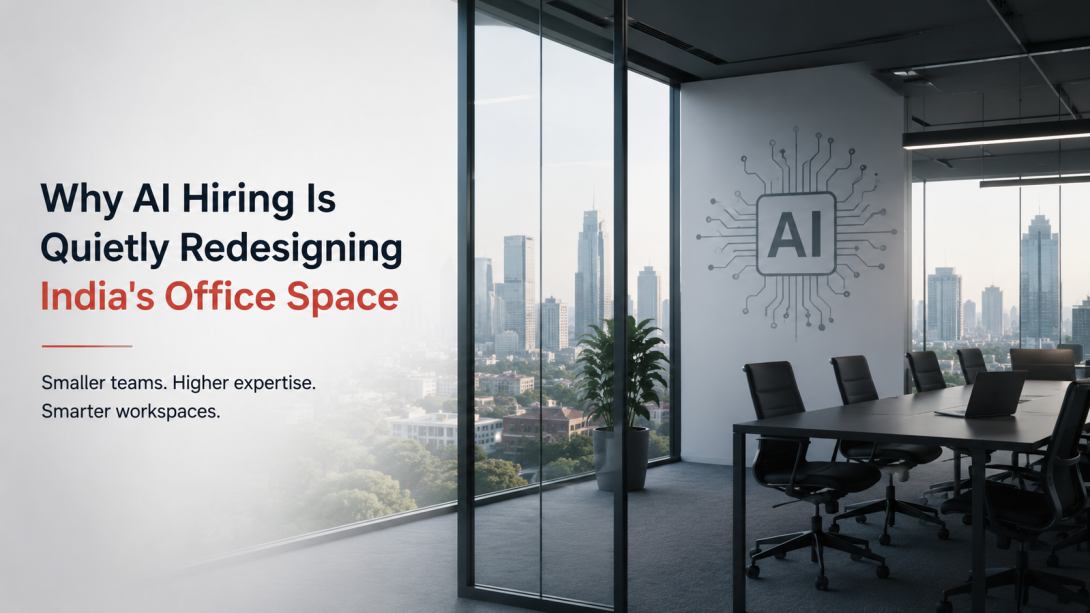
For years, every conversation about AI and jobs in India assumed the same ending: fewer people, smaller teams, emptier offices. That assumption is turning out to be wrong, at least for commercial real estate. Companies adopting AI are not shrinking their footprint. They are redesigning it.
The shift is visible across every major sector in India right now, and it centres on one theme that keeps repeating in industry data: AI office space demand in India is rising even as entry-level hiring slows down.
The Workforce Is Getting Smaller and More Senior
AI is taking over the execution layer first: coding, testing, validation, and other repetitive tasks that used to sit at the bottom of the org chart. That base is thinning out. What is growing instead is the layer above it, the mid-level and senior employees who supervise AI output, make judgment calls, and coordinate across teams.
This is not a one-sector story. BFSI, domestic enterprises, SaaS companies and global capability centres are all reporting the same direction of travel: leaner teams, but a much higher share of senior talent within them over the next three to five years.
Why a Smaller Team Still Needs More Office Space
This is the part that surprises most people. A leaner team should, in theory, need less space. In practice, senior employees need a different kind of space altogether, and that space costs more per person, not less.
Senior hires do not sit at a desk and execute alone. They validate, review, and coordinate, which means offices are being asked to provide more meeting rooms, better video-conferencing setup for cross-time-zone work, high-speed connectivity, and dedicated collaboration zones. None of this is optional infrastructure anymore. It has become table stakes for hiring and retaining the kind of talent AI-native companies actually need.
Location itself has become part of the pitch. Companies are increasingly using the quality and location of their workspace as a hiring lever, especially when competing for scarce, senior AI talent.
Long-Term Leases No Longer Fit a Fast-Changing Workforce
Until a few years ago, long-term leases of five years or more were the default in Indian commercial real estate, because headcount was predictable and planning cycles were long. AI has broken that predictability. Roles, skill needs and team composition can shift within a single quarter, and planning horizons across enterprises have compressed sharply as a result.
A ten-year lease built for a stable headcount becomes a liability the moment that headcount stops being stable. This is exactly why flexible workspace in India has moved from a niche option to a mainstream strategy for fast-growing, AI-driven companies.
Flex Space Is Absorbing the AI-Led Hiring Shift
Flexible workspace solves a very specific problem: it lets companies access premium, high-spec space without the capital burden of a traditional long lease. Traditional leasing locks a company into a fixed area regardless of daily occupancy, along with a heavy upfront capital outlay. Flex removes that barrier and gives companies room to expand or contract without renegotiating a decade-long commitment.
Global capability centres are leaning into this shift faster than almost anyone else, and AI-led hiring real estate strategy is a big part of why. As centres scale their AI functions, they are increasingly choosing flexible formats over conventional leases, precisely because it lets them match space to a workforce that will not stay the same size for long.
The Bigger Picture
None of this means AI is shrinking India's office market. It means AI is repricing and reshaping it. The story is not fewer people, so less space. It is fewer people, but each of them needing better, more collaborative, more connected space, arranged in a format the company can actually commit to without betting on a headcount number nobody can predict anymore.
That is the real story behind the shift in India's AI and commercial real estate India strategy: not contraction, but a complete rethink of what an office is even for.
For a detailed breakdown of the data behind this shift, including sector-wise hiring trends, cost comparisons between traditional leasing and flex space, and projections through 2030, the original research is worth reading in full: How AI Is Restructuring India's Commercial Real Estate Strategy, published by Redseer Strategy Consultants.