
Market Estimation & Definition
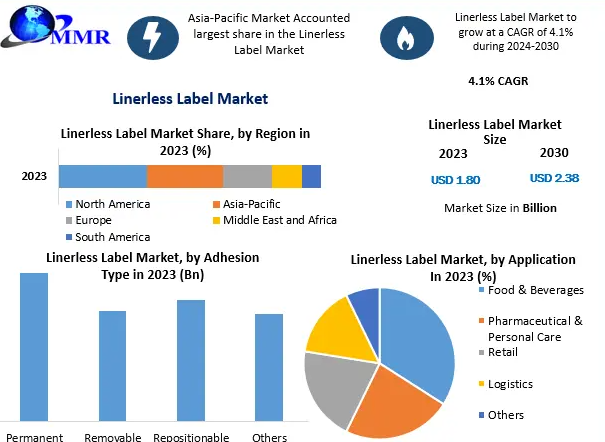
The Linerless Label Industry, valued at approximately USD 1.80 billion in 2023, is poised to surpass USD 2.38 billion by 2030, growing at a projected CAGR of 4.1%. Linerless labels are pressure-sensitive labels produced without a traditional release liner. Unlike conventional labels, these are applied directly to products or packaging without generating backing waste, making them a sustainable labeling solution for businesses prioritizing operational efficiency and environmental responsibility.
These labels offer enhanced productivity by reducing material consumption, logistics costs, and waste disposal expenses. Their versatility allows for broad application across food & beverage, logistics, retail, pharmaceuticals, and personal care industries.
Market Overview:
Linerless labels are those that do not have a backing paper and stick to the surface when pressure is applied. Its job is to keep the contents of the package safe from air, moisture, and pollution from outside sources. Linerless labels are made without a release liner, which decreases the amount of raw material used in label production and makes them an environmentally friendly option. The lack of a liner layer saves end-users money on additional labor, storage, and transportation, as well as reducing industrial waste and carbon emissions.
Ask for Sample to Know US Tariff Impacts on Linerless Label Industry @ https://www.maximizemarketresearch.com/request-sample/122602/
Market Growth Drivers & Opportunities
The growing emphasis on environmental sustainability is one of the primary factors driving the linerless label market. By eliminating release liners, companies are significantly reducing solid waste generated in packaging operations, aligning with global environmental regulations and corporate sustainability initiatives.
Cost-effectiveness is another crucial growth driver. Linerless labels reduce material costs, require less storage space, and offer increased operational speed in packaging lines. The rising demand for convenient, easy-to-use labeling systems in fast-paced logistics and retail environments is further accelerating market adoption.
Additionally, technological advancements in printing processes such as thermal transfer, direct thermal, and digital printing are expanding the capabilities of linerless labels. Modern linerless labels now support full-color, variable data printing and high-speed application, making them ideal for industries requiring dynamic and scalable labeling solutions.
The e-commerce boom and growth of quick-service restaurants have increased the need for efficient packaging and labeling, presenting a significant opportunity for linerless label manufacturers. Automation and smart labeling technologies integrated with linerless labels — including RFID tags and QR codes — offer enhanced inventory management, product tracking, and customer engagement capabilities.
What Lies Ahead: Emerging Trends Shaping the Future
The linerless label market is undergoing transformative changes, driven by technology integration and heightened sustainability requirements. Some of the notable trends shaping the industry include:
- Smart Labeling Integration: Incorporation of QR codes and RFID chips into linerless labels enhances product traceability and consumer interaction.
- Advanced Ink and Adhesive Technologies: Development of eco-friendly, UV-curable, and water-based inks combined with improved pressure-sensitive adhesives are increasing label durability and environmental compatibility.
- High-Speed Automation: Adoption of automated linerless label applicators and high-speed printing equipment is streamlining packaging operations, particularly in food, logistics, and retail sectors.
- Custom and On-Demand Printing: Businesses are increasingly adopting digital printing for on-demand and personalized label production, minimizing inventory and waste.
Segmentation Analysis
The linerless label market is segmented as follows:
- By Component: The facestock segment holds the largest market share. As the primary material in a label — typically composed of vellum paper, sugarcane paper, or metalized paper — facestock comprises up to 80% of the label’s weight and serves as the printing surface.
- By Adhesion Type: Repositionable linerless labels are anticipated to witness the fastest growth, offering flexibility in applications where temporary labeling is essential. However, permanent labels continue to hold a significant share, driven by strong demand in retail, logistics, and food packaging sectors.
- By Printing Technology: Flexographic printing dominates the market due to its cost-efficiency, high-speed capability, and suitability for large-volume applications. The food and beverage industry, particularly in emerging markets, is a key adopter of this technology.
Explore key trends, innovations & market forecasts: https://www.maximizemarketresearch.com/market-report/linerless-label-market/122602/
Country-Level Analysis
United States: The U.S. remains one of the largest consumers of linerless labels, with a market size surpassing USD 490 million in 2023. Growing demand for smart, eco-friendly packaging in logistics, food services, and pharmaceuticals is propelling market growth. The country is also at the forefront of adopting RFID-enabled and digital linerless labeling systems.
Germany: Known for its stringent environmental regulations and strong industrial base, Germany’s linerless label market is projected to grow at a CAGR of 3.5% through 2030. The food, beverage, and manufacturing sectors are increasingly adopting sustainable packaging solutions, contributing to the steady rise in demand for linerless labels.
Competitive Landscape
The global linerless label market is highly competitive, with several major players actively pursuing innovation and market expansion strategies. Leading companies focus on R&D to enhance label durability, sustainability, and printing quality. Strategic mergers, acquisitions, and partnerships are common as firms aim to diversify product portfolios and broaden geographic reach.
Key players include
1. Coveris
2. Avery Dennison Corporation
3. Lexit Group AS
4. Hub Labels
5. Optimum Group
6. Bostik
7. Ravenwood Packaging
8. Innovia Films
9. Constantania Flexibles
Press Release Conclusion
The linerless label market is entering a promising growth phase driven by sustainability, operational efficiency, and technology integration. As industries increasingly prioritize waste reduction and automation, linerless labels are emerging as the preferred choice for modern, efficient, and eco-friendly labeling. The market’s upward trajectory is expected to continue, fueled by innovations in smart labeling, printing technologies, and advanced adhesives, solidifying its role as a cornerstone of the global packaging industry.
About Us
Maximize Market Research is one of the fastest-growing market research and business consulting firms serving clients globally. Our revenue impact and focused growth-driven research initiatives make us a proud partner of majority of the Fortune 500 companies. We have a diversified portfolio and serve a variety of industries such as IT & telecom, chemical, food & beverage, aerospace & defense, healthcare and others.
Contact Maximize Market Research
MAXIMIZE MARKET RESEARCH PVT. LTD.
2nd Floor, Navale IT park Phase 3,
Pune Banglore Highway, Narhe
Pune, Maharashtra 411041, India.
+91 9607365656