

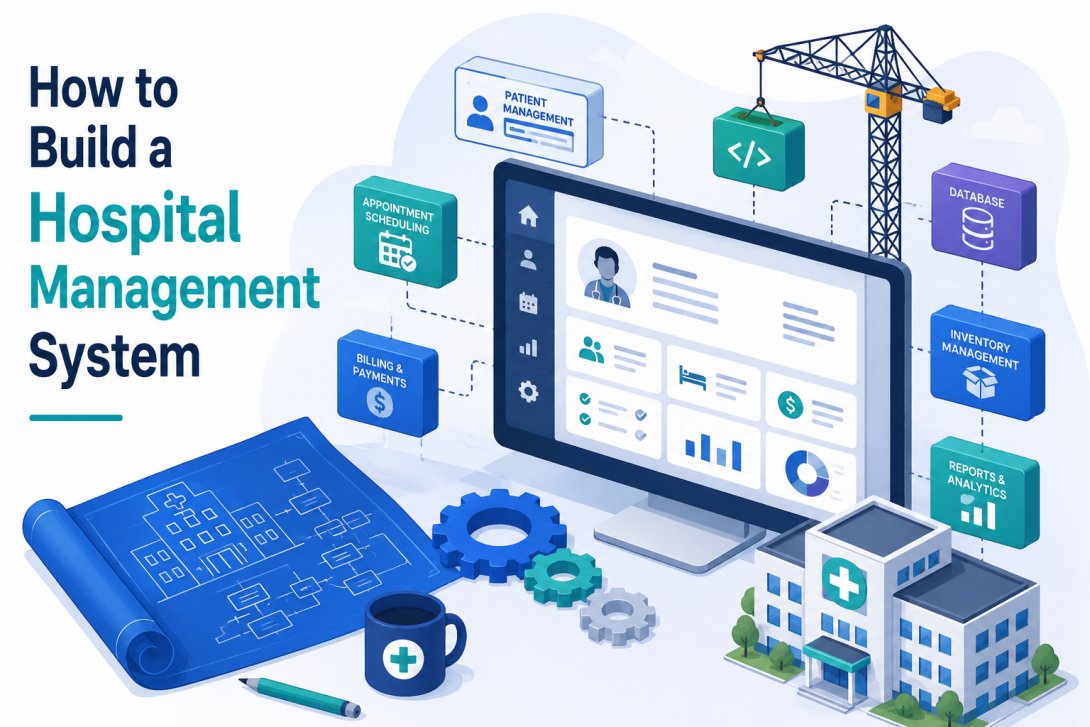
A hospital management system (HMS) is the software backbone that runs a facility's clinical and administrative operations: patient registration, scheduling, clinical documentation, billing, pharmacy, lab and radiology orders, and inventory. Building one is less a software problem than a workflow problem wearing software clothes. Get the clinical workflows and data model wrong, and no amount of clean code will save the rollout.
This guide walks through the real decisions involved: what the system needs to do, whether to build or buy, how to handle interoperability and security, and where these projects typically go wrong.
What a Hospital Management System Actually Has to Do
Most HMS platforms are really a collection of modules that share a common patient record and a common identity system. The modules matter less individually than how well they talk to each other.
- Registration / ADT
- Core Function: Patient admission, discharge, transfer, master patient index
- Primary Users: Front desk, admissions
- EHR / Clinical Documentation
- Core Function: Notes, orders, results, medication administration
- Primary Users: Physicians, nurses
- Billing & Revenue Cycle
- Core Function: Charge capture, claims, insurance verification, payments
- Primary Users: Billing office, finance
- Pharmacy
- Core Function: Prescribing, dispensing, drug interaction checks
- Primary Users: Pharmacists, nurses
- Lab & Radiology (LIS/RIS)
- Core Function: Order routing, result reporting, imaging workflow
- Primary Users: Lab techs, radiologists
- Scheduling
- Core Function: Appointments, OR scheduling, resource allocation
- Primary Users: Schedulers, department heads
- Inventory & Assets
- Core Function: Supply tracking, equipment maintenance
- Primary Users: Materials management
A facility building its own system rarely needs all of these on day one. The mistake many teams make is trying to launch every module simultaneously instead of sequencing around what actually breaks first when a paper process fails: usually registration and scheduling, then clinical documentation, then billing.
Build, Buy, or Configure
For most hospitals, buying and configuring a commercial platform is the right call, not building from scratch. Enterprise vendors such as Epic, Oracle Health (formerly Cerner), and MEDITECH already cover the regulatory and interoperability groundwork that a custom build would spend years reconstructing. Nearly all U.S. hospitals and roughly 80 percent of physicians now use EHR technology certified through the ONC Health IT Certification Program, which means the baseline expectations for a system entering this market are already set high.
Custom development still makes sense in specific situations: small or rural facilities that commercial vendors price out of reach, specialty clinics with workflows no off-the-shelf product handles well, or health systems in regions where certified commercial products aren't sold. Open-source platforms like OpenMRS, originally built for resource-constrained settings, are a credible middle path here and now run in hospitals and clinics across sub-Saharan Africa and parts of Asia.
A hybrid approach is common in practice: a commercial EHR as the clinical core, with custom modules built around it and connected through an integration engine for anything the vendor doesn't handle well, such as a specialty scheduling workflow or a local billing requirement.
Whichever path you take, price the decision on total cost of ownership, not license fees. Commercial platforms carry heavy implementation, training, and ongoing configuration costs that often exceed the software price itself over a five-year horizon. Custom and open-source builds shift that cost into internal engineering and support staff instead of a vendor invoice, which can be cheaper or more expensive depending on how much specialized talent you can retain. Neither option is free of long-term maintenance, so the honest comparison is staffing model against staffing model, not sticker price against sticker price.
Data Architecture and Interoperability
The hardest engineering problem in an HMS build isn't the user interface. It's getting data to move correctly between systems that were never designed to talk to each other. Three things matter most:
A single, reliable master patient index. Every module needs to resolve to the same patient record, and duplicate or mismatched records are one of the most common sources of clinical error in hospital IT.
Standard messaging formats. HL7 v2 still carries the bulk of real-time hospital messaging (admissions, orders, results), while HL7 FHIR handles modern API-based exchange, and DICOM governs imaging data. A system that doesn't speak these fluently will need custom point-to-point integrations for every connection, which becomes unmanageable past a handful of interfaces.
An integration engine. Tools like Mirth Connect or Rhapsody sit between systems and translate, route, and validate messages, so you build one connection to the engine instead of one connection per system pair.
Even with certified systems in place, actual interoperability lags adoption. ONC research on U.S. hospitals found that only about 55 percent were able to electronically send, receive, find, and integrate a patient's summary of care record from an outside source. Having certified software is a starting point, not proof that data actually flows where it needs to.
Security, Compliance, and Access Control
In the U.S., HIPAA sets the floor: encryption of data at rest and in transit, role-based access control, audit logging on every record access, and a documented breach response plan. These aren't optional add-ons to bolt on before launch. Access control in particular has to reflect how hospitals actually operate, including "break glass" protocols that let emergency staff override restrictions during a crisis while still logging the exception for review.
The stakes are not theoretical. Large healthcare data breaches reported to the HHS Office for Civil Rights hit a record 772 incidents in 2025, with the majority tracing back to network servers and compromised email accounts rather than exotic attacks. Most of these are preventable failures in access management and basic hygiene, not sophisticated exploits, which is exactly why access control design deserves as much attention as any clinical feature.
A Realistic Build and Rollout Roadmap
Start with workflow mapping, not software selection. Spend time observing how registration, nursing, and billing staff actually work before writing a single requirement. Then build or configure a minimal core: registration, scheduling, and basic clinical documentation, tested with real staff before adding anything else.
Roll out by department or site rather than all at once. The U.S. Department of Veterans Affairs' EHR modernization effort, a shift to Oracle Health across its hospital network, is a useful cautionary example of what happens when scope and pace outrun readiness. The project's cost estimate has grown from roughly $10 billion at signing in 2018 to an estimated $37 billion more recently, and a March 2025 GAO review found that only 13 percent of staff using the new system believed it made the VA as efficient as possible, while 58 percent believed it had increased patient safety risk. The VA has since shifted to smaller, staggered site deployments with dedicated feedback loops, which is the pattern smaller organizations should follow from the start rather than learning the hard way.
Common Mistakes That Sink These Projects
A few patterns show up repeatedly in troubled implementations:
- Treating it as an IT project instead of a clinical operations project, with no clinician co-leading design decisions.
- Underestimating data migration, particularly cleaning up years of inconsistent paper or legacy records before they enter the new system.
- Skipping change management, so staff revert to workarounds and shadow spreadsheets within weeks of go-live.
- Launching without a rollback plan, leaving no safe way to pause if a critical defect surfaces post-launch.
Each of these is a project management failure more than a technical one, which is why they're avoidable with deliberate planning rather than better code.
Measuring Whether the System Is Actually Working
Going live is not the finish line. HIMSS Analytics' Electronic Medical Record Adoption Model (EMRAM) gives hospitals an external benchmark, an eight-stage scale from paper-based records at Stage 0 to a fully integrated, outcomes-driven digital environment at Stage 7, that many health systems use to track progress rather than assuming adoption equals success. Beyond formal benchmarks, track practical indicators: time clinicians spend on documentation per patient, claim denial rates before and after go-live, average time to deliver lab and imaging results, and how often staff fall back to manual workarounds. Patient-facing metrics matter too, particularly portal adoption and message response times, since a hospital system that clinicians tolerate but patients never use has only solved half the problem.
The Takeaway
Building a hospital management system succeeds or fails on workflow design, interoperability discipline, and security fundamentals, not on which vendor logo appears on the login screen. Whether you buy a commercial platform, adopt an open-source foundation, or build custom modules around a core EHR, the sequencing matters as much as the technology: map real workflows first, roll out in stages small enough to correct course, and treat compliance and access control as core features rather than afterthoughts. Organizations that get this right spend less time firefighting after launch and more time actually improving patient care.
Hospitals require a digital presence that reflects professionalism, accessibility, and trust. Raqbash Technologies develops tailored healthcare websites with intuitive navigation, responsive design, clear service presentation, and patient-focused functionality. Their hospital website development ahmedabad services help healthcare organisations strengthen their online presence, communicate effectively, and deliver a more credible digital experience for patients and visitors.