

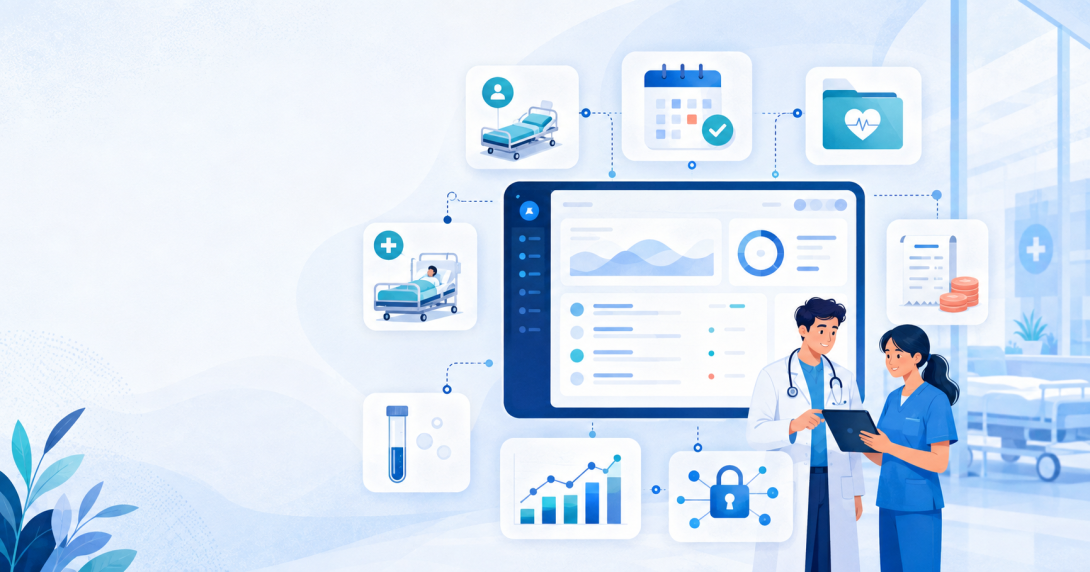
Running a hospital requires coordinating medical care, multi-tier regulatory compliance, inpatient bed logistics, and multi-payer billing cycles simultaneously. When clinical operations rely on disparate point solutions or legacy on-premise systems, communication breakdowns occur. Nurses spend shifts hunting down open beds, physicians navigate clunky charting screens, and medical billing teams spend weeks chasing claim denials.
Hospital management software (HMS) serves as the core operational platform that connects clinical, administrative, and financial functions across a healthcare facility. Building or modernizing this platform demands deep engineering discipline. The system must process high-concurrency clinical events without latency while maintaining strict patient data privacy.
This guide analyzes the core architectural modules, essential feature sets, optimal technology stack, and engineering trade-offs required to build or evaluate modern hospital management software.
What Is Hospital Management Software?
Hospital management software is an integrated enterprise system designed to automate and orchestrate the full spectrum of hospital operations. This includes patient admission, bed management, clinical documentation, laboratory and radiology workflows, pharmacy inventory, and revenue cycle management.
Unlike basic clinic management tools that focus on outpatient scheduling and simple SOAP notes, an enterprise HMS coordinates inpatient clinical workflows with continuous telemetry, shifting acuity levels, and complex multi-facility administrative oversight.
Key Features and Functional Modules of Hospital Management Software
A scalable hospital management system operates as a unified platform serving clinical, diagnostic, and administrative stakeholders. Rather than building a monolith where every process is tightly coupled, successful implementations divide operational workflows into distinct functional services.
1. Inpatient Bed Management and ADT (Admission, Discharge, Transfer)
The ADT module is the operational pulse of the hospital. It tracks the patient journey from emergency room intake to bed placement, procedural transfers, and final discharge.
Bed allocation logic must account for real-time housekeeping statuses, clinical isolation requirements, specialty equipment needs, and nurse-to-patient acuity ratios. Providing bed coordinators and charge nurses with a dynamic, visual ward map reduces emergency department boarding times and prevents bed bottlenecks.
2. Clinical Documentation, CPOE, and eMAR
Physicians and bedside nurses require fast, reliable interfaces that streamline documentation without distracting from direct patient care.
Administrative burden remains a primary contributor to clinician dissatisfaction. A landmark time-motion study funded by the American Medical Association (AMA) revealed that for every hour physicians spend providing direct face time to patients, they spend nearly two additional hours on EHR documentation and desk work during their shift. A modern HMS must prioritize streamlined interaction patterns:
- Computerized Provider Order Entry (CPOE): Physicians enter orders for medications, laboratory panels, blood products, and physical therapies directly into structured digital workflows, preventing transcription errors from handwritten instructions.
- Electronic Medication Administration Records (eMAR): Bedside nurses verify prescriptions by scanning the patient's wristband barcode alongside the unit-dose medication packaging prior to administration, systematically verifying the five rights of medication safety: right patient, right medication, right dose, right route, and right time.
- Specialty Clinical Charting: Flexible, structured encounter templates tailored to clinical departments (such as emergency medicine, intensive care, pediatrics, and surgical suites) minimize manual typing through standardized terminology lookups.
3. Integrated Diagnostic Services: LIS and RIS/PACS
Diagnostic modules must support continuous, high-volume data ingestion:
- Laboratory Information System (LIS): Automates specimen collection, generates unique barcode tracking IDs, connects directly with automated lab analyzers via serial or TCP/IP connections, and uploads verified results directly to the patient record.
- Radiology Information System (RIS) and PACS: Connects with diagnostic imaging modalities (such as CT, MRI, and X-ray systems) using standard DICOM communication, enabling clinicians to view imaging datasets through lightweight, zero-footprint web viewers linked to encounter notes.
4. Pharmacy and Consumable Inventory Control
Hospital pharmacy software requires tighter controls than retail pharmacy systems. The pharmacy engine must manage bulk formulation tracking, narcotic sign-out logs, automated reorder triggers based on average daily consumption, and cold-chain temperature logs.
Integrated clinical decision support (CDS) must automatically check for dangerous drug-drug interactions, known patient allergies, and duplicate therapies during dispensing workflows.
5. Automated Revenue Cycle Management (RCM) and Billing
Hospital billing requires coordinating bed tariffs, nursing charges, procedural fees, diagnostic panels, and surgical supplies into clean claim files.
The billing engine should enforce automatic charge capture. When a nurse scans a surgical dressing or an IV kit, the item should attach to the active patient ledger automatically. The billing pipeline must format outbound insurance claims using standard Electronic Data Interchange formats (such as EDI 837I for institutional inpatient claims and EDI 837P for professional fees) to clear commercial and government clearinghouses smoothly.
- Admission, Discharge, Transfer (ADT)
- Primary User Base: Front desk, triage nurses, bed coordinators
- Core Operational Responsibility: Inpatient room tracking, bed state coordination, and patient identity reconciliation.
- CPOE & eMAR
- Primary User Base: Attending physicians, hospitalists, registered nurses
- Core Operational Responsibility: Digital order entry, closed-loop bedside barcode scanning, and medication safety checks.
- Laboratory (LIS) & Radiology (RIS)
- Primary User Base: Laboratory technicians, pathologists, radiologists
- Core Operational Responsibility: Machine telemetry capture, specimen routing, and DICOM diagnostic imaging review.
- Pharmacy & Consumables
- Primary User Base: Clinical pharmacists, material supply coordinators
- Core Operational Responsibility: Formulary management, controlled substance tracking, and automated inventory reordering.
- Revenue Cycle Management (RCM)
- Primary User Base: Medical billing specialists, coding auditors
- Core Operational Responsibility: Charge capture automation, EDI claim generation, and remittance reconciliation.
Recommended Technology Stack for Hospital Management Software
Building enterprise hospital software demands an architecture prioritizing high availability, strict multi-tenancy, and low-latency API communication.
Frontend Architecture
- Administrative & Clinical Web Portals: React.js or Next.js paired with TypeScript provides a mature, type-safe ecosystem. Hospital staff require data-dense interfaces with robust local state management (via TanStack Query or Redux Toolkit) to manage multi-tab charting workflows without browser crashes.
- Point-of-Care Mobile Apps: For rounding physicians and bedside nurses, Flutter or native Swift/Kotlin applications running on enterprise mobile devices allow rapid barcode scanning and immediate vitals entry.
Backend and Application Services
- API Frameworks: Go or Node.js (TypeScript) for lightweight, high-concurrency microservices. Go provides exceptional memory efficiency and speed for ingestion pipelines handling high-frequency telemetry feeds from ICU monitors.
- Enterprise Integration Engines: Mirth Connect (NextGen Connect) or HAPI FHIR are standard choices for bridging custom hospital code with legacy hospital hardware protocols.
Database and Storage
- Relational Storage: PostgreSQL is the industry baseline for healthcare records due to its robust ACID compliance, advanced JSONB support for semi-structured clinical templates, and built-in row-level security.
- Time-Series Telemetry: TimescaleDB (as an extension to PostgreSQL) handles continuous vital sign tracking from bedside monitors without bloating core transactional tables.
- Caching and Asynchronous Queues: Redis handles active session states, rate limiting, and real-time bed assignment locks. Apache Kafka or RabbitMQ orchestrates message queues, processing high-volume events such as lab results and audit logging asynchronously.
Cloud Infrastructure and Hosting
- Hosting Environments: AWS (utilizing HIPAA-eligible services such as AWS ECS, RDS Multi-AZ, and S3) or Google Cloud Platform (GCP Healthcare API). Multi-region failover and automated daily encrypted snapshotting are mandatory to ensure continuous operation during regional network outages.
Interoperability Standards: HL7, FHIR, and DICOM
A common engineering failure in hospital software development is relying entirely on proprietary internal data models. Hospitals do not operate in a vacuum. The HMS must communicate with external clinical labs, government health reporting agencies, state prescription monitoring databases, and third-party medical hardware.
1. HL7 FHIR (Fast Healthcare Interoperability Resources)
The modern healthcare industry is standardized around HL7 FHIR Release 4. FHIR organizes medical records into discrete, modular RESTful resources, including Patient, Encounter, Condition, MedicationRequest, and DiagnosticReport. Conforming to FHIR models ensures that your HMS can integrate with public health networks, external electronic health records, and regulatory patient data portals without expensive translation middleware.
2. HL7 v2.x Standards for Legacy Hardware
While FHIR dominates modern cloud APIs, thousands of hospital devices (such as bedside hemodynamic monitors, automated syringe pumps, and benchtop hematology analyzers) communicate exclusively using older, pipe-delimited HL7 version 2.x messages. Your HMS integration layer must reliably ingest:
- ADT Messages: Admission, discharge, and transfer events (such as
ADT^A01for inpatient admission andADT^A03for discharge). - ORM and ORU Messages: Order management (
ORM) sent to diagnostic labs and observational results (ORU) returned from lab equipment.
3. DICOM for Medical Imaging
Digital Imaging and Communications in Medicine (DICOM) is the universal protocol for storing and transmitting medical imaging files. Modern hospital management software interfaces with picture archiving and communication systems (PACS) to display diagnostic-quality imaging within the patient's record using client-side DICOM rendering engines like Cornerstone.js.
Regulatory Compliance and Security Architecture
Healthcare software represents one of the most heavily targeted attack surfaces in enterprise computing. According to breach statistics compiled by the U.S. Department of Health and Human Services (HHS) Office for Civil Rights, hundreds of large-scale healthcare data breaches are reported each year, exposing tens of millions of patient records through compromised application endpoints, third-party vendor misconfigurations, and credential theft.
Security engineering must be embedded into the application lifecycle from the first line of code.
- HIPAA Security Rule
- Jurisdictional Scope: United States
- Primary Engineering Mandate: End-to-end data encryption, minimum necessary data access policies, signed BAAs with all cloud infrastructure providers.
- HITECH Act
- Jurisdictional Scope: United States
- Primary Engineering Mandate: Immutable audit logging for protected health information (PHI) and automated security breach notification workflows.
- GDPR
- Jurisdictional Scope: European Union
- Primary Engineering Mandate: Data minimization standards, localized server residency, explicit consent management, and secure automated patient data export workflows.
- ISO 27799 / ISO 27001
- Jurisdictional Scope: Global
- Primary Engineering Mandate: International information security standards specifying implementation controls tailored specifically to the health informatics sector.
Field-Level Encryption and Key Management
Standard disk encryption is insufficient for healthcare systems. If an unauthorized actor gains access to a compromised database session, disk encryption offers zero protection.
High-sensitivity fields (such as social security numbers, mental health notes, and HIV test results) must use field-level encryption (AES-256-GCM) with distinct cryptographic keys stored in dedicated key management systems (such as AWS KMS or HashiCorp Vault).
Attribute-Based Access Control (ABAC)
Basic Role-Based Access Control (RBAC) often proves inadequate on the clinical floor. A registered nurse may have the broad role of "Nurse," but they should not have access to every patient record in the hospital.
ABAC evaluates dynamic operational context before granting access:
- What is the user's role?
- Is this clinician actively scheduled on shift right now?
- Is this clinician assigned to the specific ward or bed where the patient is admitted?
If the situational context fails to align, access to the chart is blocked and an audit flag is recorded.
Tamper-Evident Audit Trails
Every data interaction—whether a read, export, update, or deletion—must generate an unalterable log. Audit records must capture the user ID, patient record ID, IP address, timestamp, and the exact action performed.
Storing these logs in an immutable, write-once-read-many (WORM) storage system ensures that compliance logs cannot be modified or purged during security investigations.
Architectural Comparison: Monolith vs. Microservices in Healthcare
Engineering teams must carefully evaluate how to structure the core system architecture. While early-stage systems often begin as monoliths to move quickly, large hospital networks require operational isolation.
- System Uptime & Stability
- Monolithic Architecture: A fatal exception in the billing generator can crash bedside vitals tracking.
- Modular Microservices Architecture: Fault isolation ensures failures in inventory or billing never disrupt emergency intake.
- Deployment Agility
- Monolithic Architecture: Deploying a minor UI update requires testing and deploying the entire system.
- Modular Microservices Architecture: Individual clinical services deploy independently with zero downtime during maintenance windows.
- Infrastructure Scalability
- Monolithic Architecture: The entire system must scale together, driving up server costs.
- Modular Microservices Architecture: High-throughput services (such as lab telemetry ingestion) scale dynamically on isolated node pools.
- Development Complexity
- Monolithic Architecture: Simpler database relations and lower initial DevOps overhead.
- Modular Microservices Architecture: Requires enterprise API gateways, robust distributed tracing, and distributed transaction handling.
For smaller specialty surgical centers, a modular monolith using cleanly isolated domain boundaries is often the fastest, most cost-effective path to launch. For tertiary hospitals or multi-site hospital networks, a decoupled microservices architecture is essential to provide system resilience and continuous uptime.
Common Implementation Pitfalls in Hospital Systems
Even well-funded hospital software projects can run into severe operational roadblocks when development teams fail to account for real-world hospital environments:
- Designing for Fast Networks Only: Hospitals feature concrete radiation-shielded radiography rooms, underground basements, and surgical units where Wi-Fi drops frequently. Critical clinical workflows must be built with offline-first data synchronization, allowing nurses to record medications locally and sync automatically once connectivity is restored.
- Neglecting Hardware Validation: Hospital software relies heavily on physical peripherals. Developing solely in modern web browsers without validating compatibility against thermal barcode label printers, flatbed document scanners, and bedside handheld terminals leads to significant delays during floor deployment.
- Over-Engineering Clinical Input Forms: Clinicians will bypass or resist systems that demand excessive clicks. Charting interfaces must offer structured keyboard shortcuts, intuitive autocomplete matching against standardized medical vocabularies (such as RxNorm and ICD-10), and single-click macro inputs for common clinical scenarios.
Engineering a Dependable Foundation for Clinical Care
Building modern hospital management software requires balancing clinical speed, technical interoperability, and strict security controls. The platform must deliver dependable performance across emergency departments, intensive care wards, and back-office financial departments without missing a beat.
By architecting around modular functional services, adhering to established interoperability standards like FHIR and HL7, enforcing granular access controls, and designing for the physical realities of the clinical shift, engineering teams can deliver an HMS that minimizes administrative burnout, protects patient data integrity, and improves clinical care across the hospital.
For hospitals seeking a clearer, accessible online experience, Raqbash Technologies develops structured platforms supporting patient journeys across departments. Its hospital website development company services unite searchable clinician directories, intuitive service information, responsive design, and secure appointment pathways, helping organisations improve discoverability, reinforce trust, and streamline access for patients at every stage.