

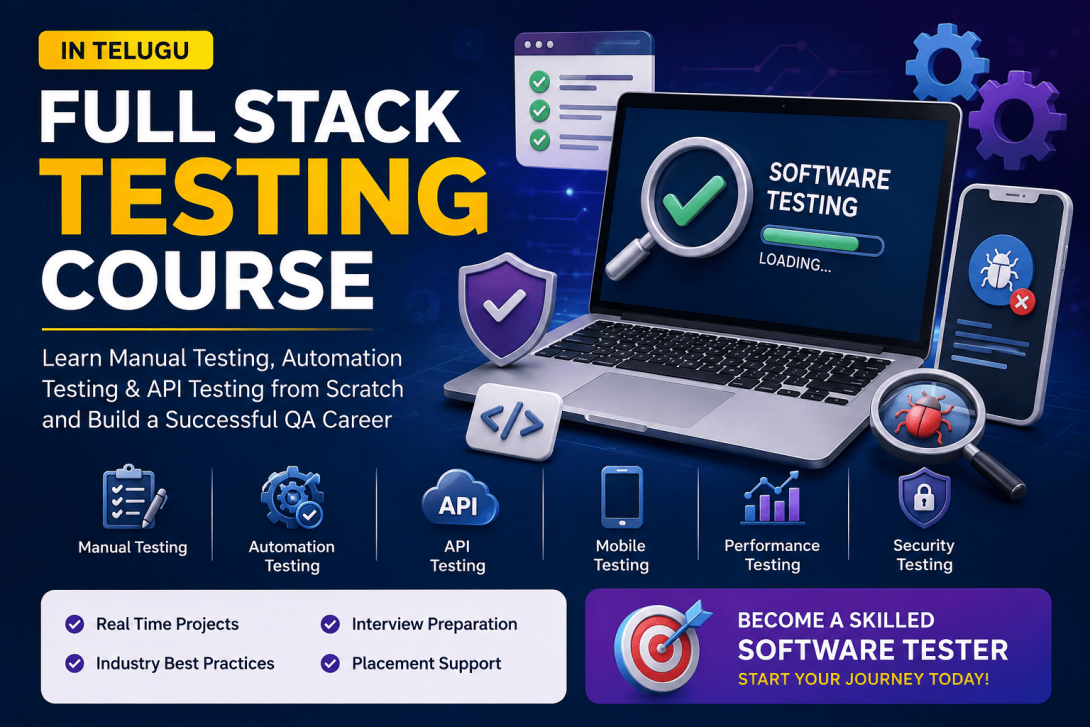
The software industry continues to create new applications, websites, and digital platforms. Every software product needs proper testing before it is released to users. A small error can affect user experience, business operations, and customer trust. This is why software testing has become an important part of the technology industry.
For beginners who want to understand both traditional and modern testing methods, a Full Stack Testing Course in Telugu can provide a structured learning experience. The course can help learners understand the difference between manual testing and automation testing while building practical skills for software quality assurance.
Understanding Manual Testing
Manual testing is the process of checking a software application without using automated scripts or tools to execute the test cases. A tester manually interacts with the application and verifies whether its features work according to the requirements.
For example, when testing a login page, a manual tester may check whether users can log in with valid credentials and whether proper error messages appear when incorrect information is entered.
Manual testing helps beginners understand how software applications behave and how users interact with different features.
Key Concepts in Manual Testing
Before moving to automation, learners should understand important manual testing concepts such as:
- Software Testing Life Cycle
- Test scenarios
- Test cases
- Test execution
- Defect reporting
- Bug life cycle
- Functional testing
- Regression testing
- Smoke testing
A strong foundation in these areas can help learners understand the complete testing process.
Why Is Manual Testing Important?
Manual testing allows testers to explore applications and identify unexpected problems. Some issues are easier to discover through human observation and user-focused testing.
Testers can analyze the application, check different user journeys, and identify usability problems. This helps organizations deliver better products to customers.
A Full Stack Testing Course in Telugu can help beginners understand these concepts through simple explanations and practical examples.
Introduction to Automation Testing
Automation testing uses tools and scripts to perform testing tasks automatically. It is especially useful when the same tests need to be executed repeatedly.
For example, after developers make changes to an application, a testing team may need to verify whether existing features still work properly. Automated tests can help perform these repetitive checks more efficiently.
Automation does not completely replace manual testing. Instead, both approaches can work together to improve the testing process.
Skills Required for Automation Testing
Automation testing usually requires some technical knowledge. Beginners may need to learn programming fundamentals and understand how automated testing frameworks work.
Important skills can include:
- Basic programming concepts
- Test automation frameworks
- Web application testing
- Locators and elements
- Test scripts
- Test execution
- Reporting
Students do not need to learn everything at once. A step-by-step approach can make the learning process easier.
Manual Testing vs Automation Testing
Manual and automation testing have different purposes.
Manual testing is useful when exploring new features, testing user experience, and identifying unexpected issues. Automation testing is useful for repetitive test cases and regression testing.
A skilled testing professional should understand when to use manual testing and when automation can provide better efficiency.
This combination is one reason why learning both skills through a Full Stack Testing Course in Telugu can be useful for aspiring testers.
The Importance of Practical Practice
Testing cannot be learned effectively through theory alone. Students should practice testing real or sample applications.
Practical exercises can include creating test cases for a website, identifying defects, documenting bugs, and automating simple testing scenarios.
Projects can help learners understand how software testing happens in a professional environment. They also provide valuable examples that students can discuss during interviews.
Career Opportunities After Learning Testing
Learning manual and automation testing can open opportunities in roles such as:
- Manual Tester
- Software Tester
- QA Engineer
- Automation Tester
- Test Engineer
- Quality Assurance Analyst
With additional experience and technical knowledge, professionals can explore advanced testing areas and specialized roles.
Who Can Learn This Course?
A Full Stack Testing Course in Telugu can be suitable for students, fresh graduates, career changers, and professionals who want to upgrade their skills.
Beginners should focus on understanding testing fundamentals first. Once the foundation is strong, learning automation tools and frameworks becomes easier.
Conclusion
Both manual and automation testing play important roles in software quality assurance. Manual testing helps professionals understand applications and discover issues through human observation, while automation improves efficiency by handling repetitive testing tasks.
A Full Stack Testing Course in Telugu can help beginners learn both approaches through a structured learning process. With consistent practice, practical projects, and continuous learning, aspiring testers can develop valuable skills and prepare for opportunities in the software testing industry.