

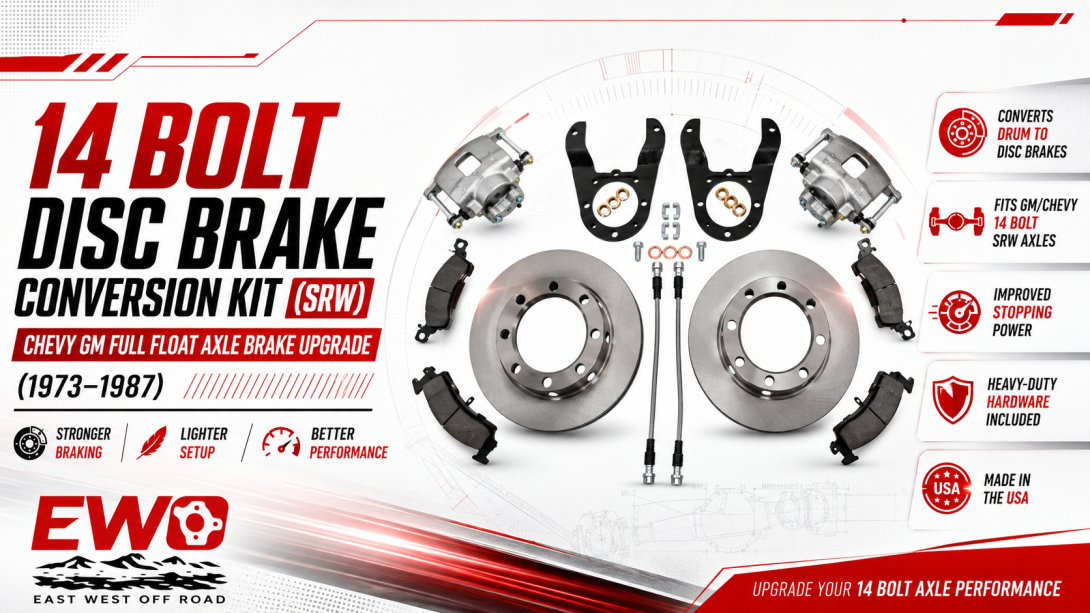
Buy Now: EWO 14 Bolt Disc Brake Conversion Kit
A Chevy truck brake conversion can be a worthwhile upgrade when you're restoring a classic GM truck, building a 4x4, or modernizing an older rear axle. One of the most common upgrades is converting the original rear drum brakes to disc brakes, particularly on the GM 14-bolt full-float axle used in many classic Chevy and GMC trucks. A properly selected conversion can simplify brake service and provide a modern disc-brake configuration, but the axle type, wheel clearance, hydraulic system, and intended use all need to be considered before installation.
For compatible 1973–1987 Chevy/GM full-float single-rear-wheel 14-bolt axles, the EWO 14 Bolt Disc Brake Conversion Kit is designed specifically around this application.
What Is a Chevy Truck Brake Conversion?
A Chevy truck brake conversion generally refers to replacing an existing factory brake system with a different brake configuration.
For classic Chevy and GMC trucks, one popular approach is a rear drum-to-disc brake conversion.
Instead of using the factory drum, shoes, wheel cylinders, springs, and adjusters, the conversion uses a rotor and caliper system.
A typical rear disc conversion can include:
- Disc brake rotors
- Brake calipers
- Brake pads
- Caliper mounting brackets
- Hydraulic brake hoses
- Brake-line hardware
- Mounting hardware
- Optional parking-brake components
The exact components depend on the axle and conversion kit.
For the GM 14-bolt application, current conversion products commonly target the 1973–1987 full-float SRW configuration.
Why Convert a Chevy Truck From Drum to Disc Brakes?
Older Chevy trucks are often upgraded with larger tires, suspension lifts, heavier drivetrain components, and more capable axles. As the rest of the vehicle is modernized, the original rear drum brakes may become an area owners want to replace.
Easier Inspection
One major advantage of disc brakes is accessibility.
The rotor and brake pads are exposed, making it easier to inspect wear without removing a large brake drum.
This can be especially useful on a frequently driven truck or an off-road vehicle that sees mud, water, and debris.
Simpler Brake Service
Disc brake service generally revolves around the rotor, pads, and caliper rather than the collection of springs, shoes, adjusters, and other hardware inside a drum.
For a truck being restored, this can make future maintenance more straightforward.
Better Water and Mud Management
Disc brakes have exposed friction surfaces that can shed water and debris more readily than enclosed drum assemblies.
MotorTrend's coverage of a GM 14-bolt conversion noted that disc brakes can shed heat effectively and recover more consistently in trail conditions where water and mud can negatively affect drum-brake performance.
This doesn't mean every disc conversion automatically produces shorter stopping distances. The result depends on the complete brake system, vehicle weight, tires, hydraulics, and brake bias.
Modernizing a Classic GM Truck
A rear disc conversion can complement other upgrades on:
- Chevy K10
- Chevy K20
- Chevy K30
- K5 Blazer
- GMC K-series trucks
- Classic 4x4 builds
- Rock-crawling trucks
- Street-and-trail builds
The important part is selecting a conversion that matches the actual rear axle.
14 Bolt Rear Disc Conversion for Chevy Trucks
The GM 14-bolt full-float axle is a popular choice for heavy-duty Chevy and GMC builds. MotorTrend describes the GM Corporate 14-bolt as a high-strength rear axle commonly used in trail/street applications and notes its full-floating design and 10.5-inch ring gear.
Many older 14-bolt applications use drum brakes, creating an opportunity for a rear disc upgrade.
For compatible axles, a purpose-built conversion kit can replace the original drum assembly without requiring the builder to source every brake component separately.
Chevy GM 14 Bolt Disc Brake Conversion Kit
The EWO product is specifically listed for 1973–1987 Chevy/GM full-float SRW 14-bolt axles.
Full-Float vs. Semi-Float 14 Bolt
Before purchasing a Chevy truck brake conversion, identify the axle.
This is especially important with GM 14-bolt axles because "14 bolt" does not describe only one configuration.
A full-float 14-bolt and a semi-float 14-bolt are different applications, and a conversion designed for one should not automatically be installed on the other.
The EWO conversion covered here is intended for the specified full-float SRW application.
Current competitor information similarly excludes semi-float axles from this style of 1973–1987 SRW conversion.
How to Identify the Correct Application
Before ordering, verify:
- Full-float axle
- Single rear wheel configuration
- Chevy/GM application
- Applicable model year
- Hub and drum configuration
- Wheel requirements
- Brake-system compatibility
If the axle has been modified or rebuilt previously, measuring the relevant mounting dimensions is a smart additional step.
SRW vs. Dually Brake Conversion
SRW stands for Single Rear Wheel.
A dually uses dual rear wheels, and the hub and wheel arrangement can be different.
This matters because a brake conversion designed around an SRW hub configuration may not fit a dually axle.
The EWO kit is specifically listed for SRW full-float 14-bolt axles, not as a universal dually conversion.
If you're building a dually or a non-standard axle configuration, confirm compatibility with the manufacturer before purchasing.
What Does a 14 Bolt Disc Brake Conversion Kit Include?
A complete conversion kit can make a Chevy truck brake conversion considerably easier because the major components are selected as a system.
Depending on configuration, a kit can include:
- 14-bolt disc brake brackets
- Grade 8 mounting hardware
- Brake-line tabs
- Brake-line clips
- Disc brake calipers
- Hydraulic hoses
- Brake pads
- Rear rotors
A comparable current SRW conversion package lists a pair of caliper brackets, Grade 8 bolts, brake-line tabs and clips, two calipers, hydraulic hoses, four pads, and two rotors.
The EWO product also provides optional parking-brake-caliper and steel-braided-hose configurations.
Always verify the current product configuration before ordering because options can change.
Wheel Clearance Is One of the Most Important Checks
One of the easiest mistakes during a Chevy truck brake conversion is assuming that the factory wheels will automatically clear the new calipers.
They may not.
The brake conversion changes the hardware inside the wheel, so you need to evaluate:
- Wheel diameter
- Wheel backspacing
- Caliper clearance
- Rotor clearance
- Wheel-spoke profile
- Lug-stud length
- Lug-nut engagement
Current 14-bolt SRW conversion information commonly specifies a minimum 15-inch steel wheel with maximum 4-inch backspacing, or larger aluminum wheels, depending on the specific setup.
However, wheel diameter alone isn't enough.
Two wheels with the same diameter can have very different spoke and barrel designs.
Always test-fit the actual wheels you intend to use.
Check the Hub and Rotor Configuration
Another important consideration is the relationship between the rotor and hub.
The common 1973–1987 SRW full-float conversion configuration places the rotor at the backside of the hub.
This means the hub, mounting flange, rotor, and caliper need to work together as designed.
If your axle has been modified, don't assume that it still has the original dimensions.
Comparable conversion documentation recommends checking the distance from the four-bolt mounting flange to the relevant hub face, with approximately 4-11/16 inches commonly specified for this application.
Brake Bias After a Rear Disc Conversion
Converting a Chevy truck from rear drums to discs can change the hydraulic characteristics of the braking system.
That's why brake bias should be considered as part of the complete conversion.
The objective isn't simply to make the rear brakes more aggressive.
You want the front and rear brakes to work together appropriately.
A proportioning valve can be useful on a modified truck because it allows the builder to fine-tune front-to-rear braking behavior. Current conversion documentation recommends evaluating proportioning when moving from rear drums to discs.
If you're also changing the master cylinder, booster, front brakes, tire size, or vehicle weight, evaluate the entire braking system.
What About the Parking Brake?
The parking brake is another issue that should be addressed before starting a rear disc conversion.
The factory drum setup may provide a mechanical parking-brake function that isn't automatically retained when conventional disc calipers are installed.
For this reason, some conversion kits offer calipers with integrated parking-brake mechanisms.
The EWO kit provides a parking-brake-caliper option for the applicable configuration.
For a street-driven Chevy truck, determine your parking-brake solution before completing the conversion.
Chevy Truck Brake Conversion Installation Overview
A rear disc conversion should be treated as a safety-critical brake-system project.
Step 1: Confirm the Axle
Verify that your rear axle is the correct Chevy/GM full-float SRW 14-bolt application.
Do not rely only on the truck's model year.
Step 2: Remove the Original Drum Components
Remove the original drum and associated brake hardware according to the axle configuration.
Inspect the hub, axle flange, wheel studs, seals, and surrounding components while everything is accessible.
Step 3: Install the Caliper Brackets
Install the conversion brackets using the supplied hardware.
Use the manufacturer's specified torque values.
The bracket determines the caliper's position relative to the rotor, so correct installation is essential.
Step 4: Install the Rotors
Install the rotors in the correct relationship to the hub.
Confirm that the rotor seats properly and doesn't interfere with surrounding components.
Step 5: Install the Calipers and Pads
Install the brake pads and calipers according to the kit instructions.
Verify that the caliper is properly positioned over the rotor.
Step 6: Connect the Hydraulic Hoses
Route the brake hoses carefully.
They should not contact:
- Tires
- Wheels
- Suspension components
- Sharp edges
- Exhaust components
- Moving parts
The hose needs enough movement for suspension travel without becoming stretched or pinched.
Step 7: Bleed the Brake System
After hydraulic connections are opened, bleed the brakes completely.
Check all connections for leaks.
Current installation guidance also emphasizes re-bleeding the brake system after completing the conversion.
Step 8: Check Wheel Clearance
Install the intended wheels and verify clearance between the wheel and caliper.
Do not skip this step.
Step 9: Test the Complete Brake System
Before normal driving, verify:
- Brake pedal feel
- Hydraulic connections
- Brake-fluid level
- Rotor seating
- Caliper mounting
- Pad position
- Wheel clearance
- Lug-nut torque
- Parking-brake function
- Brake bias
Perform controlled testing in a safe location before returning the truck to normal road or trail use.
Common Chevy Truck Brake Conversion Mistakes
Choosing a Kit Without Identifying the Axle
A 14-bolt axle isn't automatically compatible with every 14-bolt disc conversion.
Confirm the exact axle configuration first.
Installing the Conversion on a Semi-Float Axle
A kit designed for a full-float axle shouldn't be assumed to work on a semi-float axle.
The EWO application is specifically for the applicable full-float SRW configuration.
Forgetting Wheel Clearance
Factory wheels can clear the original drum assembly but interfere with a new caliper.
Always test-fit.
Ignoring Lug-Nut Engagement
The wheel studs need adequate engagement with the lug nuts after the conversion.
Current conversion guidance specifies at least 5/8 inch of lug-nut thread engagement for the referenced setup.
Skipping Brake-Bias Evaluation
Changing the rear brake type can affect front-to-rear brake behavior.
Don't assume the original hydraulic configuration is automatically ideal after a conversion.
Losing the Parking Brake
If the truck is street driven, decide how the parking brake will operate before buying the parts.
Treating Brake Work Like a Cosmetic Upgrade
A rear brake conversion is safety-critical.
Proper torque, hydraulic bleeding, clearance checks, and final brake testing are essential.
Is a Chevy Truck Brake Conversion Worth It?
For a compatible classic Chevy or GMC truck, converting the rear drums to discs can be a practical modernization.
The biggest advantages are easier visual inspection, accessible pad and rotor service, reduced drum hardware, and a more contemporary rear brake configuration.
The upgrade can make particular sense when you're already rebuilding or upgrading the rear axle.
MotorTrend's 14-bolt conversion coverage also noted that disc brakes can offer more consistent performance in trail environments where water and mud can affect drum brakes.
However, the best conversion is the one that correctly matches your axle and complete brake system.
Why Choose an EWO Chevy Truck Brake Conversion?
For owners of a compatible 1973–1987 Chevy/GM full-float SRW 14-bolt axle, the EWO conversion is designed around the specific application rather than being marketed as a universal 14-bolt brake kit.
The product is listed as the 14 Bolt Disc Brake Conversion Kit (SRW) – Chevy GM Full Float Axle Brake Upgrade (1973–1987), with optional parking-brake calipers and steel-braided brake hoses.
Shop the 14 Bolt SRW Disc Brake Conversion
This makes it a relevant option for classic GM truck restorations, custom 4x4 builds, and off-road projects using the specified axle configuration.
Frequently Asked Questions (FAQs)
What is the most common Chevy truck brake conversion?
One common upgrade for classic Chevy and GMC trucks is converting rear drum brakes to disc brakes, particularly on compatible GM 14-bolt full-float axles.
Can I convert my Chevy 14 bolt from drums to discs?
Yes, if the axle matches the conversion kit's specifications. The EWO kit is designed for compatible 1973–1987 Chevy/GM full-float SRW 14-bolt axles.
Does this Chevy truck brake conversion fit a semi-float 14 bolt?
No. The EWO application covered here is intended for the specified full-float configuration.
Does the EWO kit fit a dually?
The product is designed for SRW, or single-rear-wheel, applications. Do not assume compatibility with dually hubs.
What years does this 14-bolt conversion cover?
The EWO product is listed for 1973–1987 Chevy/GM full-float SRW 14-bolt axles.
Will my factory wheels fit after the conversion?
Not necessarily. The caliper and rotor require adequate clearance inside the wheel. Check diameter, backspacing, spoke design, and caliper clearance before final installation.
Do I need a proportioning valve?
It depends on the complete brake system. A proportioning valve may be useful for tuning front-to-rear brake bias after converting the rear brakes from drums to discs.
Can I keep a parking brake?
A parking-brake solution depends on the caliper and conversion configuration. EWO offers a parking-brake-caliper option for this product.
Does converting to discs automatically improve stopping distance?
Not necessarily. Overall braking performance depends on the entire system, including front brakes, rear brakes, master cylinder, booster, tire traction, brake bias, vehicle weight, and component condition.
Where does the rotor install on this 14-bolt conversion?
The referenced 1973–1987 SRW conversion configuration installs the rotor at the backside of the hub.
What wheel size is required?
Current information for this style of SRW conversion commonly specifies 15-inch steel wheels with maximum 4-inch backspacing or larger aluminum wheels. Actual caliper clearance should always be verified with the specific wheel.
Should I install a Chevy truck brake conversion myself?
If you have experience with axle work, hydraulic brake systems, torque procedures, and brake testing, you may be able to perform the installation according to the manufacturer's instructions. If you are not experienced with brake-system work, professional installation or inspection is recommended.
What should I verify before buying a Chevy truck brake conversion?
Confirm the axle is a compatible full-float 14-bolt, verify SRW versus dually configuration, check the year range, hub dimensions, rotor arrangement, wheel clearance, lug-stud engagement, hydraulic requirements, and parking-brake requirements.