

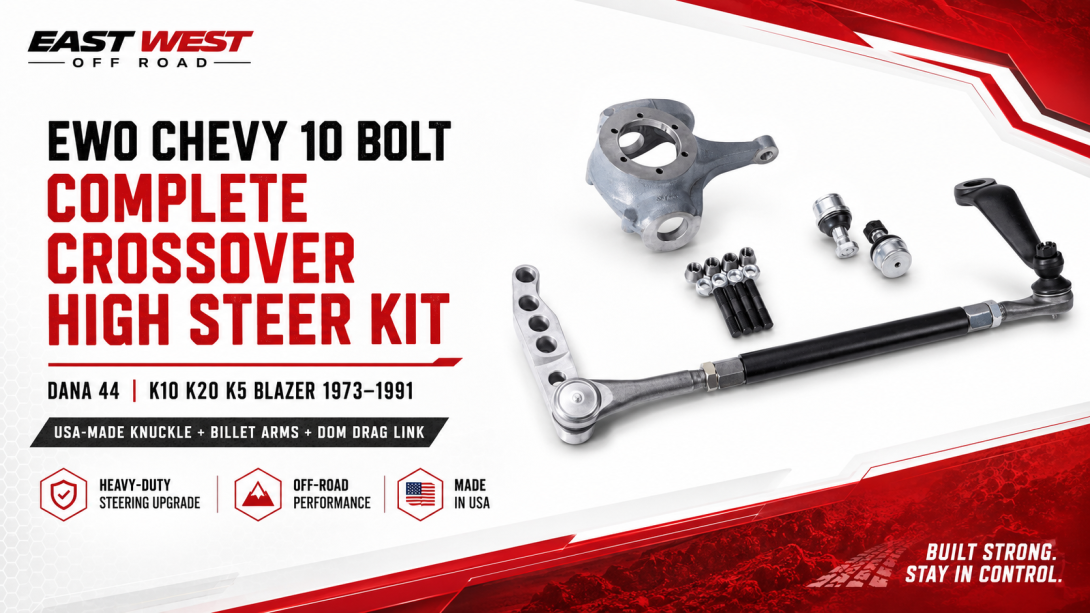
Buy Now: Chevy Dana 44 High Steer Kit – East West Off Road
A Chevy Dana 44 High Steer Kit is a popular upgrade for classic Chevy and GMC 4x4 builds that use a Dana 44 front axle and need a more suitable steering configuration for lifted or heavily modified applications. Once a truck receives larger tires, suspension lift, axle modifications, or regular trail use, the original steering arrangement may no longer provide the geometry and clearance desired by the builder.
A high-steer crossover setup changes the position and routing of the steering linkage while allowing the use of heavy-duty steering components. For compatible Chevy Dana 44 applications, a complete system can combine high-steer arms, knuckles, steering ends, DOM tubing, studs, and other components into one conversion.
What Is a Chevy Dana 44 High Steer Kit?
A Chevy Dana 44 High Steer Kit is an aftermarket steering conversion designed for compatible Dana 44 front axles used in Chevy and GMC 4x4 applications.
Instead of keeping the steering linkage in the original factory position, high steer moves the steering connection higher on the steering knuckle.
A crossover configuration typically uses:
- A drag link running from the pitman arm toward the passenger-side steering arm
- A tie rod connecting the steering knuckles
- High-steer arms
- Compatible steering knuckles
- Heavy-duty steering ends
- DOM tubing
- Steering-arm studs and hardware
The exact configuration depends on the axle, steering box, suspension, and vehicle.
Why Install a High Steer Kit on a Chevy Dana 44?
The factory steering configuration on an older Chevy was designed around the vehicle's original suspension height and tire size.
Modern off-road builds can be significantly different.
A Chevy Dana 44 may now be supporting:
- Larger-than-stock tires
- Suspension lift
- Increased suspension travel
- Custom axle positioning
- Aftermarket steering boxes
- Crossover steering
- Rock-crawling use
- Custom suspension components
These modifications can change steering geometry and reduce clearance around the original steering linkage.
A high-steer conversion addresses the steering system as part of the modified vehicle rather than simply replacing one factory component.
Benefits of a Chevy Dana 44 High Steer Conversion
Higher Steering Linkage
One of the main reasons for installing high steer is to move the steering linkage higher on the axle.
This can provide additional clearance from rocks, ruts, ledges, and other obstacles encountered during off-road driving.
Better Geometry for Lifted Builds
Suspension lift changes the relationship between the axle and chassis.
A high-steer configuration can provide a more appropriate steering-linkage position on certain lifted Dana 44 applications.
The actual improvement depends on the relationship between the drag link, track bar, pitman arm, steering arms, and suspension.
Heavy-Duty Steering Components
Many aftermarket Chevy Dana 44 steering systems use 1-ton-style tie rod ends and larger steering links.
This provides an opportunity to upgrade the steering system as a complete package rather than relying entirely on original components.
Cleaner Crossover Configuration
Crossover steering provides a side-to-side steering arrangement that can be better suited to certain lifted solid-axle builds.
It is particularly common in custom Chevy and GMC off-road applications.
Chevy Dana 44 Crossover Steering Explained
Crossover steering changes the way the steering box interacts with the front axle.
In a typical crossover configuration, the pitman arm connects to a drag link that travels across toward the passenger-side steering knuckle.
The tie rod then connects the left and right steering knuckles.
This differs from a factory push-pull arrangement used on many older solid-axle GM trucks.
The conversion can provide a better steering layout for a modified vehicle, but the steering box and pitman arm must be compatible with the new configuration.
Chevy Dana 44 High Steer Kit Applications
A Chevy Dana 44 high-steer conversion can be relevant to a variety of classic GM builds.
Common platforms include:
Chevy K5 Blazer
The K5 Blazer is one of the most popular classic GM platforms for Dana 44 and GM 10-bolt steering upgrades.
A lifted K5 running larger tires can benefit from a steering configuration designed around its modified suspension and axle setup.
Chevy K10
The K10 is another common platform for Dana 44 crossover and high-steer conversions.
Many K10 builds use suspension lifts and larger tires, making steering geometry and under-axle clearance important considerations.
Chevy K20
The heavier-duty K20 platform is also frequently modified for off-road use.
When a Dana 44 is used in a custom K20 configuration, the steering system should be selected around the actual axle and suspension combination.
GMC Jimmy and Classic GM Trucks
Similar crossover steering principles can apply to compatible GMC and other classic GM solid-axle builds.
Always verify exact axle and steering-box specifications before purchasing components.
Flat-Top Knuckles for Chevy Dana 44 High Steer
Flat-top knuckles are an important part of many Dana 44 high-steer conversions.
The flat-top surface provides the mounting location for the high-steer arm.
If the existing Dana 44 knuckles are not compatible, a knuckle conversion or replacement knuckles may be required.
This is why a complete Dana 44 High Steer Kit with Knuckles can be useful for a custom build.
Instead of searching for compatible knuckles separately, the builder can start with a complete steering conversion designed around the high-steer configuration.
View the Complete Dana 44/Chevy 10-Bolt High-Steer Kit with Knuckles
1-Ton Steering Components for a Chevy Dana 44
The term 1-ton steering generally refers to the use of heavy-duty steering components commonly associated with larger truck applications.
A typical aftermarket system can include:
- 1-ton tie rod ends
- Heavy-duty drag-link ends
- High-steer arms
- DOM tubing
- Weld-in bungs
- Jam nuts
- Steering-arm studs
- Heavy-duty mounting hardware
The benefit of using these components is not simply that they are larger. The steering links, arms, ends, and hardware need to be correctly matched.
For an off-road Chevy, the complete steering system should be considered rather than focusing only on the tie rod.
Chevy Dana 44 High Steer and Bump Steer
Bump steer is a common concern on lifted solid-axle vehicles.
It occurs when suspension movement causes an unintended steering change.
The drag link and track bar each move through an arc as the suspension cycles. If their geometry is poorly matched, the steering can change as the axle moves.
A high-steer configuration can help reposition the drag link, but it does not automatically eliminate bump steer.
To improve the geometry, inspect:
- Drag-link angle
- Track-bar angle
- Drag-link length
- Track-bar length
- Pitman-arm position
- Steering-arm height
- Axle-side mounting points
- Frame-side mounting points
The entire suspension and steering system should be evaluated together.
How to Choose the Right Chevy Dana 44 High Steer Kit
Not every Dana 44 is identical.
Before ordering a high-steer kit, verify your specific axle.
Check the Axle Type
Confirm that your vehicle actually has the Dana 44 configuration supported by the steering kit.
Check the Knuckles
Determine whether your existing knuckles are compatible with high-steer arms.
If they are not, a complete kit with knuckles may be the better option.
Verify Ball-Joint Compatibility
The steering knuckle must match the correct ball-joint and axle configuration.
This is especially important when combining parts from different vehicles or axle generations.
Check the Steering Box
The steering box must work with the crossover configuration.
Some classic GM applications may require a compatible 2WD steering box.
Check the Pitman Arm
The pitman arm influences the drag-link position and steering geometry.
Verify spline, length, drop, and steering-box compatibility.
Check Wheel Backspacing
High-steer arms and steering links can occupy additional space near the wheels.
Always check clearance at full steering lock.
2WD Steering Box Considerations
Classic Chevy crossover steering conversions often require careful steering-box planning.
The original 4WD steering configuration may not provide the desired pitman-arm and drag-link geometry for a crossover setup.
Depending on the specific application, a 2WD steering box can be used as part of the conversion.
However, this is not universal for every Chevy Dana 44 build.
Before purchasing a steering box, verify:
- Steering-box model
- Mounting configuration
- Output shaft spline
- Pitman-arm compatibility
- Steering ratio
- Frame clearance
- Drag-link geometry
This step can prevent expensive compatibility problems during installation.
Chevy Dana 44 High Steer vs. Factory Steering
A factory steering system is designed around the original vehicle configuration.
A high-steer crossover system is designed for a different steering layout that can be better suited to modified solid-axle vehicles.
Feature
Factory Steering
Chevy Dana 44 High Steer
Steering layout
Factory configuration
Crossover configuration
Linkage position
Lower
Higher
Lifted applications
May require correction
Designed around modified geometry
Off-road clearance
Can be limited
Improved potential
Steering ends
Factory-style
Heavy-duty aftermarket options
Customization
Limited
Greater
Knuckle requirements
Factory
High-steer compatible
Neither configuration is automatically right for every truck. The correct choice depends on the vehicle and intended use.
DOM Tubing and Heavy-Duty Steering Links
DOM tubing is commonly used in custom off-road drag links and tie rods.
A properly fabricated steering link requires more than simply choosing a large tube.
Consider:
- Tube diameter
- Wall thickness
- Thread engagement
- Weld penetration
- Tube-end design
- Jam-nut engagement
- Steering-end orientation
- Clearance
If the steering links require cutting and welding, use a qualified fabricator experienced with structural off-road steering components.
Steering Clearance on a Chevy Dana 44
One of the practical advantages of high steer can be improved steering-linkage clearance underneath the axle.
However, moving the steering components upward can create clearance requirements in other areas.
Check the relationship between the steering components and:
- Wheels
- Tires
- Brake components
- Differential
- Axle housing
- Leaf springs
- Suspension components
- Frame
- Steering stops
Cycle the suspension and steering through their usable range before finalizing the installation.
Chevy Dana 44 High Steer for Larger Tires
Larger tires increase the loads placed on the steering system.
This does not mean that a high-steer kit automatically makes a vehicle suitable for unlimited tire sizes.
Instead, the steering system should be selected based on:
- Tire size
- Vehicle weight
- Suspension design
- Axle type
- Steering box
- Off-road use
- Driving style
A properly matched 1-ton-style steering system can be a useful component of a larger off-road build.
Installation Considerations
Installing a Chevy Dana 44 High Steer Kit requires careful attention because steering components are safety-critical.
Before driving the vehicle:
- Confirm Dana 44 axle compatibility.
- Verify high-steer knuckle compatibility.
- Install the knuckles and high-steer arms correctly.
- Verify all steering-end tapers.
- Check drag-link and tie-rod lengths.
- Confirm steering-box compatibility.
- Verify pitman-arm specifications.
- Check track-bar and drag-link geometry.
- Check wheel and tire clearance.
- Verify steering stops.
- Torque all hardware according to manufacturer specifications.
- Perform a professional alignment and steering inspection.
Do not assume that a bolt-on-looking component is compatible simply because it fits physically.
Common Chevy Dana 44 High Steer Mistakes
Buying Based Only on the Dana 44 Name
Different Dana 44 applications can have different knuckle, ball-joint, brake, and steering configurations.
Ignoring the Steering Box
A crossover steering system may require a different steering-box configuration on some classic Chevy applications.
Forgetting Track-Bar Geometry
Changing the drag-link position without evaluating the track bar can create new geometry problems.
Using an Incorrect Pitman Arm
The wrong pitman arm can alter drag-link angle, travel, and steering-box geometry.
Ignoring Wheel Clearance
High-steer arms can interfere with wheels or tires depending on backspacing and steering configuration.
Skipping Final Inspection
Steering hardware should be inspected and torqued correctly before the vehicle is driven.
Why Choose an East West Off Road Chevy Dana 44 High Steer Kit?
For builders who want a complete steering conversion, East West Off Road offers Dana 44 and Chevy 10-bolt high-steer configurations designed around crossover steering applications.
A complete kit can simplify the sourcing process by bringing key steering components together rather than requiring the builder to locate every part individually.
Shop the East West Off Road Chevy Dana 44 High Steer Solution
For a custom Chevy build, however, always verify exact axle and vehicle compatibility before ordering.
Final Thoughts
A Chevy Dana 44 High Steer Kit can be a valuable upgrade for classic Chevy and GMC trucks that have been modified with suspension lifts, larger tires, custom axles, and serious off-road equipment.
The high-steer configuration can move steering linkage higher, provide additional clearance, and create a more suitable steering arrangement for certain lifted Dana 44 applications.
The most important factor is correct system design.
Your Dana 44 knuckles, high-steer arms, tie rod, drag link, pitman arm, steering box, track bar, wheels, and suspension all need to work together.
If you're building a K5 Blazer, K10, K20, or another classic Chevy 4x4, verify your exact axle and steering configuration before choosing the kit.
For compatible applications, a complete East West Off Road high-steer system can provide a practical foundation for a heavy-duty crossover steering conversion.
Frequently Asked Questions
What is a Chevy Dana 44 High Steer Kit?
It is an aftermarket steering conversion designed for compatible Chevy Dana 44 applications. It typically uses high-steer arms and crossover steering components to reposition the steering linkage higher on the axle.
Is high steer good for a lifted Chevy?
High steer can be beneficial for lifted Chevy solid-axle builds because it can provide a higher steering-linkage position and potentially improve clearance. The complete steering and suspension geometry still needs to be properly configured.
Do I need flat-top knuckles for a Chevy Dana 44 high-steer kit?
Many Dana 44 high-steer systems require compatible flat-top knuckles for mounting high-steer arms. If your existing knuckles are not compatible, replacement or conversion knuckles may be necessary.
Can I use a high-steer kit on a Chevy K5 Blazer?
Yes, compatible K5 Blazer Dana 44 and GM 10-bolt configurations are common applications for crossover and high-steer conversions. Always verify the exact axle and steering-box configuration.
Does high steer eliminate bump steer?
Not automatically. High steer changes the steering-linkage position, but bump steer also depends on drag-link, track-bar, pitman-arm, and suspension geometry.
Do Chevy Dana 44 crossover steering systems require a 2WD steering box?
Some classic GM crossover configurations use a compatible 2WD steering box, but the requirement depends on the specific vehicle and steering setup.
Are 1-ton tie rod ends suitable for a Chevy Dana 44?
1-ton-style tie rod ends are commonly used in heavy-duty aftermarket Dana 44 steering systems. They must be matched correctly with the steering arms, tapers, tubing, and other steering components.
What size tires can I run with a Chevy Dana 44 high-steer kit?
There is no universal tire-size limit determined by the high-steer kit alone. Tire size should be considered alongside vehicle weight, axle strength, steering components, suspension design, and intended use.
Does a high-steer kit improve off-road clearance?
Moving the steering linkage higher can provide additional clearance underneath the axle, which can be useful when driving over rocks and other obstacles.
What should I check after installing a Chevy Dana 44 high-steer kit?
Check all steering hardware, steering-end tapers, drag-link and track-bar geometry, steering stops, wheel clearance, suspension travel, steering-box compatibility, torque specifications, and alignment.